150 years ago today: the beginning of the end. Or should it be the end of the beginning? The first complete Ring Cycle concludes with the premiere of “Götterdämmerung” – “Twilight of the Gods” – at the inaugural Bayreuth Festival in 1876.
Tag: Ring Cycle
-
Vintage Wagner on “The Lost Chord”
I’ve been celebrating the sesquicentennial of the “Ring” on my radio shows this weekend. The four installments of Wagner’s famed operatic tetralogy were performed on quasi-consecutive days for the first time in the newly-constructed Festspielhaus at the inaugural Bayreuth Festival on August 13-17, 1876.
I’ll conclude my three-part homage on “The Lost Chord,” with an hour of vintage recordings, two of them “Ring”-related and the other captured on the premises at Bayreuth.
American baritone Lawrence Tibbett never actually sang the role of Wotan on stage, in the context of a “Ring” cycle. However, he did record “Wotan’s Farewell and Magic Fire Music,” magnificently, in 1934, with the Philadelphia Orchestra and Leopold Stokowski.
Karl Muck was a casualty of anti-German sentiment during his time as music director of the Boston Symphony Orchestra, which, unfortunately, happened to coincide with the First World War. Be that as it may, he was held in the highest regard by fellow musicians and thought by many to be one of Wagner’s finest interpreters. We’ll hear a fascinating 1927 recording of the Transformation Music and the beginning of the Grail Scene from Act I of “Parsifal,” made at the Festspielhaus in Bayreuth.
The recording employs the original bells designed by Wagner, which would be melted down by the Nazis for ammunition during the Second World War. So this will be a rare opportunity to experience the “Parsifal” Wagner actually knew. Muck was principal conductor of the Bayreuth Festival since 1903. He conducted “Parsifal” at Bayreuth 14 times between 1901 and 1930.
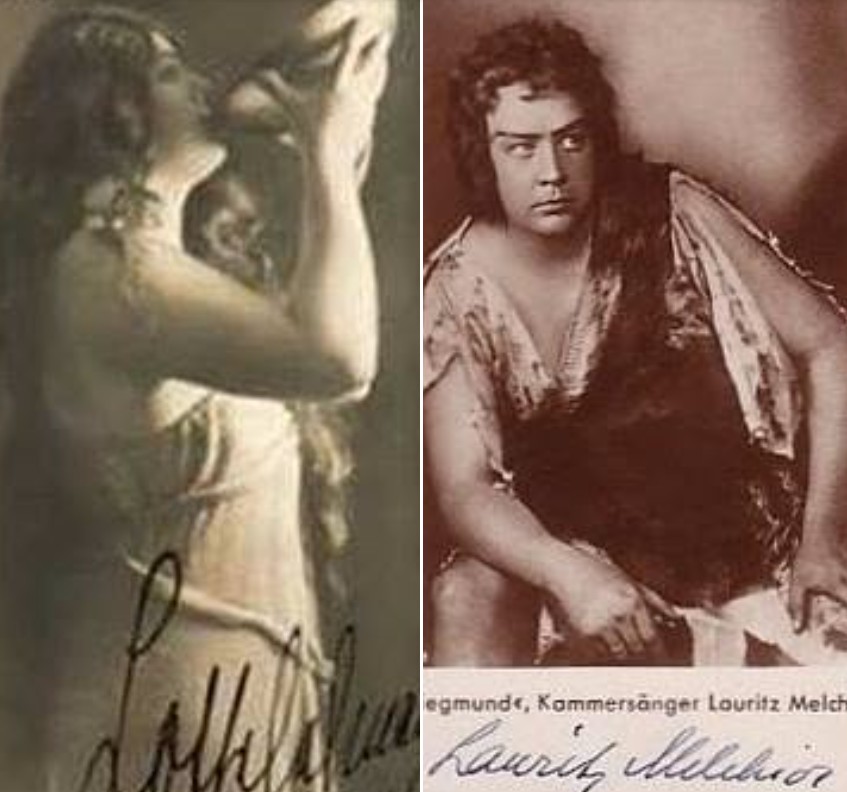
Finally, we’ll return to “Die Walküre” to wrap things up on a buoyant note with Siegmund and Sieglinde’s love music from Act I, which concludes with the lovers fleeing together into the welcoming spring. Nine months later, Sieglinde gives birth to Siegfried, the saga’s hero-without-fear. Lotte Lehmann strikes sparks with legendary Danish heldentenor Lauritz Melchoir in a 1935 recording with Bruno Walter and the Vienna Philharmonic.
The power of these performances remains undiminished by the passage of time. I hope you’ll join me for another Wagner power hour on “Vintage Wagner,” on “The Lost Chord,” now in syndication on KWAX Classical Oregon!
——-
Clip and save the start times for all three of my recorded shows:
PICTURE PERFECT, the movie music show – Friday at 8:00 PM EDT/5:00 PM PDT
SWEETNESS AND LIGHT, the light music program – Saturday at 11:00 AM EDT/8:00 AM PDT
THE LOST CHORD, unusual and neglected rep – Saturday at 7:00 PM EDT/4:00 PM PDT
Stream them, wherever you are, at the link!
https://kwax.uoregon.edu
——-
PHOTOS: Lotte Lehmann as Sieglinde and Lauritz Melchior as Siegmund -
Frolicking with Light Music Master Richard Wagner on “Sweetness and Light”
The four installments of Wagner’s Ring Cycle were performed together for the first time in the brand-spanking-new Festspielhaus at the inaugural Bayreuth Festival on August 13-17, 1876. This week on “Sweetness and Light,” to mark the 150th anniversary of Wagner’s magnum opus, we’ll have music tying in, in one way or another, with opera’s most successful “miniseries.” An unlikelier source for a light music program would be more difficult to imagine!
I may lack the muscle to hoist Donner’s hammer, but I will employ the cunning of Loge to dissipate the Wagnerian gloom with virtuosic piano transcriptions of “Ride of the Valkyries” (by Carl Tausig) and “Magic Fire Music” (by Louis Brassin), Wagner’s “Siegfried Idyll” (arguably the sweetest thing he ever wrote), humorist Anna Russell’s classic routine “The Ring of the Nibelungs (An Analysis),” and a cheeky work for piano four-hands by Gabriel Fauré & André Messager, in which they render somber motifs from the “Ring” as a quadrille!
They say it can’t be done! You’ll be left agog at the evidence of your own ears when you join me for an hour of Wagnerian “light” music, in celebration of 150 years of the “Ring,” on “Sweetness and Light,” this Saturday morning at 8:00 EDT/11:00 PDT, exclusively on KWAX Classical Oregon!
Stream it, wherever you are, at the link:
https://kwax.uoregon.edu/ -
Wagner Out the Wazoo on “Picture Perfect,” “Sweetness and Light,” and “The Lost Chord”
In 1876, the four operas – or music dramas (the composer’s preferred term) – of Wagner’s “Ring Cycle” were performed together for the first time, from August 13 through August 17, at the inaugural Bayreuth Festival, in the Festspielhaus (a theater of the composer’s design) in Bayreuth, Germany. The Bayreuth Festival has continued as a mecca for Wagnerites down to the present day.
To mark the 150th anniversary of the “Ring,” all three of my radio shows this weekend will tie in, in one way or another, with this most grandiose and influential undertaking.
First, today on “Picture Perfect,” we’ll have music from four films in which Erich Wolfgang Korngold served as ghostwriter for onscreen composers, providing a ballet for Errol Flynn’s in “Escape Me Never” (1946), a tone poem for Charles Boyer in “The Constant Nymph” (1943), and a cello concerto for Claude Rains in “Deception” (1946). More to the point, Korngold actually appears onscreen – hastily made-up when the actor hired for the purpose didn’t show – to play conductor Hans Richter in the Wagner biopic “Magic Fire,” for which he adapted selections from, yes, the Ring Cycle.
Then tomorrow morning, on “Sweetness and Light,” it will be the unlikeliest “light music” program, as we listen to piano transcriptions by Carl Tausig and Louis Brassin, the “Siegfried Idyll” (probably the sweetest thing Wagner ever wrote), humorist Anna Russell’s classic routine “The Ring of the Nibelungs (An Analysis),” and a cheeky work for piano four-hands by Gabriel Fauré & André Messager, in which they distill somber motifs from the cycle into a frivolous ballroom dance.
Finally, tomorrow afternoon/evening (depending on where you are), it will be an hour of historic recordings of “Die Walküre” – the second of the “Ring” operas (er, music dramas) – by Lawrence Tibbett, with Leopold Stokowski and the Philadelphia Orchestra, in 1934, and Lotte Lehmann and Lauritz Melchior, with Bruno Walter and the Vienna Philharmonic, in 1935. Also, we’ll hear Karl Muck conducting selections from Wagner’s “Parsifal” at the actual Festspielhaus, in 1927. The recording will feature actual bells of Wagner’s design, which were later melted down for munitions by the Nazis.
Hojotoho! Get out your party hats (helmets with horns and wings, of course), as we celebrate the 150th anniversary of the “Ring” this weekend, on KWAX Classical Oregon!
Stream the shows, wherever you are, at the times below:
PICTURE PERFECT, the movie music show – Friday at 8:00 PM EDT/5:00 PM PDT
SWEETNESS AND LIGHT, the light music program – Saturday at 11:00 AM EDT/8:00 AM PDT
THE LOST CHORD, unusual and neglected rep – Saturday at 7:00 PM EDT/4:00 PM PDT
Here’s the link!
https://kwax.uoregon.edu -

James Morris and a Figaro Fiasco
The following started out as a response to a comment made by Brennan Morsette at the bottom of yesterday’s Wagner post, regarding the immense pleasure he experienced viewing the Ring Cycle on PBS. But you know how I am. As I warmed to my subject, it grew to such monumental proportions that I decided I would just touch it up a little and use it as today’s post. I hope you will enjoy this reminiscence about Otto Schenk’s Ring and my subsequent experiences with bass-baritone James Morris.
If the Ring you’re talking about is the Otto Schenk production from the Metropolitan Opera, I too watched it on PBS, in the summer of 1990. Years later, in 2009, I caught a revival of “Siegfried” in the same production, live at the Met, with James Morris in his farewell run as the Wanderer (Wotan in disguise). He was in fabulous voice, which totally floored me, since in the interim he had developed some wear and, I thought, a dispiriting wobble. But that day, it was as if he sang with a fluency and vigor that befitted the Ruler of the Gods.
It was also the farewell run of the Schenk production itself, with its traditional staging and representational (as opposed to abstract) sets. A kind of Twilight of the Gods in itself, then, as it was likely one of the last of the traditional Rings to linger at a major opera house. Now it’s difficult to find any standard repertoire, least of all the Ring, in productions that honor the composers’ intentions, as opposed to glorify trendy directors and desperate companies grasping for grit and “relevancy.” We’re living in a decadent age, my friend, and woe betide anyone coming to the art form new. (Granted, the Met’s subsequent “seesaw” production, overseen by Robert Lepage, wasn’t exactly avant-garde.)
Not long after the PBS Ring aired, I actually wound up working with Morris at what was then the Opera Company of Philadelphia. He was in town to sing the role of the Count in “The Marriage of Figaro,” and I was an intern, who made $300 for three weeks’ work. Clearly, it was not sustainable! But I had a blast while it lasted, even if it was often quite stressful, as I was basically expected to do or solve anything that had to be done or solved. So I was running for coffee, renting trucks, searching the old Academy of Music for a prop sword. Largo al factotum, indeed! (I know, wrong opera, but same characters.) I had to be available in all three day-parts, because the rehearsal schedule would always be shifting.
One day, when they were blocking a scene with the Count, there were no supernumeraries present, so the stage director called me over, and I actually did rehearse a scene with Morris. It was hilarious, because I totally had no idea what was expected from me. I was just this enthusiastic kid, and Morris would chuckle as I’d overshoot my marks and reach over and rein me in.
He wasn’t always so jovial, however, especially once the performances started. I had no real authority, so all I could do, basically, was stand stage left with my headset and cue the singers to enter when I received word from the stage manager. Of course, the manager was completely unseen, feeding his instructions to me remotely through an ear piece. So Morris would be standing there, behind a flat, watching for my signal, and I’d have my hand in the air, waiting, my adrenaline racing. Finally, Morris would lose patience and just make the entrance himself. The stage manager (whose name was Batman, believe it or not), who didn’t have to look him in the eye, would take it philosophically and move the cue up in his score for next time. But it never seemed to be early enough for Morris and I was a wreck.
Fortunately, Morris’ wife, mezzo-soprano Susan Quittmeyer, was singing the part of Cherubino, and she was an angel. So whenever Morris would be fuming, she would intervene and calm him down. Once, a Wawa coffee was enough to restore me to his good graces.
I hasten to clarify that Morris’ reactions were in no way “prima donna.” He was one of the biggest singers in the world at the time, used to dealing with houses like the Met, and of course he was the most in demand Wotan of his day. You don’t want to get on the wrong side of the Ruler of the Gods! He was a professional who clearly cared deeply about his performance and he had justifiably high standards. Philadelphia was, let’s say, perhaps a little more relaxed than what he was used to (despite the fact he had graduated from the city’s Academy of Vocal Arts in 1971).
It was an interesting three weeks – at any rate, it has given me lots of stories! – but, as I say, as an intern, it simply wasn’t sustainable. Clearly it was going to take multiple productions for me even to squeak across the learning curve (like the Rainbow Bridge of Asgard), and I needed to figure out how to pay my rent. It was impossible to hold a second job, because of the ridiculous schedule. Anyway, I’m not sure I’m wired for that kind of stress.
Before things got too heated, I got Morris to sign my recording of “Das Rheingold” (pictured), which features the same forces as the PBS television broadcast. I was hesitant to ask him, and I’m not sure that Batman was thrilled, but Morris was delighted. And delighted is how you wanted him. He was a big guy, standing 6-foot-4, with a marked preference for blue jeans and large belt buckles. I would have pegged him for a Texan, but he was actually born in Baltimore. I’m including a link, below, to a segment about Morris that aired on “CBS Sunday Morning” a few years after I worked with him. The video is not the best quality, but there’s plenty of interest in it. You’ll get an idea of his street clothes at around 4:30.
Also in the cast of the Philadelphia “Figaro” was Justino Diaz, who had opened the “new” Met at its current location in Lincoln Center, back in 1966, singing opposite Leontyne Price, in the world premiere of Samuel Barber’s “Antony and Cleopatra” (which tanked – by all accounts, thanks to director Franco Zeffirelli’s excess).
One of my favorite moments in our “Figaro” was a scene in which there was all kinds of business with characters leaping out of windows and off balconies and I was backstage coordinating the sound effects. These involved shattering terracotta pots into a barrel. I was not allowed to do it myself, of course. It was a union job! (The same with costume changes. Once, the costumer was not in the wings at the right time, so I tried to assist one of the singers in a quick-change. She blew in right in the middle of it and brushed me aside. I could feel the chill emanating from her. I did not do it again. But I digress.)
Anyway, I found that by delaying the crash of the flower pots, I would get a bigger laugh from the audience. Otherwise, they would still be reacting to the leap itself. So every night, I would extend the drop time to an increasingly ludicrous degree. It was actually very funny. At one performance, things just got completely out of hand, and Diaz was hilarious in his reactions, as he was tossing stuff off stage, and the thuds were coming back so randomly. It was a good time.
The worst time was during the finale of Act IV, with all the principals on stage, everyone singing, the tension mounting, and everything pointing to the one moment when the Countess emerges from her disguise and the Count responds with true contrition and tenderness. It’s the most touching moment in the entire opera. Everything dies down to a hush, and there’s a moment’s silence before the Count sings. One night, at that very moment, a union laborer was standing in the wings and his watch beeped. Morris sang beautifully, but of course I could tell what was brewing and everything in me tensed. When he left the stage, it was like a near-death experience at the rim of an active volcano. Again, I couldn’t blame him, as he let fly some choice words for what he perceived, quite rightly, as the provincial working conditions. Awkwardly, the curtain calls followed immediately.
That was another issue on opening night, I remember, as no one had thought to organize in what order the singers were expected to take their calls. Leaving the singers to work it out for themselves is never a good idea!
In the end, it turned out to be a pretty good show, or at any rate a lot of fun. I remember the director (who was a piece of work, popping lozenges the whole time) came in for some criticism in the Philadelphia Inquirer. I think the production was a little too standard for the critic’s taste? Hey! It’s farce! There are only so many ways to hide people behind things. Lighten up!
Perhaps somebody who subscribes to the Inquirer would be so kind as to do a search and message me a copy of the review, if it’s archived. Try searching under Opera Company of Philadelphia, Nozze di Figaro, Marriage of Figaro, Academy of Music, Justino Diaz, and/or James Morris, 1990. I would be much obliged!
In writing this, I have taken care to leave out any of the backstage shenanigans that would get anyone today cancelled. Thank you, Brennan, for inspiring this pleasurable reminiscence!
James Morris segment on “CBS Sunday Morning”
PHOTO: Best wishes from the Ruler of the Gods!
Tag Cloud
Aaron Copland (93) Beethoven (95) Composer (114) Film Music (144) Film Score (143) Film Scores (255) Halloween (94) John Williams (195) KWAX (229) Leonard Bernstein (104) Marlboro Music Festival (125) Movie Music (159) Mozart (90) Opera (212) Philadelphia Orchestra (89) Picture Perfect (174) Princeton Symphony Orchestra (109) Radio (88) Ross Amico (244) Roy's Tie-Dye Sci-Fi Corner (290) The Classical Network (101) The Lost Chord (269) Vaughan Williams (105) WPRB (397) WWFM (881)