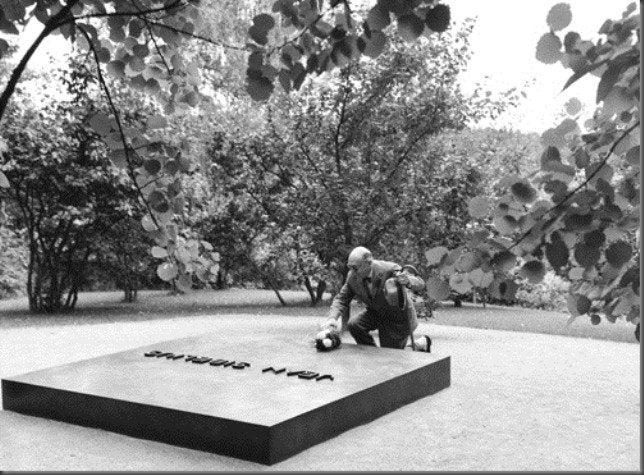
Tag: Robert Craft

  • Stravinsky’s Requiem Canticles Premiere at Princeton

    Stravinsky’s Requiem Canticles Premiere at Princeton

    Igor Stravinsky’s late, serial masterwork, “Requiem Canticles,” was given its first performance at McCarter Theatre in Princeton on this date in 1966. It would be the composer’s last major work. (Only his setting of Edward Lear’s “The Owl and the Pussycat” followed.) Stravinsky described the 15-minute, six-movement piece, which is sung in Latin, as his “pocket requiem.” The work would be performed at the composer’s funeral in 1971. It was also played at the funeral of J. Robert Oppenheimer, who attended the premiere.

    I wrote about its first performance in 2016, its 50th anniversary, for an article for the Trenton Times, somewhat limited by word count and by the fact that I was tying it in with two Stravinsky concerts to be held at Princeton University – neither of which, disappointingly, included “Requiem Canticles” – but I did get some interesting information from my interview subjects, both eyewitnesses who were working at McCarter in 1966.

    There’s conflicting information as to who exactly conducted “Requiem Canticles” on that occasion, the composer or his assistant, Robert Craft. My sources maintain that it was Stravinsky himself.

    If you’re interested, you can find the article archived here:

    https://www.nj.com/times-entertainment/2016/12/classical_music_puo_pugc_so_pe.html

    Robert Craft’s 2005 recording of “Requiem Canticles”

    Recording of the actual McCarter premiere (thanks to Mather Pfeiffenberger)


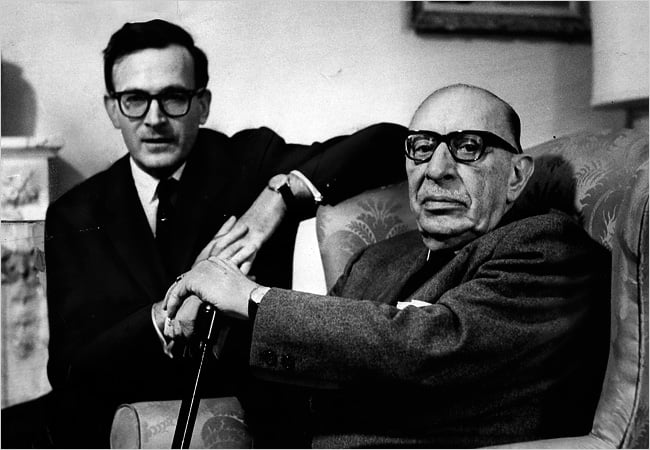
    PHOTO: Stravinsky (right) and Robert Craft in 1964
  • Schoenberg’s Feud with Stravinsky & Hidden Passions

    Schoenberg’s Feud with Stravinsky & Hidden Passions

    He played tennis with Gershwin. He adored Hopalong Cassidy. He feared the number 13.

    That’s right, kids! It’s Arnold Schoenberg’s birthday!

    In common with many composers who fled political unrest in Europe, Schoenberg settled in Los Angeles. He was outspoken about his dislike of many of his contemporaries. Igor Stravinsky, similarly catty, lived only a few miles away. Earlier in their careers, they were on friendly, or at least cordial terms (by Schoenberg and Stravinsky standards), but after 1925, when Schoenberg wrote a “nasty verse” (according to Stravinsky) and set it as a canon, the friendship cooled. For his part, Stravinsky told the press that he viewed Schoenberg as more of a chemist than an artist. Their contempt for one another never mellowed, and the trash talk flowed.

    This is from Schoenberg’s “Three Satires.” “Vielseitigkeit” (“Versatility”) is a palindromic canon. It can be performed front to back or back to front by inverting the music and reading it backwards. Igor is savaged as “kleine Modernsky.”

    “But who’s this beating the drum?
    Why, it’s little Modernsky!
    He’s had his hair cut in an old-fashioned queue,
    And it looks quite nice!
    Like real false hair!
    Like a wig!
    Just like (or so little Modernsky likes to think)
    Just like Papa Bach!”

    Meow, boys!

    After Schoenberg’s death, Stravinsky apparently developed an interest in “chemistry,” as he began to assimilate Schoenberg’s twelve-tone system of composition into his later works.

    This one, “Requiem Canticles,” was given its first performance at Princeton’s McCarter Theater on October 8, 1966. In attendance were Aaron Copland and J. Robert Oppenheimer. Afterward, Oppenheimer requested that the piece be played at his funeral. The request would be honored only four months later. The “Requiem Canticles” would also be performed at Stravinsky’s funeral in Venice in 1971.

    Ironically, Stravinsky and Schoenberg shared a disciple in Robert Craft, who conducted this recording. Craft championed both composer’s music and apparently was accepted in both camps.

    I wonder if Schoenberg ever met Rachmaninoff? Now that would be a scowling contest I would pay to see.


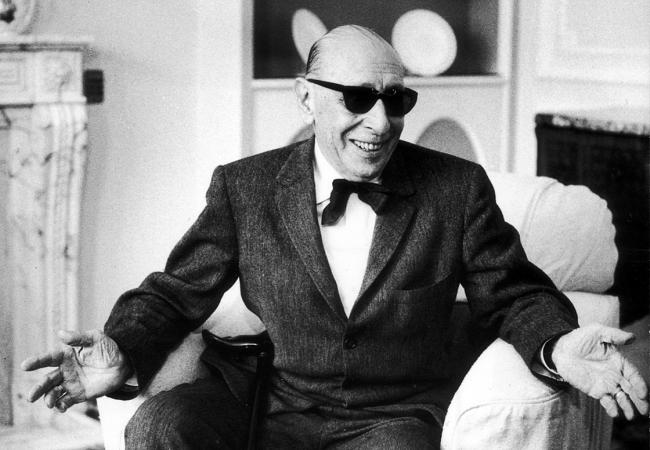
    PHOTOS: Showboat Stravinsky and scowly Schoenberg

  • Stravinsky’s Unexpected Sibelius Tribute

    Stravinsky’s Unexpected Sibelius Tribute

    I’ve been dropping birthdays all over the place recently, and having to pass over some of them really bothers me, especially those of favorites like Carl Nielsen (June 9) and Edvard Grieg (June 15); but there are only so many hours in the day, and how much is one man expected to give, anyway?!!

    That said, one can’t draw breath on June 17 and not pay respect to the great Igor Stravinsky, who here pays it forward to Jean Sibelius, of all people. Such radically different composers! I happen to adore Sibelius, so all the more respect to Stravinsky – who I don’t think in reality was all that fond of the Finnish master’s music.

    However, Stravinsky’s amanuensis Robert Craft did recall an appreciative remark made during a visit to Helsinki in 1961, in which Stravinsky praised Sibelius’ “Canzonetta” from the incidental music to “Kuolema” (“Death”). You know, the play written by Sibelius’ brother-in-law, Arvid Järnefelt, that also yielded the ubiquitous “Valse triste.”

    Stravinsky commented, “I like that kind of northern Italianate melodism – Tchaikovsky had it too – which was a part, and an attractive part, of St. Petersburg culture.”

    Sibelius’ original is scored for strings. Stravinsky’s version is for two clarinets, four horns, harp, and double bass.

    Stravinsky won the Wihuir-Sibelius Prize in 1963. His arrangement of the “Canzonetta” was premiered on March 22, 1964, by the Finnish Broadcast Company.

    Happy birthday, Igor Stravinsky, from Sibelius’ No. 1 fan.


    Stravinsky, “Canzonetta” after Sibelius’ Op. 62a.

    Sibelius, as originally written

    “Valse triste”

  • Stravinsky 50 Years On A Requiem Remembered

    Stravinsky 50 Years On A Requiem Remembered

    Igor Stravinsky died in New York City 50 years ago today.

    As per his wishes, he was buried in the Russian corner of the cemetery island of San Michele in Venice, transported there by gondola, following a service at the Basilica di Santi Giovanni e Paolo.

    His late, serial masterwork, “Requiem Canticles,” was performed at his funeral. Stravinsky described the 15-minute, six-movement piece, which is sung in Latin, as his “pocket requiem.” It was given its debut at Princeton’s McCarter Theatre in 1966, with the composer conducting.

    The event left a lasting impression. If you’re interested in some first-hand accounts, you can learn more in this article I wrote in 2016, to mark the work’s 50th anniversary, for the Trenton Times.

    https://www.nj.com/times-entertainment/2016/12/classical_music_puo_pugc_so_pe.html?fbclid=IwAR10cMEcv0Uaz4sYSGv-yX2-Xrr7tXOWpumyXcazdrnrigHpgl8rrXpquKg

    Robert Craft’s recording of “Requiem Canticles”:

    Leonard Bernstein conducts a Stravinsky memorial concert, including “The Rite of Spring,” “Capriccio for Piano and Orchestra,” and “Symphony of Psalms,” in April of 1972.


    Gone but not forgotten: Stravinsky and his assistant, Robert Craft, in 1964

Tag Cloud

Aaron Copland (92) Beethoven (95) Composer (114) Film Music (120) Film Score (143) Film Scores (255) Halloween (94) John Williams (185) KWAX (229) Leonard Bernstein (100) Marlboro Music Festival (125) Movie Music (135) Opera (198) Philadelphia Orchestra (88) Picture Perfect (174) Princeton Symphony Orchestra (106) Radio (87) Ralph Vaughan Williams (85) Ross Amico (244) Roy's Tie-Dye Sci-Fi Corner (290) The Classical Network (101) The Lost Chord (268) Vaughan Williams (103) WPRB (396) WWFM (881)

DON’T MISS A BEAT

Receive a weekly digest every Sunday at noon by signing up here


RECENT POSTS