Tag: Robert Kajanus

  • Vintage Sibelius on “The Lost Chord”

    Vintage Sibelius on “The Lost Chord”

    I have no hesitation in ranking Jean Sibelius as one of my top two favorite composers. He and Vaughan Williams pretty much run a three-legged race. Sibelius was born on December 8, 1865. This week on “The Lost Chord,” we’ll anticipate his 160th birthday with an hour of early recordings of his music.

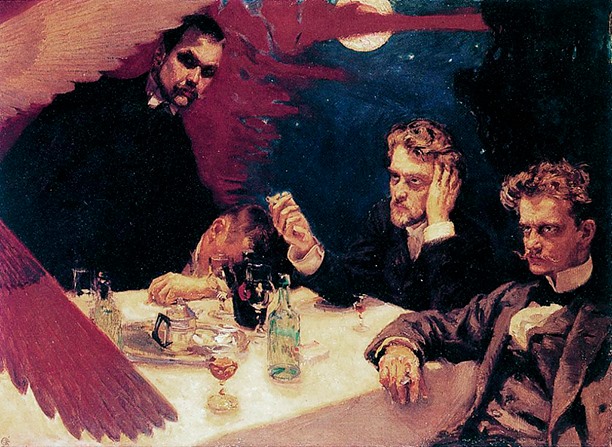
    Robert Kajanus was Sibelius’ good friend, a sometimes rival, and often a drinking buddy. The duo was captured during one of their infamous binges in a painting by the artist Akseli Gallén-Kallela (pictured). Kajanus set down first recordings of a number of Sibelius’ major works, including the underappreciated Symphony No. 3, which we’ll hear in a 1932 performance, with the London Symphony Orchestra.

    As a personal aside, it was actually this recording that served as an introduction for me to the composers’ grandson. For a number of years, I owned a second-hand book business in Philadelphia. I suppose it’s hardly surprising that if anyone ventured into the shop there would be probably an 8-in-10 chance that I would be playing Sibelius.

    Well, on this particular occasion, the composer’s grandson, Anssi Blomstedt (son of Sibelius’ youngest daughter, Heidi), wandered in during the Kajanus 3rd, which impressed him sufficiently that he struck up a conversation with me. It turned out he is a documentary filmmaker who was actually living in Philadelphia at the time. By further coincidence, Simon Rattle was coming to town to conduct Sibelius’ 5th Symphony. I was able to get Anssi an introduction to Rattle, who invited us to attend a rehearsal. Somewhere in Vanity Fair’s archives there is a photo of Rattle planting a big kiss on Sibelius’ grandson’s forehead.

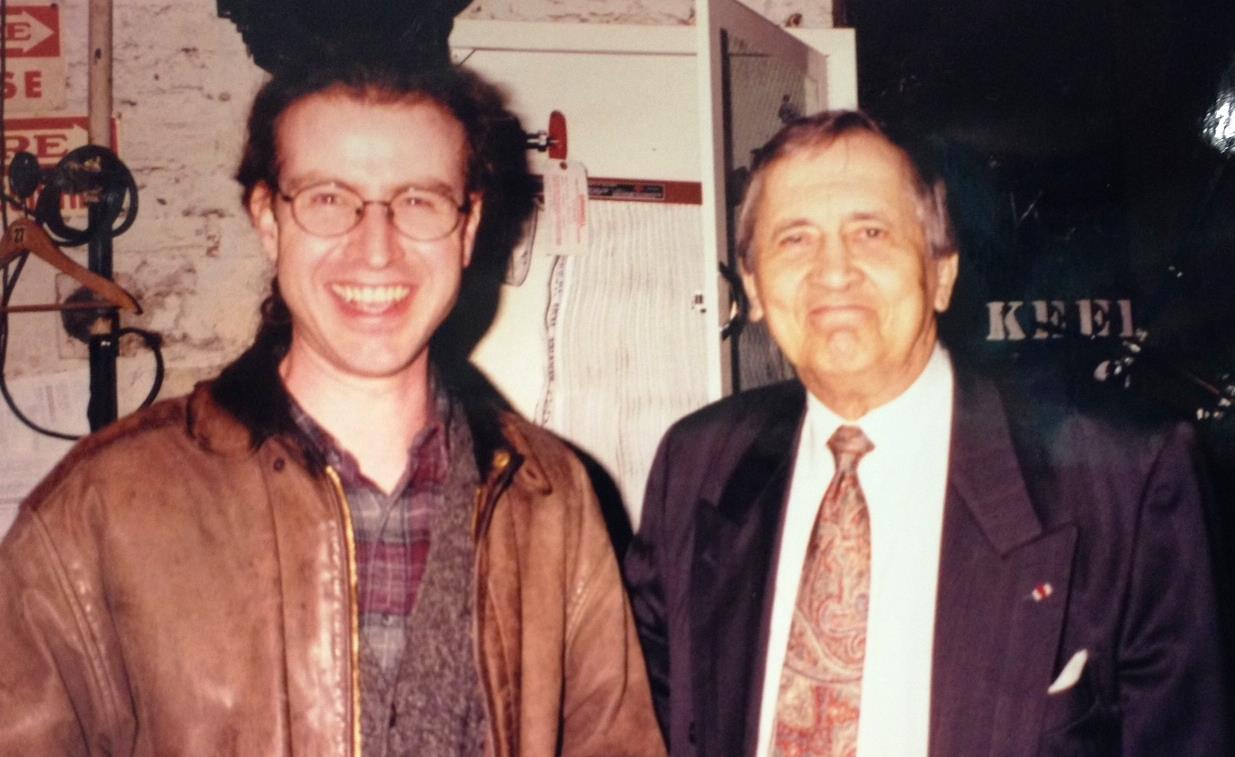
    Anssi later returned the favor by introducing me to Einojuhani Rautavaara, who came to Philadelphia for the premiere of his 8th Symphony. I’ve got a snapshot of me with Rautavaara, and I’m grinning like a Tyrannosaurus rex. I know I’ve posted it before.


    Back to tonight’s show: I’ll also include a highly regarded performance of Sibelius’ last major work, the tone poem “Tapiola,” from 1926. The piece takes its name from Tapio, the forest god mentioned throughout the Finnish national epic, the Kalevala, who inhabits the stark pine forests of the wild North. Again, Kajanus gave the piece its first recording, in 1932, but we’ll hear an equally atmospheric, and at times awe-inspiring reading, given seven years later, with the Boston Symphony Orchestra, conducted by Serge Koussevitzky.

    Sibelius would live another 30 years after the completion of “Tapiola.” Although he spent a portion of that time laboring at a highly-anticipated 8th Symphony, with the premiere promised to Koussevitzky, he eventually destroyed the manuscript.

    We’ll give the last word to one of the heroes of the Kalevala, the swashbuckling Lemminkäinen. Eugene Ormandy was a superb interpreter of Sibelius’ “Four Legends from the Kalevala.” A stereo recording he made with the Philadelphia Orchestra in 1978 must be one of his finest. However, his 1940 recording of the last of the legends, “Lemminkäinen’s Return,” is on a whole other level. It surpasses even Sir Thomas Beecham’s legendary account, in terms of sheer virtuosity and visceral excitement. If there’s a more hell-for-leather performance of the piece, I have yet to hear it.

    I hope you’ll join me for “Vintage Sibelius,” on “The Lost Chord,” now in syndication on KWAX Classical Oregon!

    ————————————————

    IMAGE: “Kajustaflan” by Akseli Gallén-Kallela. Pictured (from left to right), the artist, composer Oskar Merikanto, Robert Kajanus, and Jean Sibelius.

    All you need to know about Gallén-Kallela and “The Symposium,” and then some, here:

    https://www.19thc-artworldwide.org/autumn14/coleman-on-sibelius-gallen-kallela-and-the-symposium
  • Sibelius Champion Kajanus Birthday

    Sibelius Champion Kajanus Birthday

    EIGHT DAYS OF SIBELIUS – DAY 2

    Yesterday, I mentioned Robert Kajanus’ recording of Sibelius’ Symphony No. 3, a performance that fatefully brought me together with the composer’s grandson. Now, only six days in advance of Sibelius’ birthday, December 8, it happens to be the anniversary of the birth of Kajanus, his good friend and first devoted champion.

    It was Kajanus who set down the first recording of Sibelius’ Third Symphony in 1932. It was he who commissioned the symphonic poem “En Saga.” “Pohjola’s Daughter” was also dedicated to him. In 1900, he toured with the Helsinki Orchestra (a group he founded), presenting programs that both he and Sibelius conducted. These concerts included performances of a number of Sibelius’ works heard for the first time outside of Finland.

    Later, Kajanus made premiere recordings of Sibelius’ Symphonies Nos. 1, 2, 3 & 5, and the composer’s crowning symphonic poem, “Tapiola.” The plan had been to record all the symphonies. Unfortunately, Kajanus died, in 1933, before he could complete the cycle.

    Kajanus himself was a composer. Here’s a recording of his Sinfonietta, dedicated to Sibelius:

    By coincidence, today is also the birthday of Sir John Barbirolli, the conductor Ralph Vaughan Williams memorably dubbed “Glorious John.” Barbirolli was another inspired interpreter of the music of Sibelius, with his recording of the composer’s Symphony No. 2 with the Royal Philharmonic one of the best I have ever heard. In fact, I am posting links to both the Kajanus and Barbirolli recordings of Sibelius’ most frequently-performed symphony, below. They are very different interpretations, both superb in their own ways.

    Kajanus, brisk, thrilling, and authoritative:

    Barbirolli, passionate and big-hearted:

    Happy birthday, Robert Kajanus and Sir John Barbirolli!


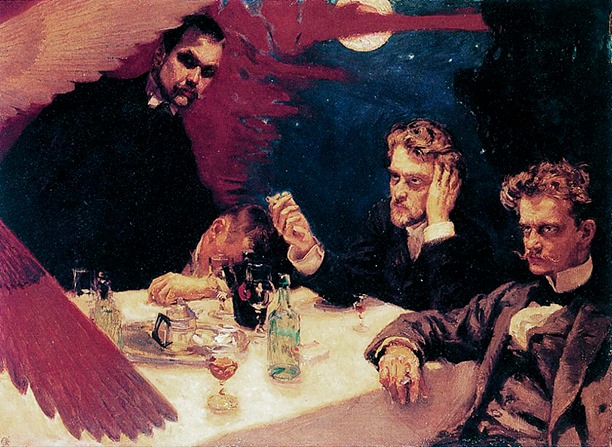
    Of course, Sibelius was fond of his drink, a weakness apparently shared by his friends and associates of “the Symposion.” In Akseli Gallén-Kallela’s painting “Kajustaflan,” we find pictured (from left to right) the artist, composer Oskar Merikanto (blacked out), Kajanus, and Sibelius.

    More about the Symposium, with the original version of Gallén’s painting – if possible, even more sordid – here:

    http://www.sibelius.fi/english/elamankaari/sib_symbosion.htm

  • Sibelius Birthday Memories

    Sibelius Birthday Memories

    EIGHT DAYS OF SIBELIUS, in anticipation of the composer’s birthday anniversary on December 8:

    One day, back in the late ‘90s, when I was still an antiquarian bookseller with a weekend full of radio obligations, a stranger wandered into my shop and stood transfixed. Robert Kajanus’ world premiere recording of Sibelius’ Symphony No. 3, set down in 1932, was emanating from the mantle speakers. The man turned to me and remarked upon the quality of the performance. I told him it was Kajanus, which he acknowledged with a nod. Then he introduced himself by saying the music was composed by his grandfather. This is how, by purest chance, I struck up a friendship with Anssi Blomstedt, a documentary filmmaker, then living in Philadelphia, and the youngest grandchild of Jean Sibelius.

    Not long after, I made some phone calls and was able to get Anssi into a rehearsal of Simon Rattle conducting the Philadelphia Orchestra in Sibelius’ Symphony No. 5. The ebullient Rattle was overjoyed to meet him. The encounter happened to coincide with an interview Rattle was doing backstage with somebody from Vanity Fair, I think, and somewhere there is a photograph of the future Sir Simon planting a kiss on Anssi’s forehead.

    One good turn deserves another, and it was through Anssi that I actually got to meet Einojuhani Rautavaara, back in the year 2000. At the time, Rautavaara was Finland’s most revered living composer. As a young man, he had actually worked as Sibelius’ chauffeur! Now he was in Philadelphia for the first performance of his own Symphony No. 8, subtitled “The Journey.” Anssi took me backstage at the Academy of Music to introduce us. The venerable composer was friendly and obviously amenable to a photograph (taken by Anssi, and posted here, in all its pre-digital glory).

    Rautavaara was also kind enough to sign my Naxos CD of his Symphony No. 3, the Piano Concerto No. 1, and the Concerto for Birds and Orchestra, known as “Cantus Arcticus.” I wonder what he thought of this peculiar, 33-year-old, American fan.

    It was through Anssi that I also acquired an autographed photo of Sibelius, which he brought back from the composer’s home, Ainola, in Järvenpää, Finland, located 23 miles north of Helsinki. I have yet to come across it since my move to Princeton, but it is around here somewhere! Sometime this week, I’ll try to post a photo of the Sibelius letter I acquired earlier, as a bookseller, which I had framed with a photo of the composer enjoying a good cigar. (The letter is a note of thanks for a box of cigars, one of Sibelius’ notable weaknesses.)

    Later, Anssi lived for a time in Easton, PA, another amazing coincidence, since Easton happens to be my hometown. He then moved back to Finland, so it’s been a number of years since we’ve seen one another. I’m thinking today might be a good time to try to reestablish contact.


    Sibelius’ Symphony No. 3, conducted by Robert Kajanus:

    Probably Einojuhani Rautavaara’s most frequently-heard work, the “Cantus Arcticus,” with bird songs recorded by the composer in the bogs of Liminka, near the Arctic Circle:

    https://www.youtube.com/watch?v=CmL8oKuefOQ

  • Classical Music Marble Cake on WWFM

    Classical Music Marble Cake on WWFM

    As the days grow short and the weather more miserable, revive your spirits with a kind of musical marble cake, this afternoon (if there is an afternoon) on The Classical Network.

    One vein will consist of historic recordings of pianist Harriet Cohen, composer and conductor Robert Kajanus, and baritone Harry T. Burleigh. Another will celebrate conductors Kajanus, Sir John Barbirolli, and Mariss Jansons. (Jansons died on Saturday at the age of 76.) Yet another will explore music from the north, including works by composers Kajanus, Jean Sibelius, and Johan Svendsen.

    The magnetic Cohen captivated seemingly every British composer of her day. In particular, her love affair with Sir Arnold Bax lasted for over 40 years. Bax wrote most of his piano music for her. His most famous work, the symphonic poem “Tintagel,” ostensibly inspired by the ruins of the Arthurian castle overlooking a tempestuous Cornish seascape, is said to enshrine all the passion the two musicians felt for one another during an especially ardent six weeks over which they vacationed there. We’ll hear a classic performance, with Barbirolli presiding.

    In 1936, Bax and Cohen traveled together to Helsinki to meet Sibelius, who also greatly influenced Bax’s music. Jansons will be remembered, in part, through his conducting of Sibelius, over whose idiom he demonstrated particular mastery.

    Sibelius’ earliest champion was Robert Kajanus. Kajanus conducted the first performances of many of the composer’s major works. He also wrote over 200 pieces himself. Of those, we’ll hear “Aino,” after an episode in the Kalevala. In addition, Kajanus will conduct music by his good friend and drinking buddy.

    Harry T. Burleigh’s influence on American music is incalculable. While a student at the National Conservatory of Music in New York, he happened to be overheard by the institute’s director, the newly-installed Antonin Dvořák, while singing African-American spirituals. Dvořák was captivated.

    Burleigh’s significance looms large in Dvořák’s music of his American years. More to the point, it informs the Czech master’s exhortation to composers of the United States to embrace spirituals and music of Native Americans as building blocks for a vibrant new art music, one with a distinctive national character. If Dvořák was the godfather of American music, then surely Burleigh was the great uncle. We’ll hear some of Burleigh’s own works, as well as his own documented performance of “Go Down, Moses.” Of course, we’ll have to include a little Dvořák, too.

    Happy birthday, Sir John Barbirolli, Harry T. Burleigh, Harriet Cohen, and Robert Kajanus, and rest in peace, Mariss Jansons.

    With ingredients like those, no matter how you slice it, you’ll wind up with all the marbles, from 4 to 7 p.m. EST, on WWFM – The Classical Network and wwfm.org.

  • Sibelius Birthday Tribute Finnish Music

    Sibelius Birthday Tribute Finnish Music

    All hail Finland’s great composer! Happy birthday, Jean Sibelius!

    Sibelius wrote a ton of music inspired by the Kalevala, the Finnish national epic. Join me for one of the lesser known of these, tomorrow night on “The Lost Chord,” at 10:00 EST, on WWFM – The Classical Network and wwfm.org. The program will also include works by Robert Kajanus and Uuno Klami.

    Cigars and vodka all around!


    Here’s Kajanus conducting Sibelius’ Symphony No. 3.

    https://www.youtube.com/watch?v=5kaz56nbwns

    I was playing this recording when Sibelius’ grandson fortuitously wandered into my bookshop in, I believe, 1998. A formula for instant friendship!


    IMAGE: “Kajustaflan,” painted by Akseli Gallén-Kallela. Pictured (from left to right): the artist, composer Oskar Merikanto (blacked out), Robert Kajanus and Jean Sibelius.

    More about “The Symposium,” with the original version of Gallén’s painting, here:

    http://www.sibelius.fi/english/elamankaari/sib_symbosion.htm

    Party on, gentlemen!

Tag Cloud

Aaron Copland (92) Beethoven (95) Composer (114) Film Music (120) Film Score (143) Film Scores (255) Halloween (94) John Williams (185) KWAX (229) Leonard Bernstein (100) Marlboro Music Festival (125) Movie Music (135) Opera (198) Philadelphia Orchestra (88) Picture Perfect (174) Princeton Symphony Orchestra (106) Radio (87) Ralph Vaughan Williams (85) Ross Amico (244) Roy's Tie-Dye Sci-Fi Corner (290) The Classical Network (101) The Lost Chord (268) Vaughan Williams (103) WPRB (396) WWFM (881)

DON’T MISS A BEAT

Receive a weekly digest every Sunday at noon by signing up here


RECENT POSTS