Tag: Russian Opera

  • Spring Arrives Tchaikovsky vs Rimsky-Korsakov

    Spring Arrives Tchaikovsky vs Rimsky-Korsakov

    So long, winter. We hardly knew ye! Spring arrives this afternoon at 5:24 EDT.

    Last night on “The Lost Chord,” I presented highlights from Nikolai Rimsky-Korsakov’s opera “The Snow Maiden.” The work is an allegorical fairy tale of humans, quasi-mythological creatures, and the eternal forces of nature, with the story of a star-crossed love bringing about the end of a 15-year winter.

    Rimsky’s opera, composed in 1880-81, was based on a play by Alexander Ostrovsky, which was first presented in 1873 with incidental music by Peter Ilych Tchaikovsky.

    Tchaikovsky (1840-1893) and Rimsky-Korsakov (1844-1908) shared something of a complicated rivalry. In public, they were genial and even supportive of one another, while in private both grappled with suspicion and envy. By the mid-1880s, Tchaikovsky achieved such eminence that Rimsky found himself creatively paralyzed. For his part, Tchaikovsky swore his publisher to secrecy about his use of a recently-invented instrument, the celesta, to characterize the Sugar Plum Fairy in “The Nutcracker,” so nervous was he that Rimsky would steal his thunder.

    Tchaikovsky’s untimely death finally lifted some of the pressure. Rimsky exorcised his demons by setting Nikolai Gogol’s short story “Christmas Eve,” a work Tchaikovsky had already adapted as an opera twice: in 1874, as “Vakula the Smith,” and in 1885, as “Cherevichki” (“The Slippers”). Rimsky’s own operatic version of the tale appeared in 1895.

    Rimsky was only 50 when he began work on “Christmas Eve,” but it proved to be the start of something of an Indian summer for the composer. 11 of his 15 operas followed. By the time of his death at the age of 64, he could be said to have been every bit as revered as Tchaikovsky.

    Thanks to the orchestral suite Rimsky distilled from “The Snow Maiden,” at least some of his music is better-known, especially “Dance of the Tumblers,” which is a favorite for drive-time radio. The best-known bit from Tchaikovsky’s version, which honestly has never really caught on to the extent that Rimsky’s has, is also his “Dance of the Tumblers.”

    Winter isn’t over until a ray of sunshine strikes the Snow Maiden. All hail Yarilo, Slavic god of vegetation, fertility, and springtime!


    Tchaikovsky, “Dance of the Tumblers”

    Rimsky-Korsakov, “Dance of the Tumblers”

    Tchaikovsky, Complete incidental music to “The Snow Maiden”

    Rimsky-Korsakov, Suite from the opera “The Snow Maiden”

  • Rimsky-Korsakov’s Lost Operas: Snow Maiden

    Rimsky-Korsakov’s Lost Operas: Snow Maiden

    Nikolai Rimsky-Korsakov was the composer of no fewer than 15 operas. But how many of them are known in the West?

    This Sunday night on “The Lost Chord,” we’ll have a chance to sample one of them, as we welcome spring with selections from “The Snow Maiden.”

    Based on an allegorical fairy tale of humans, quasi-mythological creatures, and the eternal forces of nature, it’s the story of a star-crossed love that brings about the end of a 15-year winter. The orchestral suite – which climaxes with the “Dance of the Tumblers” – is fairly popular, but the opera itself is seldom done, at least outside of Russia.

    The recording we’ll sample, on the Capriccio label, features the Bulgarian Radio Symphony conducted by Stoyan Angelov. It may not hold a candle to the best Rimsky opera recordings by conductors like Nikolai Golovanov, but it’s enough to give a taste of what American opera lovers are missing.

    I hope you’ll join me for “The Thaw of the Wild,” this Sunday night at 10:00 EDT, on WWFM – The Classical Network and wwfm.org.

    And lest anyone doubt my motives in celebrating a Russian composer since the invasion of Ukraine, Rimsky was no fan of authoritarianism, or imperialism, for that matter. If you’re interested to learn more, I wrote about it in this post about another one of his operas, last year:

  • Rimsky-Korsakov’s Middle Finger to the Tsar

    Rimsky-Korsakov’s Middle Finger to the Tsar

    I know Russian music isn’t exactly “in” right now. But on Rimsky-Korsakov’s birthday, I am reminded of how the last act of this most venerable of Russian nationalist composers was to give a great big middle finger to the Tsar.

    With the completion of “The Invisible City of Kitezh” in 1905, Rimsky thought he was through with the operatic stage. He had composed 14 operas in all, and for “Kitezh” he brought the utmost in his artistry to bear. It would form the capstone in a kind of pantheon to a distinctly Russian national sound in music, the foundations of which were laid by Mikhail Glinka, beginning in the 1830s and ‘40s.

    But political indignation stirred Rimsky to take up his pen for one final statement, a sardonic take-down of autocratic rule, Russian imperialism, and military incompetence during the Russo-Japanese War.

    To say that the conflict, in which rival empires clashed for supremacy around the Yellow Sea, proved to be an enormous embarrassment for Russia would be an understatement. After a series of staggering defeats, Emperor Nicholas II remained headstrong in his determination to win. Even beyond the point of all hope for victory, he doubled-down to try to save face, rather than submit to a “humiliating peace.” He ignored an olive branch from Japan and rejected the idea of ending the war.

    The inadequacy of the Russian military and Japan’s decisive victory stunned the world. It led to the decline of Russian prestige and influence abroad, and contributed to growing domestic unrest that culminated in the 1905 Russian Revolution.

    It didn’t help that at home the Imperial Guard had fired on workers during an unarmed demonstration, a peaceful march to the Winter Palace. The actions of the Tsar’s soldiers resulted in the deaths of men, women, and children. Depending on who you believe, casualties were somewhere between 96 (according the official record) and 4,000. Ironically, the Tsar wasn’t even in residence at the time.

    That was in January. The war finally ended in September with the Treaty of Portsmouth, mediated by Theodore Roosevelt.

    Rimsky himself had earlier served as an officer in the Russian Imperial Navy and later as a civilian inspector of its bands. In 1905 he took to the ramparts, figuratively speaking, when he stood with student agitators at the St. Petersburg Conservatory. Rimsky was in his 60s at the time and a much beloved presence. For his actions, he was dismissed from his professorship, approximately 100 students were expelled, and the conservatory was threatened with closure.

    A second demonstration by students during a performance of one of Rimsky’s earlier operas, “Kashchey the Immortal,” led to a ban on his music. Widespread outrage rippled beyond Russia’s borders. 300 students staged a walkout at the conservatory until Rimsky was reinstated. Not long after, in 1906, Rimsky would resign to launch into work on his final opera, with a pen warmed up in hell.

    On its surface, “The Golden Cockerel,” after Pushkin, is a fairy tale. But like all the best fairy tales, it also serves as a thinly-veiled allegory. The Astrologer in the work’s prologue and epilogue tells us that the characters are all based on real persons and that the moral is valid and true. In between, we’re introduced to a paranoid ruler who reneges on his promises, commits criminal acts, makes war on a sovereign state, displays military ineptitude, and in the end has his jugular pecked out by a cockerel.

    There’s no way the Russian censors were ever going to allow this work onstage. Rimsky, whose health was in decline, demanded that no changes be made, and suggested to a friend that he arrange for it to be performed in Paris. It got there eventually, staged as “Le coq d’or,” the title by which it has frequently been identified in the West ever since.

    But the actual premiere took place in Moscow in 1909, the year after Rimsky’s death. And yes, the libretto was judiciously pruned and the staging carefully modified.

    In his lifetime, Rimsky-Korsakov was one of the most prominent and respected musical figures in all of Russia. The St. Petersburg Conservatory, from which he was fired, now bears his name.

    As the ironies continue to pile upon ironies, history is poised to repeat itself. In 2022, Rimsky’s barbed response to the events of 1905 now seems uncannily prescient.


    From a New York City Opera telecast, in English, with Beverly Sills in 1971. The Tsar (Norman Treigle) gets the big peck at 1:38:30.

    There are plenty more legible productions on YouTube, but most are sung in Russian, and not many have subtitles.

    Here’s a more vivid production, with no translations:

    Perhaps the opera’s best-known number, “Hymn to the Sun”

    Arthur Fielder conducts the orchestral suite:

    https://www.youtube.com/watch?v=GPnNeYW0Xls

  • Russian Folklore Music on WPRB

    Russian Folklore Music on WPRB

    I try to make it a practice never to start in on the vodka before noon. But today I will make an exception. This week on WPRB, whether by flying carpet or magic slippers, we travel to the exotic realms of Russian folklore.

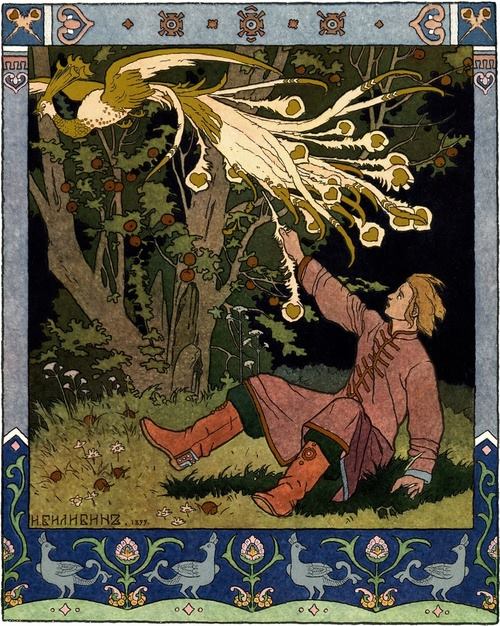
    We’ll have music inspired by the myths, legends and folktales of Russia, including works evocative of Baba Yaga, Koschei the Deathless, the Firebird, Zolushka, Ivan the Fool, Ruslan and Ludmila, and the Invisible City of Kitezh. The folk heroes Sadko and Stepan Razin will also be represented. Along the way, we’ll also hear some of the great singers of Russian opera.

    The crowning glory of the morning will be Reinhold Gliere’s epic symphony on the exploits of Ilya Muromets. We’ll hear the acclaimed recording by JoAnn Falletta and the Buffalo Philharmonic Orchestra, who took the work to Carnegie Hall in 2013 and subsequently recorded it complete (over 70 minutes) for the Naxos label. The release was described by David Hurwitz of classicstoday.com as “the finest version yet recorded,” and by Peter J. Rabinowitz of “Fanfare” as “beyond excellent.” Listen for it to begin between 9:30 and 9:45.

    I hope you’ll join me this morning from 6 to 11 ET, for five hours of Russian folk tales and fairy music at WPRB 103.3 FM or online at wprb.com. I start the day singing basso profundo this week on Classic Ross Amico.

  • Rimsky-Korsakov’s Lost Operas

    Rimsky-Korsakov’s Lost Operas

    Today is the birthday of Nikolai Rimsky-Korsakov (Julian date Mar. 6, 1844), who wrote so much enchanting music, and yet so much of it is comparatively unknown.

    In particular, his operas have failed to really secure a toehold in the West. This, despite a pre-political hot potato Valery Gergiev’s efforts to bring a taste of their opulence and pageantry to BAM, the odd touring company (the Bolshoi) bringing concert versions to Lincoln Center, or the now defunct New York City Opera putting together an English-language version of “Le coq d’or” for Beverly Sills and Norman Treigle – now almost 50 years ago!

    His works for the stage are often dismissed by Western critics, who apparently find them insubstantial, as if (non-Wagnerian) folklore is somehow less valid than an evening of Italian oom-pah-pah culminating in a jester discovering his dying daughter in a burlap sack.

    Be that as it may, I find what I’ve heard of his operas (and I’ve probably heard more than most) enthralling. He composed 16 in all, if we count the original version of “Mlada,” which he wrote in collaboration with other composers of The Mighty Handful.

    Sadly, Gergiev’s cycle of recordings for the Philips label was curtailed after only five operas, leaving one to feel one’s way through the thickets of mostly unreviewed (at least in the West) Russian recordings. The sound quality on these can be hit and miss, and the singing can be variable, but every once in a while, one hits pay dirt.

    Why is it that the most powerful recordings are from the pre-stereo era, when larger-than-life figures like Feodor Chaliapin and Mark Reizen walked the boards? If you don’t mind listening through a soup can, anything conducted by Nikolai Golovanov will knock your socks off. If ever I acquire a time-traveling DeLorean, I would make it my mission to round up some modern recording engineers and slip into the Soviet Union under Stalin’s moustache.

    Happy birthday, Rimsky. We hardly know ya.

    Chaliapin as the Viking Guest, in “Sadko”:

    Arguably topped by Reizen!

    Golovanov conducts “Christmas Eve” (complete):

    Golovanov conducts “May Night” (complete):

    Golovanov conducts “Sadko” (complete):
    https://www.youtube.com/watch?v=AMq87z_ZkPc

Tag Cloud

Aaron Copland (92) Beethoven (95) Composer (114) Film Music (120) Film Score (143) Film Scores (255) Halloween (94) John Williams (185) KWAX (229) Leonard Bernstein (100) Marlboro Music Festival (125) Movie Music (135) Opera (198) Philadelphia Orchestra (88) Picture Perfect (174) Princeton Symphony Orchestra (106) Radio (87) Ralph Vaughan Williams (85) Ross Amico (244) Roy's Tie-Dye Sci-Fi Corner (290) The Classical Network (101) The Lost Chord (268) Vaughan Williams (103) WPRB (396) WWFM (881)

DON’T MISS A BEAT

Receive a weekly digest every Sunday at noon by signing up here


RECENT POSTS