This is one steaming boar’s head Santa really worked for. Merry Christmas, everyone. And for those of you find the dish abhorrent, a happy first night of Hanukkah!
William Henry Walker (1871-1938), “Elves Serving Dinner to Santa and Mrs. Claus,” 1903. Charcoal on board.
Santa is about to climb into his North Pole hybrid and get started on his biggest night.
My computer keeps crashing on me every few minutes, and then it takes multiple false starts before it can get enough of a charge so that I can get back online, so you might not hear from me for a couple of days until I get a new battery. For now, Happy Christmas to all, and to all a good night!
IMAGE: William Henry Walker (1871-1938), “Santa Speeding Down Road in Motorized Sleigh,” 1903. Charcoal on paper.
Stop me if you heard this before. After crisscrossing the same ground for the past nine years, especially around the holidays, I sometimes feel as if we’re an old married couple, patiently enduring the same stories. All the same, I can’t bypass St. Nicholas on his day. Also, I’ve been under the weather, and I’m up against a deadline, so I hope you’ll excuse the cut and paste.
Here we go, then…
St. Nicholas Day follows on the cloven hoof of Krampus Night.
In theory, the whole Nicholas-Krampus dynamic serves as a kind of “good cop/bad cop” scenario, with the naughty, threatened with the punishment of Krampus (the Christmas devil), driven to virtue, reinforced by the rewards of Nicholas (the patron saint of children).
But that’s a gross oversimplification, as it turns out Nicholas could be a pretty rough customer. He’d have to be, to be looking after not only children, but sailors, merchants, archers, prostitutes, women seeking husbands, repentant thieves, wrongly condemned criminals, travelers, pawnbrokers, and students. I’d be grouchy too.
Nicholas did not suffer fools lightly. His modesty could be so extreme as to sometimes verge on the sociopathic, and he could be downright cantankerous when thanked.
So what’s your favorite Nicholas story?
Is it when he tosses the bags of gold down a poor man’s chimney, surreptitiously providing a dowry for the man’s daughters and rescuing them from a life of prostitution, and then sharply rebuffs the man for his thanks?
Or is it when he chastises the sailors for their salty language, and when they mock him for his prudishness, prays for stormy seas until they drop to the deck in terror and repent?
Or is it when he reconstitutes and resurrects the three pickled boys, dismembered by a treacherous butcher to be passed off to his customers as ham?
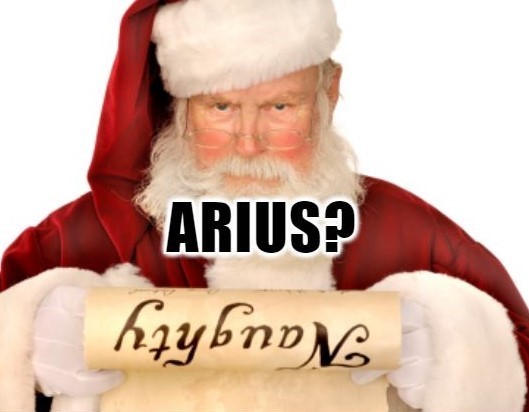
Or is it when he sends Arius, father of Arianism, sprawling for his heresy that Jesus Christ is subordinate to the entity of God?
The Nicholas of history and legend was a far cry from your Coca-Cola Santa.
There’s no way I’m sitting on this guy’s lap. Happy St. Nicholas Day!
“Legends of St. Nicholas,” performed by Anonymous 4
“The Play of St. Nicholas,” 12th century (in four parts)
St. Nicholas Day follows on the cloven hoof of Krampus Night.
In theory, the whole Nicholas-Krampus dynamic serves as a kind of “good cop/bad cop” scenario, with the naughty, threatened with the punishment of Krampus (the Christmas devil), driven to virtue, reinforced by the rewards of Nicholas (the patron saint of children).
But that’s a gross oversimplification, as it turns out Nicholas could be a pretty rough customer. He’d have to be, to be looking after not only children, but sailors, merchants, archers, prostitutes, women seeking husbands, repentant thieves, wrongly condemned criminals, travelers, pawnbrokers, and students. I’d be grouchy too.
Nicholas did not suffer fools lightly. His modesty could be so extreme as to sometimes verge on the sociopathic, and he could be downright cantankerous when thanked.
So what’s your favorite Nicholas story?
Is it when he tosses the bags of gold down a poor man’s chimney, surreptitiously providing a dowry for the man’s daughters and rescuing them from a life of prostitution, and then sharply rebuffs the man for his thanks?
Or is it when he chastises the sailors for their salty language, and when they mock him for his prudishness, prays for stormy seas until they drop to the deck in terror and repent?
Or is it when he reconstitutes and resurrects the three pickled boys, dismembered by a treacherous butcher to be passed off to his customers as ham?
Or is it when he sends Arius, father of Arianism, sprawling for his heresy that Jesus Christ is subordinate to the entity of God?
The Nicholas of history and legend was a far cry from your Coca-Cola Santa.
There’s no way I’m sitting on this guy’s lap. Happy St. Nicholas Day!
“Legends of St. Nicholas,” performed by Anonymous 4
“The Play of St. Nicholas,” 12th century (in four parts)
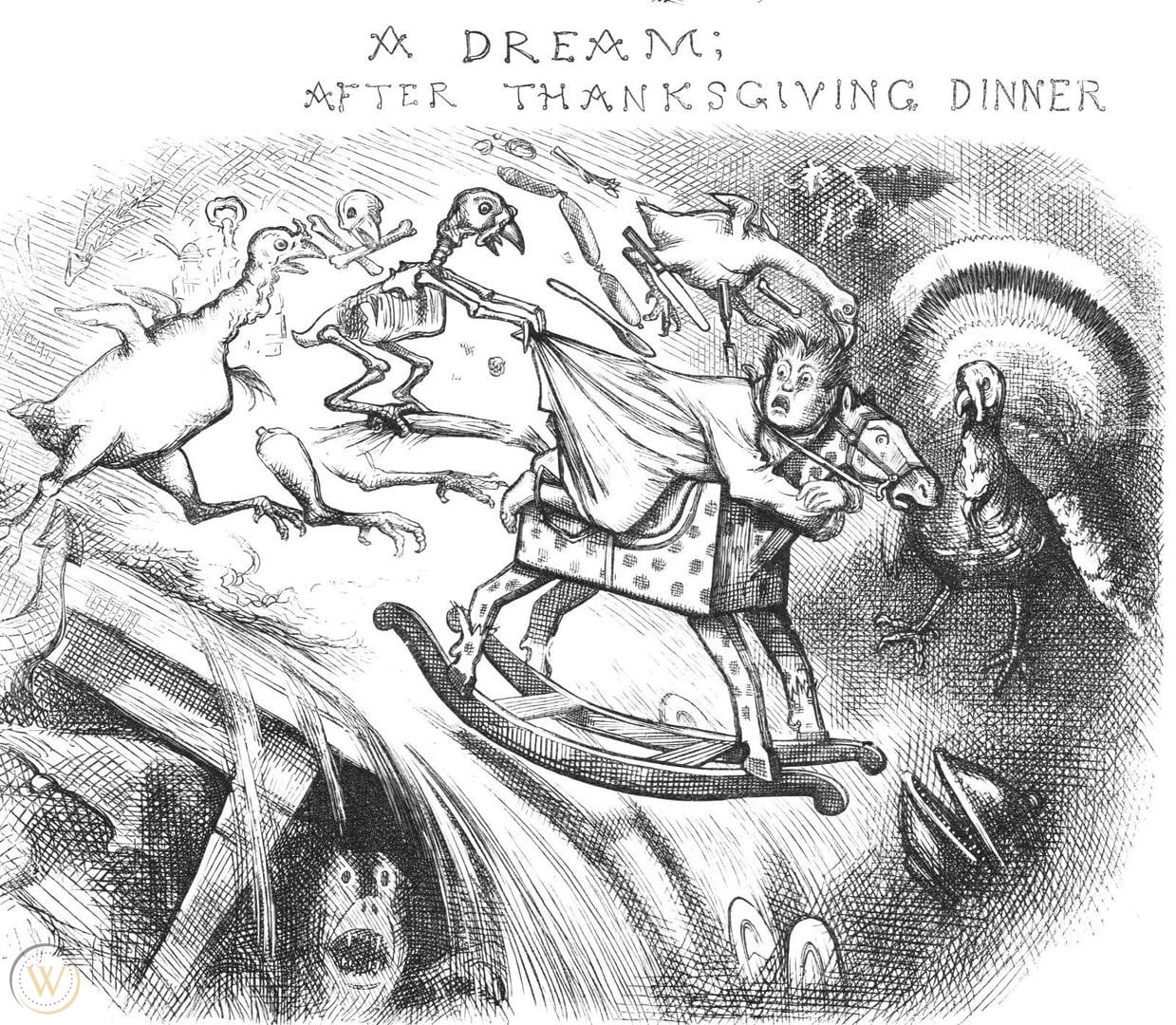
The illustration is by Thomas Nast, an artist whose influence is still felt as surely as yesterday’s Thanksgiving dinner.
Nast, of course, is the political cartoonist credited with having knocked the pins out from under Boss Tweed’s Tammany Hall machine. He’s also responsible for the popularization of Uncle Sam and the Democratic donkey, the creation of the Republican elephant, and the personification of Columbia, symbol of American values.
But this time of year his legacy is most pervasive, as foremost he is credited with having been the first to synthesize the traditional imagery employed in Clement Moore’s “A Visit from St. Nicholas” in codifying the look of our modern Santa.
What better way, then, to kick off the holiday season? Enjoy those Thanksgiving leftovers!