Serge Diaghilev, impresario of the Ballets Russes, commissioned some of the most enduring ballet scores of the 20th century, from such composers as Claude Debussy (“Jeux”), Maurice Ravel (“Daphnis and Chloe”), Manuel de Falla (“The Three-Cornered Hat”), and Igor Stravinsky (“The Firebird,” “Petrushka” and “The Rite of Spring”).
Less well known is the fact that two Englishmen were also approached.
This week on “The Lost Chord,” we’ll listen to works by Constant Lambert and Lord Berners – both men so diverse in their interests, and possessing such outsized personalities, it isn’t really possible to do justice to either in the time allotted.
Lambert was a brilliant polymath. In addition to his considerable talents as a composer, he was a conductor, arranger, and writer, as well as the lover of Margot Fonteyn. Alas, alcoholism and workaholism conspired with undiagnosed diabetes to hasten his demise at the age of 45.
His ballet, “Romeo and Juliet,” presented as a play-within-a-play, turns Shakespeare’s tragedy of star-crossed lovers on its head, with the leads falling hard in a backstage romance with happier results. Lambert would go on to greater things, but the ballet is undeniably an impressive piece of work for a 20 year-old.
Similarly, Lord Berners’ interests lie all over the place, but his was a much more relaxed character. Unfailingly productive as a composer, a painter, and a writer, nonetheless he never lost sight of the fact that life would be his magnum opus. And Berners lived well.
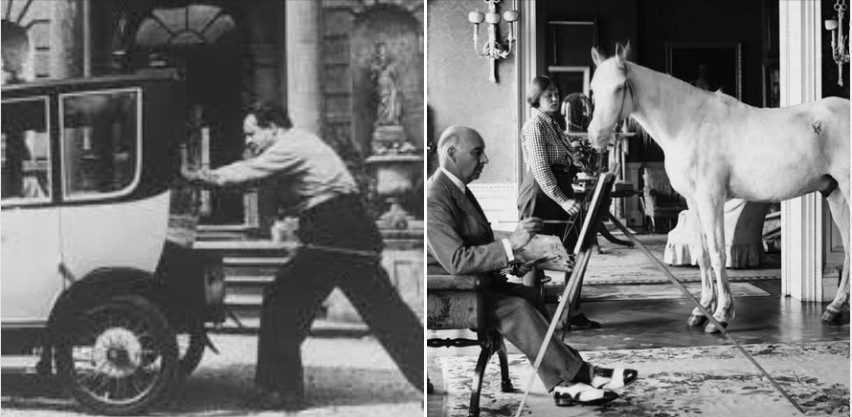
Furthermore, his fortune ensured that he would never be taken to task for any of his whimsical behavior. This included having a 140-foot folly tower constructed on his estate (partly to annoy the neighbors) and keeping a horse and a giraffe to invite to his indoor and outdoor tea parties.
Berners wrote novels, painted portraits (always sure to include a moustache, whether the sitter had one or not), and composed a respectable amount of music, especially for the ballet.
For the Ballets Russes, he wrote “The Triumph of Neptune,” which became a great favorite of Sir Thomas Beecham. Sacheverell Sitwell provided the scenario, which concerns a sailor who is shipwrecked en route to Fairyland, and George Balanchine supplied the choreography.
That’s a heady mix of hornpipes and pas de deux. I hope you’ll join me for “England à la Russe,” on “The Lost Chord,” now in syndication on KWAX Classical Oregon!
——-
Clip and save the start times for all three of my recorded shows:
PICTURE PERFECT, the movie music show – Friday at 8:00 PM EDT/5:00 PM PDT
SWEETNESS AND LIGHT, the light music program – Saturday at 11:00 AM EDT/8:00 AM PDT
THE LOST CHORD, unusual and neglected rep – Saturday at 7:00 PM EDT/4:00 PM PDT
Stream them, wherever you are, at the link!
https://kwax.uoregon.edu
——-
PHOTOS: Berners, no doubt contemplating the placement of a moustache (right); and Lambert pushing Berners car
Tag: Serge Diaghilev
-
“England à la Russe” on “The Lost Chord”
-
Ballets Russes’ Lost English Composers
Serge Diaghilev, impresario of the Ballets Russes, commissioned some of the most enduring ballet scores of the 20th century, from such composers as Claude Debussy (“Jeux”), Maurice Ravel (“Daphnis and Chloe”), Manuel de Falla (“The Three-Cornered Hat”), and Igor Stravinsky (“The Firebird,” “Petrushka” and “The Rite of Spring”).
Less well known is the fact that two Englishmen were also approached.
This week on “The Lost Chord,” we’ll listen to works by Constant Lambert and Lord Berners – both men so diverse in their interests, and possessing such outsized personalities, it isn’t really possible to do justice to either in the time allotted.
Lambert was a brilliant polymath. In addition to his considerable talents as a composer, he was a conductor, arranger, and writer, as well as the lover of Margot Fonteyn. Alas, alcoholism and workaholism conspired with undiagnosed diabetes to hasten his demise at the age of 45.
His ballet, “Romeo and Juliet,” presented as a play-within-a-play, turns Shakespeare’s tragedy of star-crossed lovers on its head, with the leads falling hard in a backstage romance with happier results. Lambert would go on to greater things, but the ballet is undeniably an impressive piece of work for a 20 year-old.
Similarly, Lord Berners’ interests lie all over the place, but his was a much more relaxed character. Unfailingly productive as a composer, a painter, and a writer, nonetheless he never lost sight of the fact that life would be his magnum opus. And Berners lived well.Furthermore, his fortune ensured that he would never be taken to task for any of his whimsical behavior. This included having a 140-foot folly tower constructed on his estate (partly to annoy the neighbors) and keeping a horse and a giraffe to invite to his indoor and outdoor tea parties.
Berners wrote novels, painted portraits (always sure to include a moustache, whether the sitter had one or not), and composed a respectable amount of music, especially for the ballet.
For the Ballets Russes, he wrote “The Triumph of Neptune,” which became a great favorite of Sir Thomas Beecham. Sacheverell Sitwell provided the scenario, which concerns a sailor who is shipwrecked en route to Fairyland, and George Balanchine supplied the choreography.
That’s a heady mix of hornpipes and pas de deux. I hope you’ll join me for “England à la Russe,” on “The Lost Chord,” now in syndication on KWAX, the radio station of the University of Oregon!
Clip and save the start times for all three of my recorded shows:
PICTURE PERFECT, the movie music show – Friday at 8:00 PM EDT/5:00 PM PDT
SWEETNESS AND LIGHT, the light music program – ALL NEW! – Saturday at 11:00 AM EDT/8:00 AM PDT
THE LOST CHORD, unusual and neglected rep – Saturday at 7:00 PM EDT/4:00 PM PDT
Stream them, wherever you are, at the link!
PHOTOS: Berners, no doubt contemplating the placement of a moustache (right); and Lambert pushing Berners car
-
Vernon Duke Autumn in New York Composer
It’s autumn in New York!
Vernon Duke (né Vladimir Dukelsky) was born in what is now Belarus on this date in 1903. In Kyiv, he studied composition under Reinhold Gliere. He left the USSR in 1920, traveling to New York, where he was befriended by George Gershwin. In fact, it was Gershwin who suggested a name-change to something a bit more comprehensible to American audiences. (Gershwin himself was born Jacob Gershowitz.)
For a time, Duke ping-ponged back and forth to Europe, where he fulfilled a commission by Serge Diaghilev (for the ballet “Zephyr and Flora”). The work impressed Sergei Prokofiev, and the two became fast friends. Dukelsky’s Symphony No. 1 was given its premiere in Paris, under Serge Koussevitzky, on the same program as excerpts from Prokofiev’s “The Fiery Angel.”
Around the same time, Duke began contributing material to musical comedies in London. This laid the groundwork for a return to New York in 1929. There, he continued to composed “serious” works, while insinuating himself into the Broadway scene. A number of his songs – “April in Paris,” “Autumn in New York,” “Taking a Chance on Love,” “I Can’t Get Started” – have since become standards.
When Gershwin died in 1937, Duke stepped in to complete his unfinished score for “The Goldwyn Follies,” for which he contributed a couple of ballets (choreographed by George Balanchine) and the song, “Spring Again.” His greatest success came in 1940, with the Broadway show, “Cabin in the Sky.”
Here’s a rare concert broadcast of his Symphony No. 3:
A number of his concert works have been recorded in recent years, including this Piano Concerto for Arthur Rubinstein:
His Cello Concerto, performed by Samuel Magill, then of the Metropolitan Opera Orchestra:
“Autumn in New York”
“Brooklyn Barcarolle”
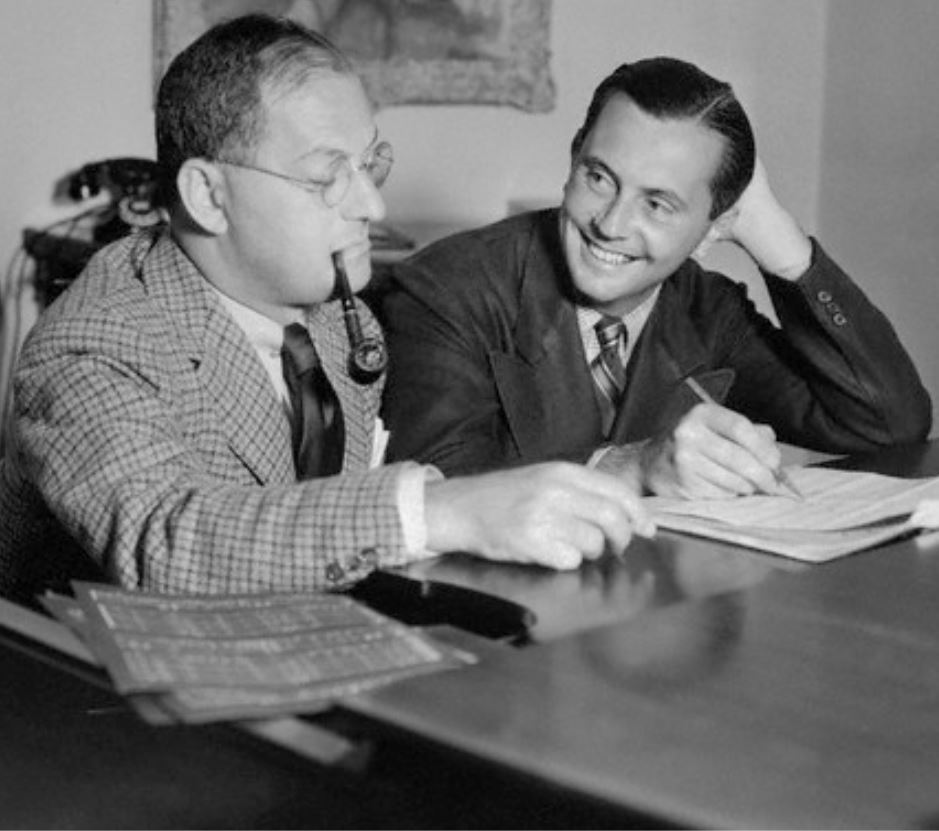
PHOTO: Duke (right) with Ira Gershwin
-

Diaghilev’s Lost English Ballets
Serge Diaghilev, impresario of the Ballets Russes, commissioned some of the most enduring ballet scores of the 20th century, from composers such as Claude Debussy (“Jeux”), Maurice Ravel (“Daphnis and Chloe”), Manuel de Falla (“The Three-Cornered Hat”) and especially Igor Stravinsky (“The Firebird,” “Petrushka” and “The Rite of Spring”).
Less well known is the fact that he approached two Englishmen to write music for his famed and influential company.
This Sunday night on “The Lost Chord,” we’ll be listening to works by Constant Lambert and Lord Berners – both figures so diverse in their interests, and possessing such outsized personalities, that it isn’t really possible to do either justice in the time allotted.
Lambert was a brilliant polymath. In addition to his considerable talents as a composer, he was a conductor, arranger, and writer, as well as the lover of Margot Fonteyn. Alas, alcoholism and workaholism conspired with undiagnosed diabetes to hasten his demise at the age of 45.
His ballet, “Romeo and Juliet,” presented as a play-within-a-play, turns Shakespeare’s tragedy of star-crossed lovers on its head, with the leads falling hard in a backstage romance with happier results. Lambert would go on to greater things, but the ballet is undeniably an impressive piece of work for a 20 year-old.
Similarly, Lord Berners’ interests lay all over the place, but his was a much more relaxed character. Unfailingly productive as a composer, a painter and a writer, he never lost sight of the fact that his life would be his magnum opus. And Berners lived well.
Furthermore, his fortune ensured that he would never be taken to task for any of his whimsical behavior. This included having a 140-foot folly tower constructed on his estate (partly to annoy the neighbors) and inviting a horse to his indoor tea parties.
Berners wrote novels, painted portraits (always certain to include a moustache, whether the sitter had one or not), and composed a respectable amount of music, especially for the ballet.
For the Ballets Russes, he wrote “The Triumph of Neptune,” which became a great favorite of Sir Thomas Beecham. Sacheverell Sitwell provided the scenario, which concerns a sailor who is shipwrecked en route to Fairyland, and George Balanchine supplied the choreography.
I hope you’ll join me for “England à la Russe,” tonight at 10 ET, with a repeat Wednesday evening at 6, or that you’ll listen to it later as a webcast at http://www.wwfm.org.
PHOTO: Berners, no doubt contemplating the placement of a moustache
Tag Cloud
Aaron Copland (93) Beethoven (95) Composer (114) Film Music (144) Film Score (143) Film Scores (255) Halloween (94) John Williams (195) KWAX (229) Leonard Bernstein (104) Marlboro Music Festival (125) Movie Music (159) Mozart (91) Opera (213) Philadelphia Orchestra (89) Picture Perfect (174) Princeton Symphony Orchestra (109) Radio (88) Ross Amico (244) Roy's Tie-Dye Sci-Fi Corner (290) The Classical Network (101) The Lost Chord (269) Vaughan Williams (105) WPRB (397) WWFM (881)