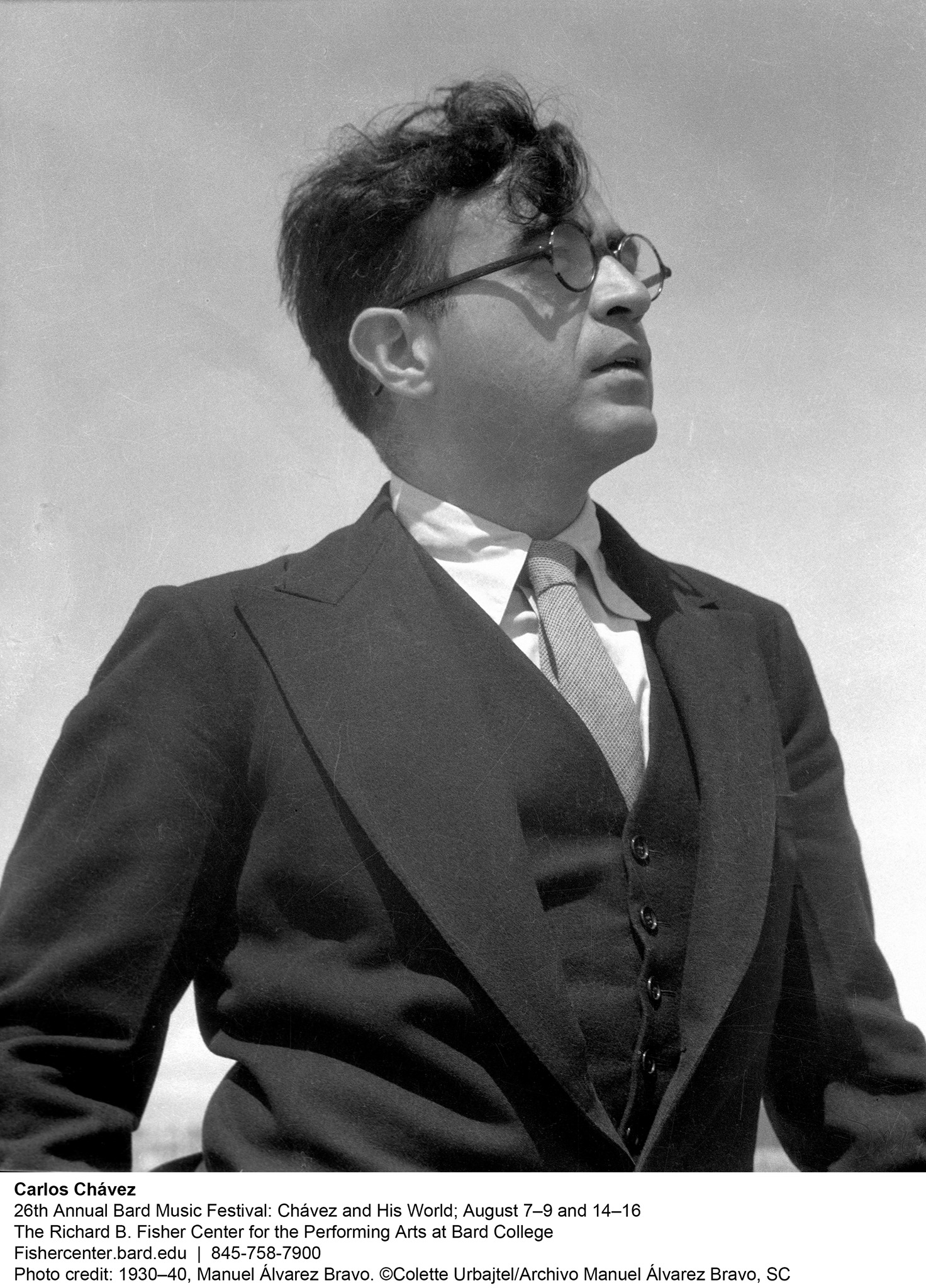
Today is the birthday of Mexico’s multitalented Carlos Chávez. I just wrote about Chávez last month, in relation to a set of his complete recordings made for Columbia Records, now reissued on Sony Classical. Gringo that I am, I posted about it on Cinco de Mayo, a holiday that I understand is a much bigger deal here than it is in Mexico. Anyway, here again are my thoughts, if you’re interested. (More below.)
In posting about the set, I remark upon Chávez’s late, atonal, wholly wackadoodle, but undeniably fascinating ballet “Pirámide” (1968). But in doing so, I neglect to mention his earlier, indigenous ballet, “Los Cuatro Soles” (“The Four Suns”), from 1925. The latter treats another “primitivist” subject (all the rage after Stravinsky’s “The Rite of Spring”), with four catastrophes ending a different epoch (symbolized by each of the four suns) in the history of the Nahua people. Listen to that drum at 10:23!
Poised somewhere between the artifice of Stravinsky and the spirit of Villa-Lobos, the work is unmistakably Chávez. It’s not going to make anybody’s hit parade, but you can tell it’s the same guy who went on to write “Sinfonía India” (1935-36).
And as I noted before, the latter work pointed the way for Aaron Copland’s western ballets. Copland was at work on “El Salón México” at the same time. Chávez would conduct the world premiere of Copland’s watershed piece in Mexico City. He also gave the first performance of Copland’s “Short Symphony,” after it was declared unplayable (because of its complexity) by Leopold Stokowski, Serge Koussevitzky, and others.
Chávez was an important musician in so many ways. Without him, art music in the United States might have developed very differently.
You’ll find links to “Sinfonía India” and ““Pirámide” at the bottom of my original post.
In these days when the industry seems to be doing its damnedest to sideline classical music and even physical media (the “vinyl revival” aside), it’s not unusual for the major labels to undervalue their considerable treasures to the extent of just dumping them out onto the market in cheaply-priced boxed sets. Many of these package their individual discs in cardboard sleeves that replicate the original LP cover art and program notes (albeit microscopically), with an accompanying booklet containing frustratingly minimal information. Even so, I must say, it’s nice, from both a collector’s and classical music-lover’s perspective, to be able to own the material!
Characteristically, this set of recordings by Carlos Chávez was issued last year with little or no fanfare. At least none that I could perceive, and you know I’m all over the internet and music magazines. It was released last May, and I only happened across it, purely by chance, online in January. Of course, I ordered it immediately. I’ve been making it a point to listen to everything attentively over the past week, thinking I would write up some of my thoughts for Cinco de Mayo.
Granted, the music of Carlos Chávez is perhaps not for everyone, but I confess this is one of those sets that made my heart skip a beat. I didn’t know some of these recordings even existed!
To give an idea of the significance of Chávez to Mexican music, pour Aaron Copland, Leonard Bernstein, and perhaps William Schuman or Howard Hanson into a margarita machine. Not that Chávez’s music sounds like any of these. At his most populist, he is closest to Copland, but when he truly flexes his modernist muscle, he looks across the States to Europe, where he assimilates the lessons of the world’s 20th century masters, but always on his own terms. How Chávez most resembles the Americans I cite is as his country’s most significant composer, conductor, and music educator. (Schuman was president of Juilliard, and Hanson headed the Eastman School for some 40 years.)
Unsurprisingly, Copland and Chávez were very good friends. The earliest of these recordings date from 1938, the year Copland introduced “El Salón México” (written during an extended stay in the country and given its debut with Chávez conducting). It was Copland’s watershed work that led to his greatest successes and his most characteristic sound. The folk song “La paloma azul” (“The Blue Dove”) is included in the set, in Chávez’s arrangement, and is immediately recognizable as one of the tunes assimilated by Copland.
I would love Chávez forever if he had composed only his “Sinfonía India” – tuneful, evocative, expansive in spirit (if concise in structure), immediate, and joyous. It’s also full of good, memorable folk tunes and indigenous percussion. Most significant for American music, it points the way for Copland’s western scores. Never have the native instruments sounded so authoritative as in these recordings. I wonder if this would now be considered cultural appropriation? Back then, it would have been regarded as musicology. More often than not, the set’s performances employ Mexican musicians. How many of them are “Indian” is anyone’s guess.
In the collection’s earliest recordings, the mono sound only lends the works a more modernist edge. The 1940 audio is impressive. The two tracks from 1938 are wonderful for Chávez cognoscenti, but I would recommend getting to know the music first from the later stereo recordings, also included in the set. Over all, the sound lacks for nothing for those of us who grew up in the era of stereo LPs. Just don’t go into it expecting state-of-the-art digital recording.
For Cinco de Mayo, my recommendation would be to start with the recordings of the populist and indigenous selections on CD 2, in stereo. Once the tequila begins to take effect, you can move on to the mono on CD 1. Then when you’re really starting to feel it, advance to the symphonies. (All six of them are here.) Beside the Symphony No. 2 (the “Sinfonía India”), they may seem a little demanding. But you might find yourself quickly warming to some of them. Some may remain tougher nuts. Throughout every one of them, Chávez retains a distinctive voice.
When you’re on the verge of blackout, that’s when you should put on the ballet “Pirámide.” It’s rare that Chávez ever conjures the mescaline visions of his compatriot Silvestre Revueltas, but this one is a real trip!
The disc devoted to “Soli,” chamber music for various combinations of winds and brass instruments, recalls Revueltas’ “Ocho por radio,” though none of the works are as concise or as perky. For me, “Soli I,” the shortest, is also the most successful, but if you’re in the right frame of mind, there’s plenty more modernism to chew over in Nos. II & IV.
A big surprise is Chávez’s Violin Concerto, with the Polish-Mexican violinist Henryk Szeryng. While not overtly melodic in the manner of the grand Romantic concertos, it is lyrical and structurally fascinating. Its four movements are played without break. The scherzo is cast as a theme and variations, and the finale reprises most of the material laid out in the first movement, in inversion! The soloist plays almost continuously, and the seven-minute cadenza falls in the middle of the piece where you would least expect it.
Chavez’s creative trajectory ranges from Romantic Nationalist to Modernist Nationalist. Which is to say, you can take the composer out of Mexico, but you can’t take Mexico out of the composer. Nor can you erase his fingerprints. But beyond some of the populist stuff, there is no way he should be reduced to a mere purveyor of picture postcards. Chávez was a composer of international stature, and you can tell by his music that Mexico City was no musical backwater. As a conductor, he imported all the major composers of his day, and he interacts with all the latest trends in his own music (except, on the evidence of this set, serialism).
By the time we get to selections from the ballet “Pirámide,” recorded in 1973, we are entering avant-garde territory. How fascinating that, on its LP release, this was on the flip side of Copland’s complete recording of “Appalachian Spring!” Here, Chávez conducts the London Symphony Orchestra and Ambrosian Singers.
By the end of the seven discs, you will be well-familiar with Chávez’s “Sinfonía India,” the equally concise, though more severe “Sinfonía de Antígona” (his Symphony No. 1, derived from incidental music written for a Jean Cocteau production of “Antigone”), his “Xochipilli” (speculative Aztec music), and his arrangement of Buxtehude’s Chaconne (a real crowd pleaser in the mold of Stokowski’s “Toccata and Fugue”), as well as Blas Galindo’s “Sones de Mariachi,” all of which Chávez recorded twice for Columbia Records.
Not everything Chávez ever recorded is here. I have his Piano Concerto on another label (originally issued on Westminster with pianist Eugene List) and his “Sinfonía India” (of course) and Symphonies 1 & 4 on Everest (with the Stadium Orchestra of New York), but presumably these are the complete Columbia recordings, as advertised.
What strikes me about Chávez’s music, in whatever creative period, is that it is crafted with great integrity. At every point does it stand toe-to-toe with any art music being produced anywhere in the world at that time – which is to say that it puts most everything written today in the shade.
Again, not for everyone. If your taste for 20th century music stops with Rachmaninoff, you might just want to sample what you can find on YouTube. (Start with “Sinfonía India,” but then try some of the other symphonies before purchasing.) However, if you’re fairly serious about 20th century classical music, this is definitely worth the layout, which is probably about the price of a Cinco de Mayo dinner out, with a pitcher of margaritas.
Join me this afternoon on The Classical Network, as I celebrate the birthday today of Mexico’s foremost composer and conductor. In the wake of the Mexican Revolution, Chávez (1899-1978) appeared like Quetzalcoatl, the creator-deity of Aztec lore, to forge a distinctive sound in Mexican music.
He became director of the Orquesta Sinfónica Mexicana, the country’s first permanent symphony orchestra. He was appointed director of the National Conservatory of Music. Later, he served as director-general of the National Institute of Fine Arts. At the same time, he formed the National Symphony Orchestra, which supplanted the old OSM.
In 1937, he conducted the world premiere of “El Salón México,” the work which essentially launched Aaron Copland into the mainstream.
Chávez himself was one of the first exponents of Mexican nationalism in music, writing ballets on Aztec themes. His most famous work is probably the Symphony No. 2, composed in 1935-36. Known as the “Sinfonia India,” it is based on melodies by indigenous tribes of northern Mexico.
The percussion section originally included a large number of traditional Mexican instruments, including the jicara de agua (half of a gourd inverted and partly submerged in a basin of water, struck with sticks), güiro, cascabeles (a pellet rattle), tenabari (a string of butterfly cocoons), a pair of teponaxtles, tlapanhuéhuetl, and grijutian (a string of deer hooves).
However, when the score was published, the composer sensibly substituted the nearest equivalents commonly used by most orchestras, though he requested that the originals be employed wherever possible. We’ll hear the work this afternoon in the 3:00 hour.
At noon today, The Classical Network will continue its partnership with Gotham Early Music Scene (GEMS), with a concert from Saint Bartholomew’s Episcopal Church in midtown Manhattan. The program of “Italian Jewels” will feature Nina Stern, recorder, Jeffrey Grossman, harpsichord, and Stephanie Corwin, bassoon, in music by Giovanni Battista Fontana, Tarquinio Merula, Arcangelo Corelli, and Antoniio Vivaldi.
It’s music from the Old World and the New, from 12 to 4 p.m. EDT, on WWFM – The Classical Network and wwfm.org.
In a development that promises to be as enlightening as it is mildly disorienting, a drive north this weekend will lead you “south of the border.”
Carlos Chávez (1899-1978), regarded by many as Mexico’s foremost composer and conductor, will be the focus of this year’s Bard Music Festival, which begins today at Bard College in Annandale-on-Hudson, NY.
For the next two weeks, Bard will bring together crackerjack artists (an impressive number of them on the Bard Conservatory faculty), leading musicologists, and appreciative audiences to celebrate music of the Americas, with an unusual focus on underplayed music of Mexico and South America.
Among the featured performers will be Princeton University’s ensemble-in-residence, So Percussion, which will appear on a concert of music by Chávez, John Cage, Lou Harrison, Henry Cowell, Amadeo Roldán, and Colin McPhee, on August 14.
Chávez is a fascinating figure, whose influence cannot be underestimated. His own works are divided between nationalistic utterances, pitched to the people, and more cosmopolitan, modernist experiments. His most famous bit of populism is his Symphony No. 2, the “Sinfonia India,” based on melodies by indigenous tribes of northern Mexico. The piece will be heard at Bard on August 15, alongside works by Latin American powerhouses Heitor Villa-Lobos, Silvestre Revueltas, and José Pablo Moncayo.
In 1937, Chávez conducted the world premiere of Aaron Copland’s “El Salón México,” which essentially launched Copland into the mainstream.
As always with the Bard festival, a tie-in book of scholarly essays, “Carlos Chávez and His World,” is being issued by Princeton University Press.
Read more about this amazing, total immersion in the composer’s life and work in my article in today’s Trenton Times.
In the wake of the Mexican Revolution, Carlos Chávez (1899-1978) appeared like Quetzalcoatl, the creator-deity of Aztec lore, to forge a distinctive sound in Mexican music.
Chávez was regarded as the foremost Mexican composer and conductor. He became director of the Orquesta Sinfónica Mexicana, the country’s first permanent symphony orchestra. He was appointed director of the National Conservatory of Music. Later, he served as director-general of the National Institute of Fine Arts. At the same time, he formed the National Symphony Orchestra, which supplanted the old OSM.
In 1937, he conducted the world premiere of “El Salón México,” the work which essentially launched Aaron Copland into the mainstream.
Chávez himself was one of the first exponents of Mexican nationalism in music, writing ballets on Aztec themes. His most famous work is probably the Symphony No. 2, composed in 1935-36. Known as the “Sinfonia India,” it is based on melodies by indigenous tribes of northern Mexico.
The percussion section originally included a large number of traditional Mexican instruments, including the jicara de agua (half of a gourd inverted and partly submerged in a basin of water, struck with sticks), güiro, cascabeles (a pellet rattle), tenabari (a string of butterfly cocoons), a pair of teponaxtles, tlapanhuéhuetl, and grijutian (a string of deer hooves).
However, when the score was published, the composer sensibly substituted the nearest equivalents commonly used by most orchestras, though he requested that the originals be employed wherever possible.
Here is Chávez’s recording of the “Sinfonia India”:
Everyone else seems to take it a tad slower. Here’s a spirited live performance with the SCM Symphony Orchestra (Sydney Conservatorium of Music), under the direction of Mexican conductor Eduardo Diazmuñoz: