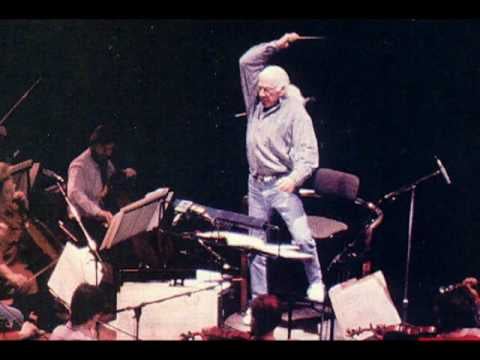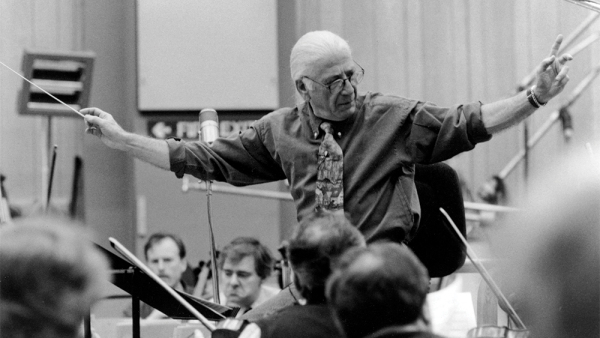
When he was a kid, Jerry Goldsmith loved going to the movies to enjoy the music – just the way I loved going to the movies as a kid to enjoy Jerry Goldsmith!
Goldsmith, born on this date in 1929, wrote indelible scores for dozens of films, such as “The Sand Pebbles” (1966), “The Blue Max” (1966), “The Flim-Flam Man” (1967), “Planet of the Apes” (1968), “Patton” (1970), “Papillon” (1973), “Chinatown” (1974), “The Wind and the Lion” (1975), “MacArthur” (1977), “The Boys from Brazil” (1978), “The Great Train Robbery” (1979), “Alien” (1979, butchered in sound editing), and “Star Trek: The Motion Picture” (1979).
For television, he wrote for “Dr. Kildare,” “The Twilight Zone,” “Gunsmoke,” “The Man from U.N.C.L.E.” and “The Waltons.”
By the 1980s, the films began to get weaker. It seemed like Goldsmith was always getting tossed the projects John Williams passed on, or cheap knockoffs of Williams’ successes. By his final decade, he was stuck writing for such garbage as “The Mummy” (1999), “The Haunting” remake (1999), and “Looney Tunes: Back in Action” (2003). A notable exception was “L.A. Confidential” (1997), but rarely were his later projects up to his talent.
Goldsmith had a reputation for being able to compose at white heat, so he was frequently called upon to write replacement scores for films like “The River Wild” (1994), “Air Force One” (1997) and “The 13th Warrior” (1999). He composed and recorded the score to “Chinatown,” one of the best of the 1970s, in only ten days.
Incredibly, he was honored with but a single Academy Award (of 18 nominations), for his influential score to “The Omen” (1976). Goldsmith died in 2004, at the age of 75. If he were to come back today, he would mop the joint with all the moody droners and computer noodlers, with their narrow palettes and paucity of inspiration.
Happy birthday, Jerry. I hope they’re still making good movies wherever you are.
Goldsmith discusses film music, circa 1986
Documentary from 1993
https://www.youtube.com/watch?v=qUemenAQYQ4
Introducing and conducting his music with the National Philharmonic in 1989
Introducing and conducting his music, and others’, with the BBC Concert Orchestra in 1994