Super Sunday! Of the great composers, none enjoyed football more than Dmitri Shostakovich. Russian football, that is (basically soccer). Shostakovich attended games whenever and wherever he could. He kept meticulous records of statistics and wrote articles for sports publications. He even became qualified as a referee. On one occasion he invited the entire Leningrad Dynamo over to his apartment for dinner.
In 1930, he composed a football ballet, “The Golden Age.” The scenario follows a Soviet team that falls victim to match rigging in the decadent West. The players are harassed by police and imprisoned by the evil bourgeoisie. Fortunately, the local workers overthrow their capitalist overlords and everyone lives happily ever after.
Shostakovich is said to have coined the phrase, “Football is the ballet of the masses.”
“The Golden Age” (1930) – fast-forward to the 55-minute mark for “Tea for Two.”
“Football” from “Russian River” (1945), composed for the NKVD Song and Dance Ensemble (the entertainment corps of the secret police!)
In America, everyone play football. In Soviet Russia, football play you!
PHOTOS: Shostakovich at the stadium, actually enjoying himself for a change
Today is the 100th anniversary of the birth of Azerbaijani composer Fikret Amirov (1922-1984).
Amirov was much decorated in Soviet Russia, awarded the Stalin Prize in 1949, honored as People’s Artist of the USSR in 1965, and the recipient of the USSR State Prize in 1980.
In 1959, he was one of several Soviet composers – including Konstantin Dankevich, Dmitri Kabalevsky, Tikhon Khrennikov, and Dmitri Shostakovich – who traveled to the United States at the invitation of the U.S. State Department, as part of a Soviet-American cultural exchange agreement, which had allowed American composers Roy Harris, Ulysses Kay, Peter Mennin, and Roger Sessions to visit the Soviet Union the previous year.
And look what I found! A 30-minute broadcast, “Aaron Copland Meets the Soviet Composers,” produced by WGBH Boston in 1959. Nicolas Slonimsky pitches a question to Amirov, and he responds, around 16:40. Shostakovich speaks around 12:00 and 24:00.
More recently, Yo-Yo Ma recorded “Kor Arab” (“Song of the Blind Arab”) with the Silk Road Ensemble.
In honor of Amirov’s centenary, I devoted “The Lost Chord” on Sunday night to two of his works: “Six Pieces for Flute and Piano” and selections from the ballet “Arabian Nights.” Here’s a link to my Facebook teaser.
If you happen to be in New York City tonight, there is a tantalizing program scheduled for Carnegie Hall, with the New York International Virtuosi Orchestra and pianist Nargiz Aliyarova. The concert, “Bridge of Friendship,” is dedicated to Amirov and will include music by Turkish, Azerbaijani, and Jewish composers. Among the selections will be Amirov’s “Azerbaijan Capriccio” and the U.S. premiere of the “Piano Concerto on Arabian Themes.” Alexander Markov will be the soloist in Mendelssohn’s Violin Concerto. You’ll find more information at the link.
Tikhon Khrennikov, in his role as Secretary of the Union of Soviet Composers, made life miserable for many of his more talented colleagues, especially Dmitri Shostakovich, Sergei Prokofiev, and Mieczyslaw Weinberg. In fact, cellist Mstislav Rostropovich, who was a big man, once stormed into Khrennikov’s office and gave him a good shaking by his lapels for being such an A-one a-hole.
But Khrennikov was also one of the great survivors. Following the death of Stalin in 1953, he managed to ride out each successive regime for four more decades, holding on to his influential post until the collapse of the Soviet Union.
There were some who claimed that Khrennikov was actually quite the sensitive fellow, who used his influence to quietly protect some of his more vulnerable colleagues. Whether or not that is true, I cannot say. He was a controversial figure, no doubt.
Just because Khrennikov was an artist doesn’t mean he was a nice person. All the same, I hope you’ll join me as I sample some of his music this afternoon, alongside that of his fellow birthday celebrants Heinrich von Herzogenberg and Frederick Loewe.
We’ll be seeing Red, between 4 and 7 p.m. EDT, on WWFM – The Classical Network and wwfm.org.
This Thursday morning on WPRB, we mark the centenary of the Russian Revolution with music by heroes, villains and victims of the mercurial Soviet system.
Dmitri Shostakovich, Sergei Prokofiev, Aram Khachaturian, Nikolai Myaskovsky, Vissarion Shebalin, Gavriil Popov, Alexander Mosolov, Mieczyslaw Weinberg, and Alfred Schnittke – none of them escaped censure, even as they were held up to the West as superior artists. We’ll hear a mix of their music, along with that of one of their primary antagonists, Tikhon Krennikov, who, in his role as Secretary of the Union of Soviet Composers, was responsible for much suffering.
The threat of imprisonment or even death hung over many of them, as they struggled to create great art in an environment of confusion and fear.
What a revolting development! We remember the Russian Revolution this Thursday morning from 6 to 11 EST, on WPRB 103.3 FM and wprb.com. Wakers of the world unite, on Classic Ross Amico!
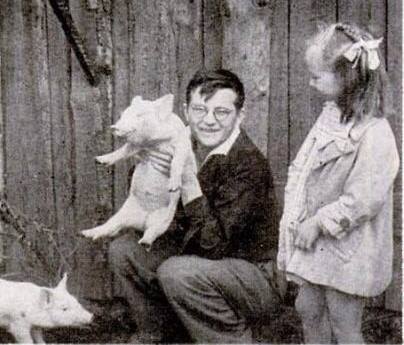
Not even Shostakovich’s fondness for pigs prepared him for Joseph Stalin.
This Thursday morning on WPRB, we’ll mark the centenary of the Russian Revolution, with music by composers who attempted to navigate an impossibly perilous course during the Soviet era.
We’ll hear Reinhold Gliere’s slightly embarrassing propagandistic runaway hit, “The Red Poppy,” in which enlightened Soviet sailors share their revolutionary spirit with oppressed coolies on the docks of Kuomingtang. We’ll also have a symphony by Tikhon Krennikov, who, in his role as Secretary of the Union of Soviet Composers, made life miserable for many of his more talented colleagues, especially Shostakovich, Prokofiev, and Mieczyslaw Weinberg.
There was scarcely anyone who was left untouched by the culture of fear. Even five-time Stalin Prize winner Nikolai Myaskovsky was condemned by the authorities for writing music of an anti-Soviet, anti-proletarian, and formalist bent. Gavriil Popov was attacked for his forward-looking Symphony No. 1. The experience drove him to alcoholism and relegated his considerable talent to Socialist Realist tub-thumpers.
Terrified, Prokofiev wrote his cantata “Hail to Stalin,” even as his wife was sent to the Gulag. He would never see her again. Alexander Mosolov, too, spent years in the Gulag, despite his earlier celebrity as one the new regime’s star futurists. Weinberg, a “rootless cosmopolitan” (Soviet speak for Jew), nearly lost his life. He was saved only by Stalin’s fortuitously timed death.
Among the true curiosities of the morning will be an historic performance of Tchaikovsky’s “1812 Overture,” in which the melody “God Save the Tsar” has been excised and replaced by a politically sanctioned snippet from Glinka’s opera, “Ivan Susanin” (ironically, once known as “A Life for the Tsar”). The performance will be led by the mercurial and magnetic Nikolai Golovanov. Golovanov, one of the most exciting conductors of the 20th century, showed up at the Bolshoi one day to be told he no longer had a job.
Hey, nobody said the New World Order was going to be easy. We’ll take a look at the public and private lives of the heroes, villains and victims of Soviet music, this Thursday morning from 6 to 11 EST, on WPRB 103.3 FM and wprb.com. It won’t be just the workers who are revolting, on Classic Ross Amico.