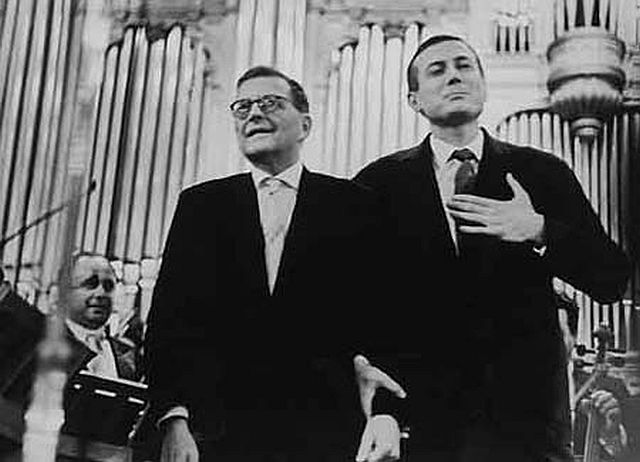
On Dmitri Shostakovich’s birthday, here’s some footage of the fleet-fingered composer knocking out a passage from his opera “Lady Macbeth from Mtsenk.”
This of course is the work that was lambasted in Pravda, following its premiere in 1936, as “muddle instead of music” – an assessment, said to have been Stalin’s own, that would have been enough to have given any Soviet artist the night sweats.
Sensing that he was walking on very thin Siberian ice, Shostakovich wisely suppressed his angry, dissonant, and frankly weird Fourth Symphony and launched into writing a Fifth, which he described as “a composer’s response to just criticism.” A good performance still has the power to exhilarate audiences, with its sense of hard-won triumph and the over-the-top grandiosity of its finale. But many have found in it a kind of shadow program that is rather more subversive.
In Solomon Volkov’s controversial “Testimony,” a memoir of challenged authenticity, assembled by Volkov from conversations with the composer, Shostakovich allegedly states, “I think it is clear to everyone what happens in the Fifth. The rejoicing is forced, created under threat, as in ‘Boris Godunov.’ It’s as if someone were beating you with a stick and saying, ‘Your business is rejoicing, your business is rejoicing, your business is rejoicing,’ and you rise, shaky, and go marching off, muttering, ‘Our business is rejoicing, our business is rejoicing.’”
How much of “Testimony” is Shostakovich, and how much is Volkov? The original manuscript, in which the composer signed off on the first page of each of the chapters, was sold to an anonymous collector and never made available for scholarly investigation. Furthermore, Volkov maintains his original notes are lost. (He is still living, at 79 years-old.) Whether or not the book is everything Volkov and his publishers claim it to be, it does have the ring of truth.
From the rollicking nature of the piano excerpt, one would never guess at the inflammatory nature of the opera, a provocative tale of sexual violence, adultery, and (multiple) murder. The video does remind one that Shostakovich once supplemented his income by accompanying films at the cinema.
The Symphony No. 4 did not receive its first performance until 1961, eight years after Stalin’s death.
Happy (?) birthday, Dmitri Shostakovich!
The clip, by the way, has been circulating on YouTube for quite some time as part of other compilations, like this one, in which Shostakovich plays, speaks, and smokes!
PHOTO: In America, people talk about news. In Soviet Russia, news talks about you!
When Shostakovich’s birthday elides with Yom Kippur, you get a very somber post indeed.
Shostakovich always felt a special kinship with the Jewish people and, while he himself was not of the faith, he pushed back against antisemitism, either overtly, defending friends and colleagues, such as the composer Mieczyslaw Weinberg, from persecution, or more stealthily, by embracing Jewish influences in his own music.
This took real courage, as Shostakovich’s own standing with the Soviet authorities was a precarious one. He would be condemned several times over the course of his career for “formalism,” an amorphous term that could be molded to suit anything that might be described as Western, modernist, or otherwise subversive to the cause of Socialist Realism – uncomplicated art of direct and inspirational nature, easily digestible to the proletariat.
In 1943, having scored a great patriotic success with his Symphony No. 7, the “Leningrad Symphony,” performed in the city during the actual siege, Shostakovich set to work on the more profoundly introspective Piano Trio No. 2. This he dedicated to the memory of his close friend Ivan Sollertinsky. Like Shostakovich, Sollertinsky had been evacuated from Leningrad, but he died suddenly in Siberia, of a heart attack, at the age of 41.
Shostakovich mourned as only he could. The Piano Trio shares in common with the later String Quartet No. 8 an inexorable, klezmer-influenced “danse macabre.” Among Sollertinsky’s many talents and pursuits – as a musicologist, a critic, a linguist, a professor, and the artistic director of the Leningrad Philharmonic – he was an ardent enthusiast of the music of Gustav Mahler.
It was also a time, with the retreat of the Nazis from the Eastern Front, when the horrors of the camps at Majdanek and Treblinka were just becoming known. It’s been observed that the klezmer influence may also be an allusion to Sollertinsky’s birthplace of Vitebsk, where a Nazi massacre of Jews had taken place in 1941.
Shostakovich’s political capital must have been high, because the work was awarded a Stalin State Prize in 1946.
In 1948, things were considerably shakier, as Shostakovich had been denounced, under the Zhdanov decree, for the second time. Furthermore, it was a period of heightened antisemitism in the Soviet Union, as Stalin targeted Jewish intellectuals and artists. So it was at great personal risk to himself that Shostakovich conceived the song cycle “From Jewish Folk Poetry.” Unsurprisingly, the songs were not given their first public performance until 1955, two years after Stalin’s death. However, the first eight of them were performed at a private birthday celebration at the composer’s home in August of 1948.
While Shostakovich’s on-again, off-again history with the Soviet authorities made him justifiably cautious, the String Quartet No. 4 grew out of a newfound confidence, the result of Stalin having personally selected him as a cultural ambassador to the West. He would travel to the United States for the first time, as part of a Soviet delegation to a “Cultural and Scientific Congress for World Peace,” on March 25, 1949. As always, the situation had to be navigated very carefully. A sign of favoritism from Papa Joe often had the effect of setting a recipient up for a very big fall.
Still, Shostakovich was determined to leverage his new-found currency. He took the opportunity to persuade Stalin that if he were going to be sent out into the decadent West, then perhaps it would be a good idea to lift the ban on performances of his music at home. Otherwise, the situation might appear a little peculiar to outsiders. Stalin recognized the logic in this, and Shostakovich was rehabilitated.
Shostakovich was not by any measure a stupid man. Yet the artistic impulse was not to be denied. He wasted no time in embarking on a new string quartet, which he loaded up with inscrutable subtexts, Jewish folk songs, and all sorts of things that had a history of angering the “wise leader and teacher.” Fortunately for the composer, after the quartet was played before a small audience of increasingly uneasy friends on May 15, 1950, they convinced him not to allow it to be performed publicly, and he prudently put it away in a drawer for another day. That other day would come on December 3, 1953 – nine months after Stalin was safely interred.
Even with the death of Stalin, the skies did not entirely clear. As late as 1962, there was political blowback, when Shostakovich decided to set poetry by Yevgeny Yevtushenko in his Symphony No. 13, known as the “Babi Yar” – the site of another sustained massacre of Jews in 1941. Yevtushenko at the time had become the object of a campaign to discredit him for supposedly placing the suffering of the Jewish people above that of Russians. Khrushchev himself threatened to halt the symphony’s performance. In the event, the premiere was tense, but the audience was sympathetic and the occasion was a triumph. However, by the third performance, Yevtushenko had supplied revisions to the text for some of the more controversial passages.
Whether as an act of solidarity or a gesture of subversion, Shostakovich would often incorporate Jewish music or treat Jewish subjects in his major works. How could he not empathize with a people who had endured such suffering, yet expressed themselves so poignantly in music?
Happy Yom Kippur birthday, Dmitri Shostakovich.
Piano Trio No. 2, with Shostakovich at the piano
String Quartet No. 4
“From Jewish Folk Poetry,” with Shostakovich at the piano
Symphony No. 13 “Babi Yar,” with Yevtushenko’s original texts
PHOTO: Shostakovich and Yevtushenko at the premiere of the Symphony No. 13 “Babi Yar”