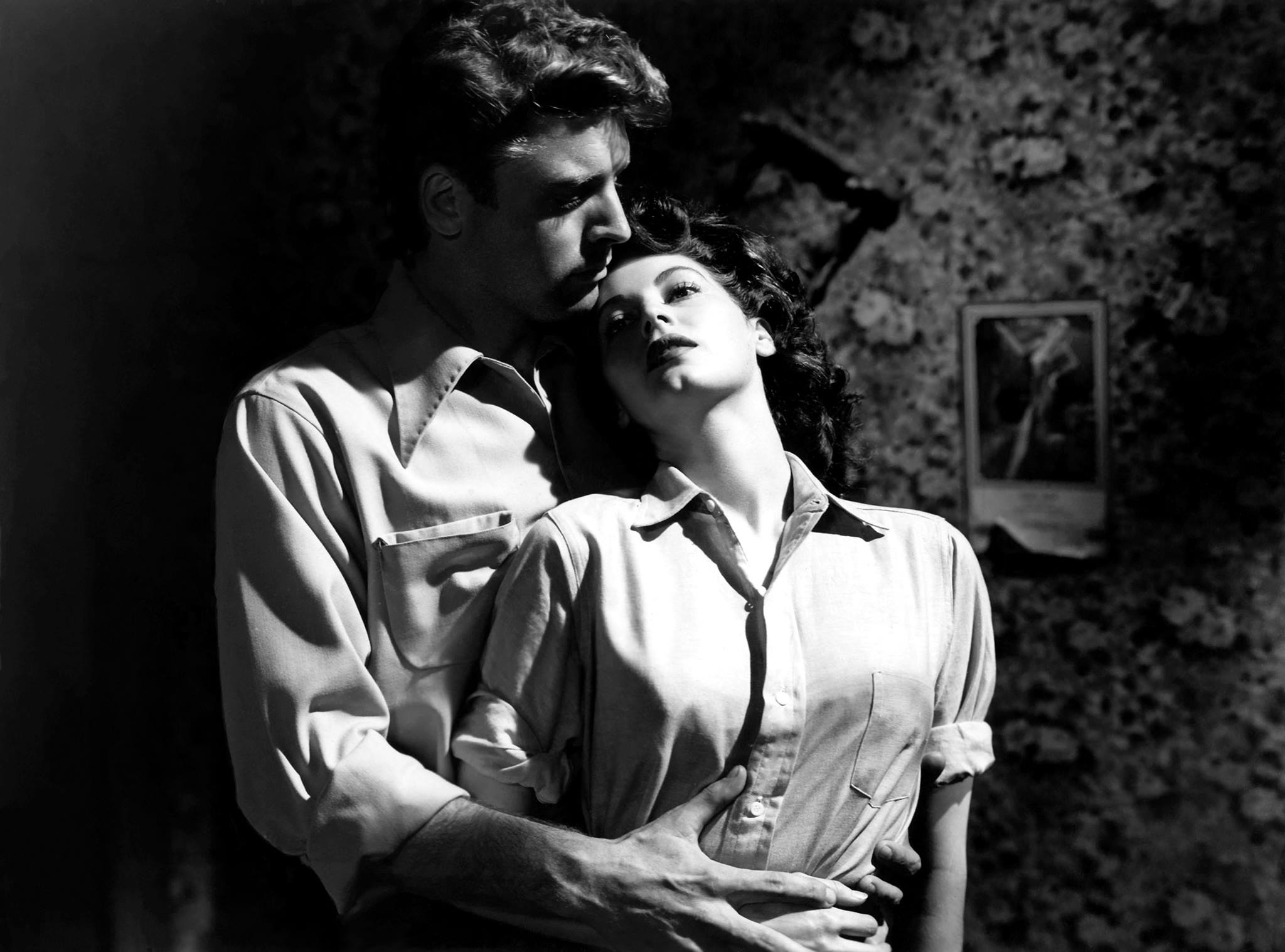
Nick sat down against the charred stump and smoked a cigarette. He lit a match and watched it burn and as it burned he thought of boxers and marlins and the Spanish Civil War. The stories were brave and strong and good. He ordered a mojito and prepared to face the music.
This week on “Picture Perfect,” the focus is on Ernest Hemingway.
Seemingly at odds with Hemingway’s minimalist, “iceberg” style, big screen adaptations of the writer’s work show what the stories don’t tell. In the case of 1946’s “The Killers,” the screenwriters unapologetically just made stuff up, an entire back story explaining the motivations for the hit of boxer “Swede” Anderson. Fortunately, those screenwriters happened to include an uncredited John Huston, who virtually codified noir with “The Maltese Falcon.”
“The Killers” provided Burt Lancaster with his break-out role. It also features a knock-out score by Miklós Rózsa, in which he uses the dum-dee-dum-dum motto later made famous by the television series “Dragnet.”
In 1977, George C. Scott reunited with his “Patton” director, Franklin J. Schaffner, for an adaptation of Hemingway’s posthumously published novel, “Islands in the Stream.” Scott gives one of his best performances as a Hemingway-like figure living on a Caribbean island. “Patton” composer Jerry Goldsmith wrote the music. Goldsmith spoke of it often as his favorite score.
Hemingway himself handpicked the leads for the 1943 adaptation of “For Whom the Bell Tolls,” with Gary Cooper and Ingrid Bergman falling in love against the backdrop of the Spanish Civil War. The music was by the prolific and versatile Victor Young.
And finally, Spencer Tracy is the whole show, as he faces off against a large marlin, in the 1958 version of “The Old Man and the Sea.” Dimitri Tiomkin’s music earned him his fourth Academy Award.
Join me for an hour of laconic grace and stoic manliness on “Picture Perfect,” music for the movies, now in syndication on KWAX Classical Oregon!
———-
Clip and save the start times for all three of my recorded shows:
PICTURE PERFECT, the movie music show – Friday at 8:00 PM EDT/5:00 PM PDT
SWEETNESS AND LIGHT, the light music program – Saturday at 11:00 AM EDT/8:00 AM PDT
THE LOST CHORD, unusual and neglected rep – Saturday at 7:00 PM EDT/4:00 PM PDT
Stream them, wherever you are, at the link!
https://kwax.uoregon.edu/
Tag: Spencer Tracy
-
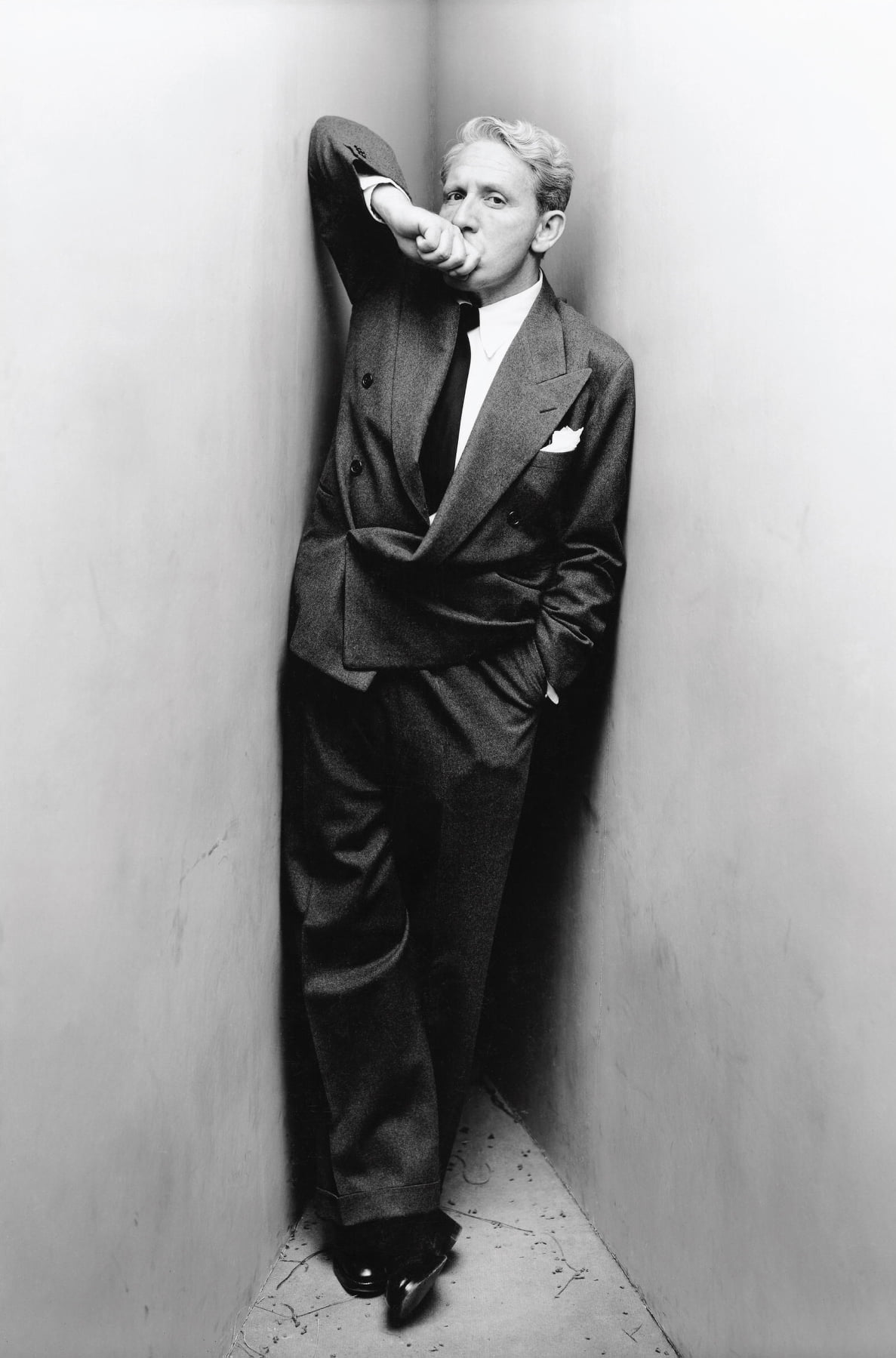
Irving Penn’s Corner: Portraits of Tracy & Stravinsky
Nobody puts Baby in a corner! But Irving Penn did, seemingly, just about everyone else.
I stumbled across a Spencer Tracy biography the other day. On its cover is a photograph of Spence, left hand in his pocket and the right in front of his mouth, elbow held high, as he leans into an unusually severe corner. Right away, I was struck by its similarity to a famous portrait of Igor Stravinsky.
A brief search yielded Stravinsky, with legs crossed casually, hand held to a cocked ear. It wasn’t necessary to examine the two side by side. Unmistakably, it was the work of same photographer. The discovery spurred me to find out more about Irving Penn.
Penn, born in Plainfield, NJ, in 1917, attended the Philadelphia Museum and School of Industrial Art – now the University of the Arts – from 1934 to 1938. There he studied drawing, painting, graphics, and industrial arts under Alexey Brodovitch. Brodovitch was art director at Harper’s Bazaar. He proved to be a good contact. Harper’s was publishing Penn’s work before he even graduated.
Penn worked for a time as a freelancer, then succeeded Brodovitch as art director at Saks Fifth Avenue. Then he took off for a year to paint and take photographs in Mexico and across the U.S. When he returned to New York, he received an offer to join the art department of Vogue magazine. Before long, his photographs began to appear on the cover.
During World War II, he was courted by the Office of War Information in London, but decided to volunteer for the American Field Service instead. His assignments took him to Italy and India. He drove an ambulance, and he took more photos.
Throughout his career, he continued to contribute covers, portraits, still lifes, fashion photography, and photographic essays to Vogue. He also founded his own studio.
In 1948, he began to invite famous subjects to that studio, where they would be photographed in an acute corner formed of two flats. He made portraits of writers, artists, athletes, dancers, actors, political figures, and socialites. Of course, what I find most interesting are the musicians.
In addition to Stravinsky, there was Duke Ellington, Jascha Heifetz, Arthur Rubinstein, Yehudi Menuhin, Vittorio Rieti (with George Balanchine), Louis Armstrong, Noel Coward, Kay Thompson and the Williams Brothers (including Andy), and Maurice Chevalier.
Irving photographed more than just these, of course. But these are the ones he put in a corner, Baby.
Penn portraits: Speak-no-evil (Tracy) and Hear-no-evil (Stravinsky)
Tag Cloud
Aaron Copland (94) Beethoven (95) Composer (114) Film Music (149) Film Score (143) Film Scores (255) Halloween (97) John Williams (197) KWAX (232) Leonard Bernstein (105) Marlboro Music Festival (125) Movie Music (164) Mozart (91) Opera (215) Philadelphia Orchestra (90) Picture Perfect (174) Princeton Symphony Orchestra (110) Radio (90) Ross Amico (244) Roy's Tie-Dye Sci-Fi Corner (290) The Classical Network (101) The Lost Chord (269) Vaughan Williams (107) WPRB (397) WWFM (881)