
Our govoreeting about Stanley Kubrick’s “A Clockwork Orange” (1971) purred away real horrorshow last night, with angel trumpets and devil trombones, and some dobby clips from past episodes to celebrate my third anniversary on Roy’s Tie-Dye Sci-Fi Corner. It was gorgeousness and gorgeousity made flesh. The very thing for leering and smacking over eggiwegs and lomticks of toast, my brothers. Viddy well!
Tag: Stanley Kubrick
-

A Clockwork Orange: Funny or Frightening?
With my lifelong love of classical music – and subversive sense of humor – one might well wonder why it’s taken us so long to get around to discussing “A Clockwork Orange” (1971). Stanley Kubrick’s controversial adaptation of Anthony Burgess’ novel presents an intelligent young sociopath who gets up to all sorts of hooliganism while worshipping Beethoven. We’ll talk about it this week on “Roy’s Tie-Dye Sci-Fi Corner.”
Oscar Wilde wrote, “There is no such thing as a moral or an immoral book. Books are well written or badly written. That is all.”
One could just as easily apply Wilde’s maxim to Kubrick’s film. Both film and book portray acts of “ultra violence” that, by all rights, should be both horrific and repellent, and yet Kubrick presents the material in such a way that the story comes across, basically, as a black comedy. And there’s the rub.
The film is actually quite funny, in a twisted sort of way, with deliberately outrageous costumes and set design, grotesque cinematography, and exaggerated performances. Electronically-altered Beethoven and hyperkinetic Rossini grace the equally over-the-top soundtrack. And then there’s Gene Kelly.
We’re like Alex and his droogs, exceeding all speed-limits, on a nocturnal joyride in a stolen supercar. When all at once we’re brought up short by the content of a particular scene that we know should be horrifying, suddenly we’re conscious of the inappropriateness of the rigored smile on our lips. That’s when the movie becomes truly disturbing.
Kubrick subjects us to an inversion of Alex’s rehabilitation therapy, in which we find a peculiar enjoyment in violence, but then the therapy is reversed, so that we realize how monstrous we’ve allowed our sympathies to become. It’s a great trick, Kubrick turning a cold lens on the viewer. It’s the most subversive element in a film that seems to embrace subversion.
The peel of “A Clockwork Orange” turns out to be a multilayered one. There are all sorts of interesting questions raised about free will, government, science, correctional institutions, violence and objectification, and yes, morality. Watching “A Clockwork Orange” is like being stretched around inside a taffy puller. Yet somehow, it’s also very, very funny. To some.
Over the years, I’ve come to realize there are those who are not equipped to take the journey: basically those who see no humor in it at all. These fall into two categories: those who find the characters’ behavior too difficult to watch; and those who glorify and emulate it. It’s a movie that inspired copycat crimes, and which became a popular defense among attorneys arguing for lighter sentences for their juvenile clients. Kubrick himself had it pulled from distribution in the U.K., where he made his home, after receiving multiple death threats. The film is especially attractive to young people, which is why you still see so many Little Alexes strolling around college campuses at Halloween.
Should we blame the movie for celebrating violence? Or is, in fact, “A Clockwork Orange” neither moral nor immoral? It’s a film that plays with our perceptions by forcing us to acknowledge some nauseating truths – holding our eyes open, as it does Alex’s – even as we laugh at some very inappropriate jokes.
For the politically correct, I’m guessing, it’s a film that has aged very badly; but for students of human nature, it’s all too up-to-date.
Just one man’s analysis. There’s plenty of food for thought, as we mark my third anniversary as neither a moral nor an immoral co-host on Roy’s Tie-Dye Sci-Fi Corner. Orange you eager to be in the comments section? We’ll be there like “Clockwork,” as we livestream on Facebook, YouTube, etc., this Friday evening at 7:30 EDT.
https://www.facebook.com/roystiedyescificorner
Viddy well, little brothers!
Did you know that Anthony Burgess himself was a composer? In fact, he considered himself as much a composer as a writer. You can check out his “Petite Symphonie pour Strasbourg” here:
A rediscovered Cello Sonata, appropriate Memorial Day, it turns out, since the slow movement bears the dedication “For the Dead 1939-45.”
Burgess works for piano
-
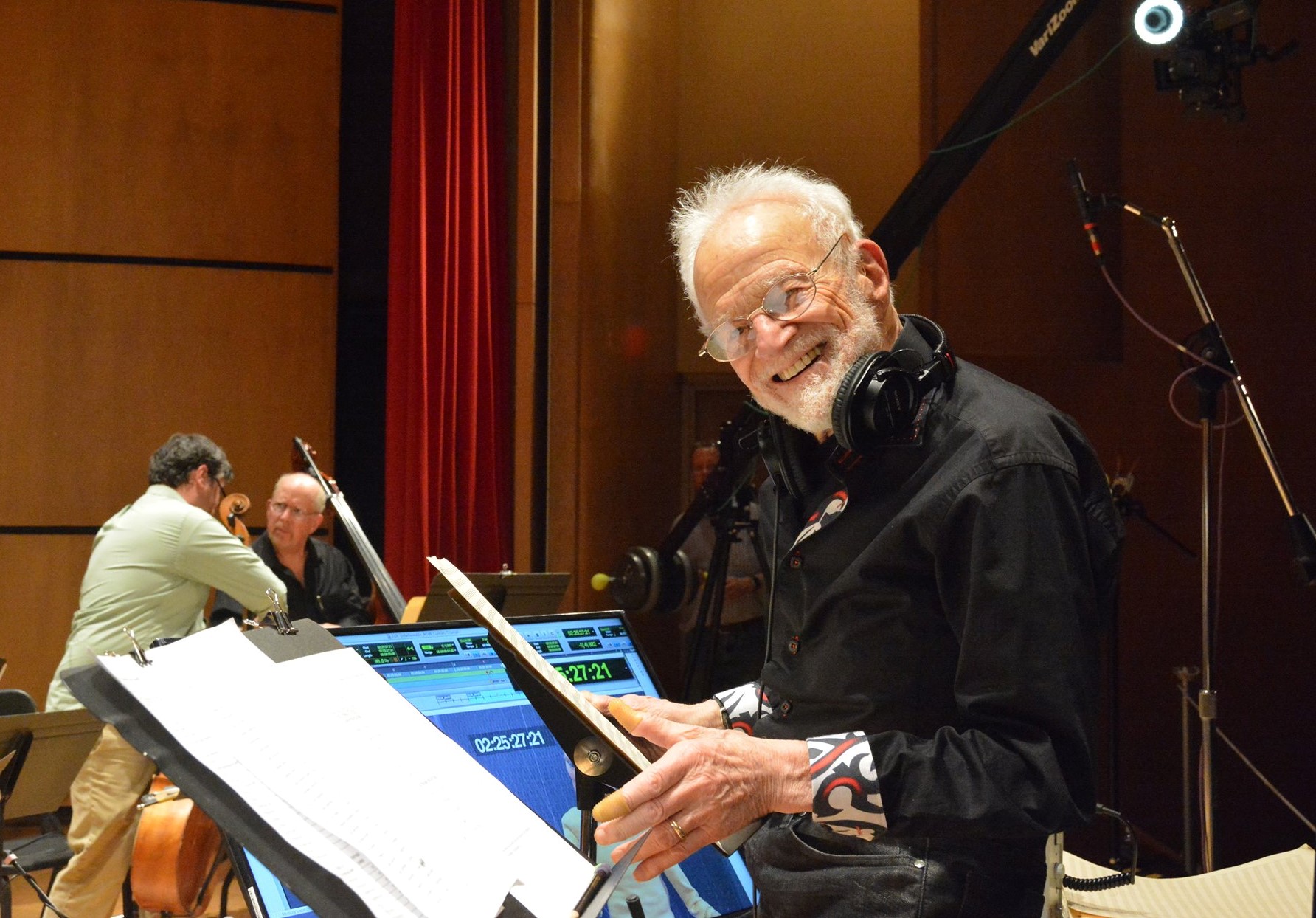
Remembering Gerald Fried Star Trek Composer
I am very sorry to learn that Gerald Fried has died.
Fried was the composer of nearly 300 film and television scores.
A schoolmate of Stanley Kubrick, he provided the music for the director’s earliest projects (up until “Spartacus”). The best known of these are “The Killing,” with Sterling Hayden, and “Paths of Glory,” with Kirk Douglas.
His fruitful collaborations with producer David L. Wolper yielded “Birds Do It, Bees Do It,” which earned Fried an Academy Award nomination, and the landmark miniseries “Roots,” which won him an Emmy.
He composed original music for five episodes of “Star Trek, in its original series incarnation, including those for fan favorites “Shore Leave” and “Amok Time” (source of the much-parodied “Star Trek fight music”). Selections from these scores were recycled in subsequent installments of the series.
He also contributed to “Riverboat,” “Shotgun Slade,” “Gilligan’s Island,” “The Man from U.N.C.L.E.,” “Mission: Impossible,” and many others.
Between 1948 to 1956, Fried was principal oboist of the Dallas Symphony Orchestra and the New York Little Orchestra.
His final film project was the science fiction parody “Unbelievable!!!!” in 2020. In his later years, he also wrote screenplays.
In 2021, we were very lucky to have him as a guest on Roy’s Tie-Dye Sci-Fi Corner. Roy characterizes his appearance as a very special interview. I concur. He impressed me as a kind and generous man.
At the time of his death, Fried was 95-years-old. R.I.P.
Fried performs music from three of his classic “Star Trek” scores – including the iconic fight music from “Amok Time”:
Finnegan
Ruth
Spock vs. Kirk
“Paths of Glory”
“Birds Do It, Bees Do It”
Fried and family perform music from “Roots”
Gerald Fried conversing with us on “Roy’s Tie-Dye Sci-Fi Corner”
-
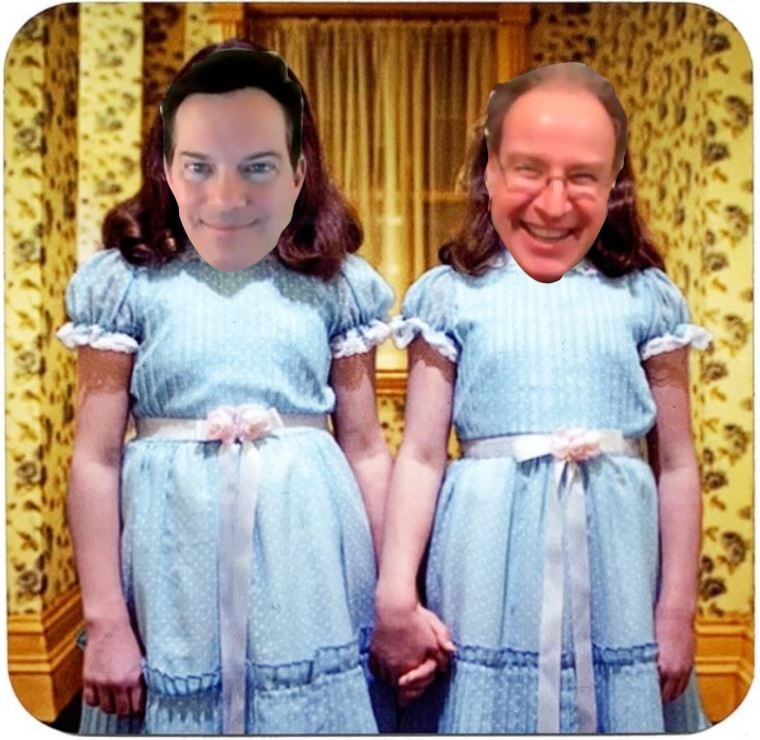
The Shining Layered Horror or Gilded Lily?
Is “The Shining” (1980) the most layered horror movie ever made? Or is it one of cinema’s most flagrant examples of gilding-the-lily? Are the two necessarily exclusive?
Roy and I grope our way through some the film’s dichotomies, as we talk “forever and ever and ever” about Kubrick, cast, and music. You might say we take a shine to “The Shining” during last night’s discussion, on Roy’s Tie-Dye Sci-Fi Corner, archived here:
Tomorrow, Roy will fly solo as he welcomes guests David Hirsch and Tim Mallett, who will talk about their work on “Super Space Theater,” a collection of high-definition restorations of four “Space: 1999” movies. Learn more about it, when they livestream on Facebook at a special time, this Sunday afternoon at 3:00 EST!
-
The Shining Telepathic Deep Dive
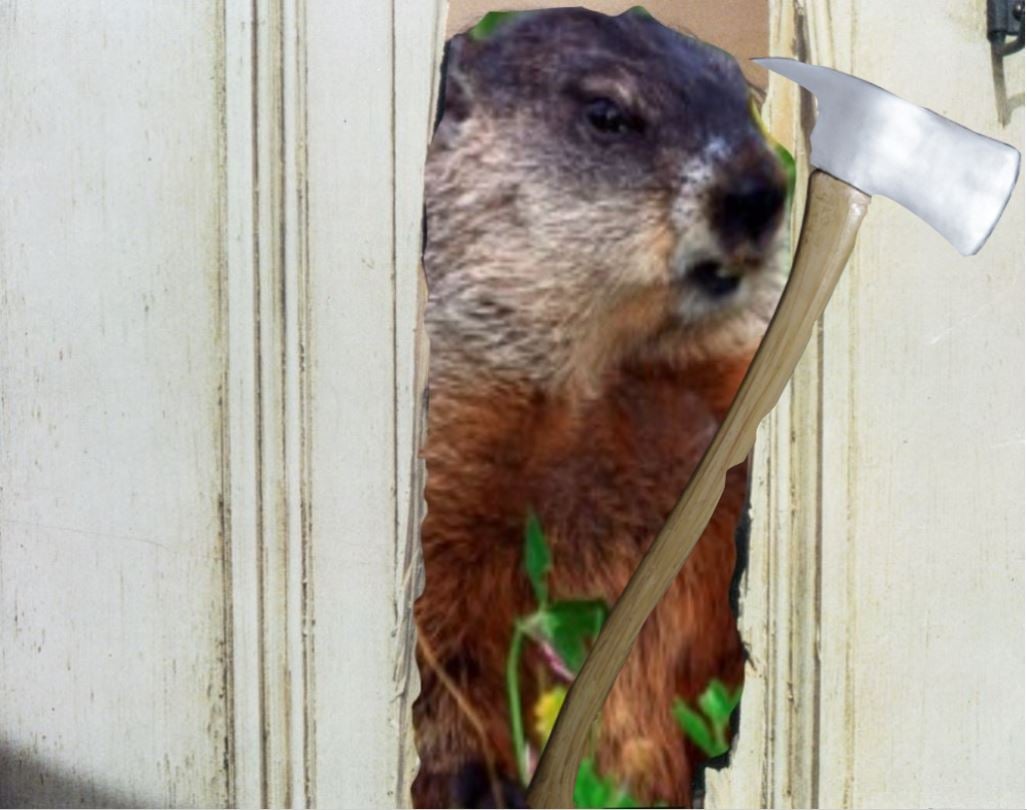
When the Groundhog forecasts six more weeks of winter, what do we do but hop a snowcat to the Overlook Hotel.
On the next “Roy’s Tie-Dye Sci-Fi Corner,” join us for a telepathic discussion of “The Shining” (1980). Stanley Kubrick builds his house on a foundation of sand – or an Indian burial ground, as the case may be (revealed in the first ten minutes of the film, so I’m not spoiling anything) – and ups the ante by casting an over-the-top Jack Nicholson, who’s obviously bananas from the start. Clearly, this is a director who savors a challenge.
Stephen King, upon whose book the film was based, has had a complicated history with this adaptation. Still, somehow, in spite of itself, “The Shining” has managed to achieve iconic status, routinely ranked toward the top of lists of the greatest horror films ever made and selected for preservation by the Library of Congress as being “culturally, historically, or aesthetically significant.”
All praise and no criticism makes Jack a dull boy. We’ll be gazing through the mirror at our REDRUM, on the next Roy’s Tie-Dye Sci-Fi Corner. Tear around the corridors on your Big Wheel in the comments section, when we livestream on Facebook, this Friday evening at 7:00 EST!
Tag Cloud
Aaron Copland (94) Beethoven (95) Composer (114) Film Music (149) Film Score (143) Film Scores (255) Halloween (97) John Williams (197) KWAX (232) Leonard Bernstein (105) Marlboro Music Festival (125) Movie Music (164) Mozart (91) Opera (215) Philadelphia Orchestra (90) Picture Perfect (174) Princeton Symphony Orchestra (110) Radio (90) Ross Amico (244) Roy's Tie-Dye Sci-Fi Corner (290) The Classical Network (101) The Lost Chord (269) Vaughan Williams (107) WPRB (397) WWFM (881)