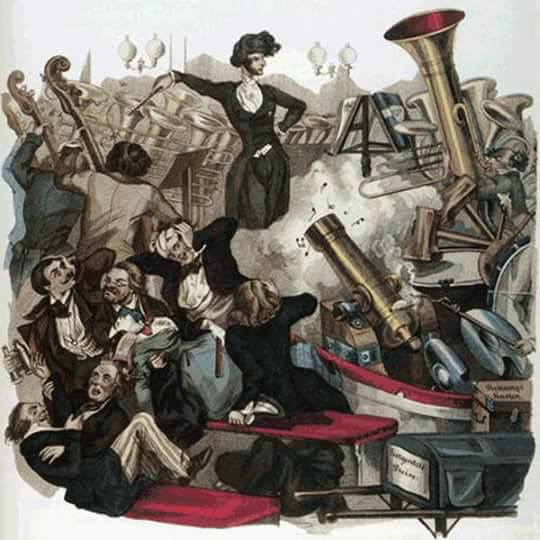
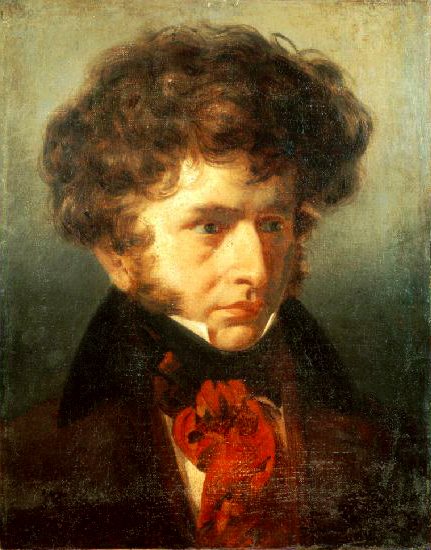
Tag: Symphonie fantastique

  • Berlioz’s Crazy Genius at Bard Festival

    Berlioz’s Crazy Genius at Bard Festival

    Hector Berlioz was not the kind of guy to always go about things the way you might expect. For instance, if you wanted to impress a prospective lover, would you think it would be in your best interest to write a programmatic symphony, in which your obsession with her drives you to overdose on opium? Then, under its influence, to dream about murdering her, so that you’re condemned to execution by the guillotine? Then to vividly illustrate being tormented in the Hereafter by her spirit, now transformed into a jeering, cackling witch?

    Well, Berlioz, arch-Romantic that he was, was a guy who followed his gut. And what do you know, it worked! The Shakespearean actress Harriet Smithson, who inspired the piece (even though Berlioz didn’t speak English and she couldn’t speak French), said “I do.” Some chicks dig the crazy.

    Not that they lived happily ever after. I know, who could have predicted it?

    Anyway, this is the backdrop to Berlioz’s “Symphonie fantastique,” his most famous work, and it kicked off the Bard Music Festival, “Berlioz and His World,” at Bard College’s Fisher Center for the Performing Arts on Friday night. Leon Botstein, founder and co-artistic director of the festival (and president of Bard College), conducted The Orchestra NOW (TON for short), Bard’s graduate-level training orchestra.

    As is so often the case, if you own a recording of the piece, for as transporting as it might be, it just isn’t the same as hearing it live. Reencountering Berlioz’s forward-looking symphony (which must have caused heads to explode in 1830) blew my hair back, or what’s left of it, again and again. It’s hard to believe I once had a coif every bit as impudent as the composer’s. Why, it seems like only yesterday…

    But I digress.

    With its faltering chromatic harmony, beefed-up orchestra (for the period), Beethovenian length, and outlandish instrumental effects, it pushed the envelope decades into the future. Wagner (among others) glommed onto Berlioz, but the composer’s legacy truly flourished with the generation of Gustav Mahler, nearly 70 years later. That’s an entire lifetime. His concept of the “idée fixe,” a recurring motif that intrudes on the flow of every movement, signifying unbidden remembrances of the composer’s beloved, was also influential.

    On to the performance at hand: I may have heard wilder ones, but none quite so visceral. With the strings at stage level, the rowdier instruments were positioned on risers, and the bass drums in particular were like volcanoes that exploded into the audience. The chimes that herald the “Dies Irae,” a presentiment of the doom if ever there was one, were immediate and chilling. It was great fun to watch the strings put through their diabolical repertoire of col legno, con sordino, pizzicato, tremolo, and double stopping, and the ensemble was able to bring the energy to put the piece over the top and bring a sense of abandon at its peak moments.

    Also notable was the inclusion of the obbligato cornet in the second movement, the one in which composer’s pangs of longing contrast with the spirited whirl of festivity at a ball, a touch seldom employed. Apparently Berlioz added the cornet (perhaps for the virtuoso Jean-Baptiste Arban), but it never made it into the published score in the composer’s lifetime. I love you, Berlioz, but in this instance I think your original conception was best. For me, the cornet brings unfortunate associations with the gazebo or the boardwalk, and also obscures the elegance of this waltz through the composer’s haunted mansion – but it was ear-opening to hear the alternative version for once at Bard. Part of the festival’s mission, after all, is to be a platform for scholarly inquiry and display. If the movement were going to be done this way, this was definitely the context in which to do it. (I believe the cornet soloist was Jid-anan Netthai, but this I will have to confirm.)

    I confess, I had my reservations about starting the festival with such a substantial and well-known piece. When the program was first announced, I was puzzled as to why Bard, known for its exploration of unusual and the neglected repertoire, would open its festival with Berlioz’s greatest hit. But in the event, it certainly paid off and got blood pumping. I also realized after a moment’s reflection, its inclusion provided the necessary context for the full appreciation of the seldom-encountered “Lelio,” which was heard on the second half of the concert.

    A sequel of sorts to the “Symphonie fantastique,” “Lelio, or the Return to Life” comes across as a much more self-indulgent affair, if only because of the extensive dramatic commentary allotted to the narrator. Again, this is a heavily autobiographical piece. Unfortunately, if you take away all the lofty references to art and Shakespeare, it’s basically the whiny “reflections” of a lovelorn 20-something.

    The Bard presentation made it even more so. I have nothing against Babe Howard (the son of Debra Winger), who was presumably a late substitute for the scheduled narrator, Wyatt Mason, and I wish him all the best with his career. But here he came across as sorely miscast and underprepared, to the extent of not perhaps fully understanding the character of the figure he was meant to portray. I can think of no lower compliment than to say that I could have done it just as well myself. (I too spent much of my twenties as lofty, whiny, and lovelorn.) For me, it was just too much of a stretch to accept him as the convincing alter ego of a seething, half-mad artist, emerging from an opium-induced nightmare to grasp his breaking heart. About the only thing he played convincingly was young. Also, he didn’t impress me much as an actor accustomed to appearing on the stage. That’s not to say the technique will not come, but I imagine he would be much more at home in something more contemporary.

    That aside, the music was fascinating, and very well performed. Having previously known “Lelio” only from recordings – especially Jean Martinon’s, in which the narrator delivers his part in French – it was as if the scales had fallen from my eyes. THIS is what Bard is all about! I’ve aired the concluding “Fantasy on Shakespeare’s ‘The Tempest’” on my radio shows many times, but I had no idea the entire score was so varied and beautiful, with the quality of the music quite high. That said, it’s impossible that it will ever secure a place in the public’s affection equal to that enjoyed by the “Symphonie fantastique,” especially as presented here, as the composer originally intended, emulating the salon format, so popular in that era, but also in the guise of a melodrama, a largely-defunct genre in which narration and music are combined to form a cohesive dramatic statement.

    As always, the Bard Festival Chorus and vocal soloists were first-rate, with bass-baritone Alfred Walker delivering a lusty “Brigands’ Song” and tenor Joshua Blue (who returned on Saturday night to solo in Berlioz’s “Te Deum”) lending further allure to “The Fisherman Ballad” and the “Song of Happiness.” The cumulative effect was one of magnification of the impressive range of Berlioz’s genius, which ranges well beyond the heaven-storming orchestral works that are so well known, especially as a composer for voice.

    I pause to wonder: whatever happened to the brigand, anyway? It’s a career that seems to have gone the way of the melodrama.

    All in all, a rewarding, often captivating, and at times even thrilling evening, and presented in a manner that Bard has perfected over the past 33 seasons. Bravo, and more, please!

    The Bard Music Festival continues through August 18. For more information, follow the link.

    https://fishercenter.bard.edu/whats-on/programs/bard-music-festival/

    Fisher Center at Bard

  • Berlioz: Underappreciated Romantic?

    Berlioz: Underappreciated Romantic?

    Is Hector Berlioz the Rodney Dangerfield of composers? *

    Despite being one of the foremost musical representatives of the Romantic era, let’s face it, Berlioz gets little respect. Or at least that was the case for much of his life and the decades following his death.

    Now he’s about to receive the full treatment from the Bard Music Festival. (More on that below.)

    Before recordings, assessments of Berlioz’s music leaned heavily on hearsay, a game of Whisper Down the Lane, distorted by prejudice, misperception, and so-called received wisdom. Even during his life – ESPECIALLY during his life – his music was met with confusion, opposition, and often outright hostility. So it always is with the new.

    And Berlioz was nothing if not original. If there was ever a composer who was ahead of his time, it was Hector Berlioz.

    Thankfully, this visionary artist has long since been vindicated. Enthusiasts are very enthusiastic indeed. But there remain those who are unconverted among the listening public. Because, let’s be honest, emerging as he did in the Paris of Boieldieu, Auber, and Meyerbeer, Berlioz was just weird. He’s still weird. With his moodiness, quirky orchestration, and willingness to shatter the rules in order to achieve his desired effects, he was a flagrant outcast among French composers. His cause was not helped by inept performances and push-back from the hidebound faculty of the Paris Conservatory (overseen by Luigi Cherubini).

    It’s interesting that this arch-Romantic worshipped at the altars of Gluck and Spontini. He felt everything so very deeply; he experienced everything so keenly, especially music. He was particularly transported by the noble simplicity of his heroes’ operas.

    On the other hand, he was also a champion of Paganini, whom he befriended in the violinist’s retirement, though he never heard him perform. (If only there had been recordings!) Paganini, of course, was legendary for his gymnastic manipulation of his instrument, as was Franz Liszt, of the piano – Liszt also admired by Berlioz. (The admiration was reciprocated.) These gentlemen could be as indulgent as Gluck and Spontini were chaste.

    Berlioz’s reaction when his fiancée broke off their engagement was more Dionysian than Apollonian. He formulated a murder-suicide plot every bit as over-the-top as something out of Alexandre Dumas (also his contemporary). It involved a vertiginous coach ride back from Italy, unlikely disguise – crossdressing, complete with a veil – and a contingency plan to administer poison in the event his pistols jammed or misfired. Thankfully, the composer’s head cooled once he discovered he had forgotten his dress.

    Since performances were scarce and often substandard, Berlioz earned much of his livelihood through his writings. And Berlioz was not one who was bashful about speaking his mind. His amusing and withering assessments, often couched in wry observation and sarcasm, earned him many enemies. He was in no way cut out for what he perceived – often rightly – as the superficiality of Paris, yet he loved and thrived on the city, and he would not leave. He was much better-received in London, and he entertained the idea of moving, but Paris was in his blood.

    Now, of course, we are blessed with recordings and radio broadcasts. Some of Berlioz’s works are standard repertoire. It is now easy to acquaint oneself with his eccentric symphonies – often symphonies, in the classical sense, in name only – his choral works, his songs, and his operas. His greatest hit, the “Symphonie fantastique,” loses some of its punch, unavoidably, through overexposure and the anesthetizing effect of all the developments in music since, but it will never be entirely free of its strangeness, thank goodness.

    “Harold in Italy,” the “Queen Mab Scherzo” (from the “Romeo and Juliet” Symphony), “The Damnation of Faust,” and some of the overtures, especially “Roman Carnival,” are here to stay.

    Lesser known are the cantatas, the songs, and some of the hybrid works, such as the melodrama “Lélio, or The Return to Life,” a sequel of sorts to the “Symphonie fantastique.”

    “Lélio” will receive a rare performance on a double bill with Berlioz’s most famous symphony – which itself concludes with a hair-raising evocation of a witches’ sabbath (that incorporates that horror movie staple, the “Dies Irae”) – to kick off this year’s Bard Music Festival. “Hector Berlioz and His World” will take place at Bard College in Annandale-on-Hudson, NY, August 9-18.

    Rarely-performed is what Bard does best, so there will be ample opportunities to enjoy musical curiosities. Morning and afternoon concerts will feature chamber music and songs; evening concerts will lean into the orchestral and choral works. Berlioz’s song cycles “Irlande” (“Ireland”) and “Les nuits d’’été (“Summer Nights”) will be performed, as will his monumental “Te Deum” and “The Damnation of Faust” (complete).

    The addendum “His World” will encompass music of his contemporaries, but also that of his influences and those he in turn influenced. Pauline Viardot’s opera, “Le dernier sorcier” (“The Last Sorcerer”), will be heard; also Louise Farrenc’s Symphony No. 3, Joachim Raff’s Symphony No. 10 “Autumn,” and Liszt’s transcription of Berlioz’s “Harold in Italy” for viola and piano.

    Bard being Bard, there will also be a concert devoted to “Berlioz’s Transformation of the World of Sound,” the program spiraling off into unsuspected territory, exploring works by Edgard Varèse, Olivier Messiaen, Luciano Berio, Steve Reich, and György Ligeti.

    As always, there will be pre-concert talks, scholarly symposia, and plenty of Berlioz merch for purch (including, but not limited to, the festival t-shirt and a book of critical essays compiled specifically for the occasion).

    The American Symphony Orchestra and The Orchestra Now (TŌN) will perform, under their music director, Leon Botstein (also the president of Bard College). In the afternoons, performers are drawn from Bard’s deep well of faculty, alumni, and visiting artists. This is not just a college music festival. I’ve seen some world-class artists and first-rate chamber ensembles there, including Christine Goerke, Stephanie Blythe, Nicholas Phan, pianists Piers Lane and Danny Driver, the Parker Quartet, and the Horszowski Trio, to name a few), along with the occasional actor, such as Michael York and David Straitharn.

    As always at Bard, you get out of it whatever you put into it. If total immersion is your thing, by all means, go for it. The festival is designed with you in mind. However, not to the exclusion of anyone who just wants to go and enjoy a good concert. Bard satisfies on that level too. Scholars, geeks, and dilettantes come together for two weekends of musical bliss (now bridged by a couple of mid-week concerts held at Church of the Messiah in nearby Rhinebeck).

    No matter how well you think you know a particular composer, I guarantee you will learn a lot. I’ve been boning up for the last month or two with a couple of volumes of Berlioz’s own writings. More about those another time.

    For now, vive le Bard!

    For more information, visit

    https://fishercenter.bard.edu/whats-on/programs/bard-music-festival/

    Fisher Center at Bard
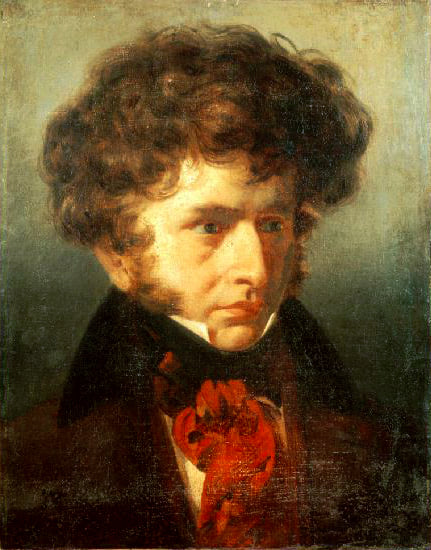

    • Credit where credit is due! The observation was originally made by Facebook follower John M Polhamus.
  • Berlioz: Passion, Obsession, and Rediscovered Music

    Berlioz: Passion, Obsession, and Rediscovered Music

    Hector Berlioz was a man governed by his passions.

    When rejected by the object of his desire, the Shakespearean actress Harriet Smithson, he frenziedly dashed off his “Symphonie fantastique,” an opium-induced fever dream that envisions his own execution for murdering her. In the last movement, her spirit reappears in the midst of a witches’ sabbath, to jeer at his headless corpse. Perhaps counterintuitively, Smithson went for this in a big way, and the two were married, though, perhaps unsurprisingly, not at all happily.

    Berlioz’s biography is full of crazed, seething adventures. Whether in regard to his affairs of the heart, his musical education, or his notorious compositions, always he was driven by mercurial passion and excess.

    He lived large, and he dreamed big music. One need only think of his Requiem, with its massive choir, antiphonal brass ensembles, and 16 timpani. The composer even suggested the orchestration could be doubled or tripled, depending on the size of the space. (However, in an uncharacteristic show of restraint, he recommended the chorus be limited to 400 singers, except in some of the larger numbers.)

    Today is Berlioz’s birthday. It also happens to be the Christmas season, so naturally my thoughts gravitate to “L’enfance du Christ” – which, I must say, is not my favorite Berlioz work. Fortunately, he also composed a “Messe solennelle” in 1824, on virtually the same subject – the commemoration of the Feast of the Slaughter of the Holy Innocents by King Herod, in his attempt to the snare the baby Jesus.

    Berlioz was only 20 years-old at the time, but already he was driven by his creative demons. If you are a fan of the composer, you must hear this piece, which teems with presentiments of many of his major works, including the “Symphonie fantastique,” “The Damnation of Faust,” “Benvenuto Cellini” (with its “Roman Carnival Overture”), and of course the Requiem.

    Berlioz himself played the tam-tam at the work’s premiere, and in his excitement gave the instrument such a blow that it knocked everyone back in their pews. The “Messe” was favorably received (unusual for this composer), but Berlioz decided he hated the piece and wound up burning the score.

    The work was believed lost for nearly 170 years, until it was rediscovered by a Belgian schoolteacher, in an organ gallery in Antwerp, in 1991. Sir John Eliot Gardiner conducted the first modern performance two years later.

    Who knows how Berlioz would have reacted? This is the guy, after all, who once responded to a Dear John letter by racing back from Italy in full drag, bearing two pistols and vial of poison.

    No one partied like Hector Berlioz. Happy birthday, my misguided friend.


    John Eliot Gardiner conducts the rediscovered “Messe solennelle”

    A knock-out recording of the “Symphonie fantastique,” conducted by Argentinean powder keg Carlos Païta – with an interesting choice of imagery: 48 minutes of fetishizing an antique Chinese vase! An exercise in misguided passion, perhaps worthy of Berlioz himself.

  • Berlioz Smithson and a Symphony of Obsession

    Berlioz Smithson and a Symphony of Obsession

    You might say Hector Berlioz was a man easily governed by his passions.

    When denied by the object of his affection, the Irish Shakespearean actress Harriet Smithson, he responded by furiously scrawling his “Symphonie fantastique,” an opium-induced fever dream that imagines his own execution for her murder. She then reappears during the course of a witches’ sabbath to mock his corpse. Perhaps counterintuitively, Smithson went for this in a big way, and the two were married on this date in 1833. Franz Liszt was one of the witnesses. Hardly surprising, but the union would not be a happy one.

    Here’s a knock-out recording of “Dream of a Witches’ Sabbath,” from “Symphony fantastique,” led by Argentinean powder keg Carlos Païta:

    The witches’ sabbath quotes from the portentous “Dies irae,” a medieval plainchant still widely familiar thanks to its continued use in countless horror movies (including the opening credits of “The Shining”).

    Liszt also used this theme as the basis for a set of variations for piano and orchestra, which he titled “Totentanz” (“Dance of Death”). Marvel here at the mercurial György Cziffra, captured live in concert:

    Damn, if these Romantics weren’t so Halloween…

  • Berlioz Passion Madness & Rediscovered Mass

    Berlioz Passion Madness & Rediscovered Mass

    Hector Berlioz was a man easily swept away by his passions.

    When denied by the object of his affection, the Shakespearean actress Harriet Smithson, he furiously scribbled his “Symphonie fantastique,” an opium-induced fever dream that imagines his own execution for murdering her. She then reappears during the course of a witches’ sabbath to mock his corpse. Perhaps counterintuitively, Smithson went for this in a big way, and the two were married, though, perhaps unsurprisingly, not at all happily.

    Berlioz’s biography is full of crazy adventures . Whether in regard to his affairs of the heart, his musical education, or his notorious compositions, always he was driven by mercurial passions and excesses.

    He lived large, and he dreamed big music. One need only think of his Requiem, with its massive choir, antiphonal brass ensembles, and 16 timpani. The composer even suggested the orchestration could be doubled or tripled, depending on the size of the space. (However, in an uncharacteristic show of restraint, he recommended the chorus be kept to only 400 singers, except for some of the larger numbers.)

    Today is Berlioz’s birthday. It also happens to be the Christmas season, so naturally my thoughts gravitate to “L’enfance du Christ” – which, I must say, is not my favorite Berlioz work. Fortunately, he also composed a “Messe solennelle” in 1824, on virtually the same subject – the commemoration of the Feast of the Slaughter of the Holy Innocents by King Herod in his attempt to the snare the baby Jesus.

    Berlioz was only 20 years-old at the time, but he was already driven by his creative demons. If you are a fan of the composer, you must hear this piece, which teems with presentiments of many of his major works, including the “Symphonie fantastique,” “The Damnation of Faust,” “Benvenuto Cellini” (with its “Roman Carnival Overture”), and of course the Requiem.

    Berlioz himself played the tam-tam at the work’s premiere, and in his excitement gave it such a blow that it blew everyone back in their pews. The “Messe” was favorably received (unusual for this composer), but Berlioz decided he hated the piece and wound up burning the score.

    The work was believed lost for nearly 170 years, until it was rediscovered by a Belgian schoolteacher in an organ gallery in Antwerp in 1991. Sir John Eliot Gardiner conducted the first modern performance two years later, and directs the live recording we will hear this afternoon.

    I’ll preface that with a knock-out recording of the “Symphony fantastique,” led by the Argentinean powder keg Carlos Païta.

    First, today’s Noontime Concert will feature the Dolce Suono Ensemble. Artistic director and flutist Mimi Stillman will join David Osenberg for “Music in the Second Capital,” which explores the musical tastes of the Founding Fathers and Philadelphia musical culture in the last quarter of the 18th century. Featured composers will include Wolfgang Amadeus Mozart, Franz Joseph Haydn, Johann Christian Bach, Arcangelo Corelli, Antonio Vivaldi, and Francis Hopkinson. That begins at 12:00 EST.

    I’ll be along following the concert, around 1:40. Our celebration of Berlioz begins at 2:00. The passionate seething will continue unabated until 4:00, on WWFM – The Classical Network and wwfm.org.

Tag Cloud

Aaron Copland (92) Beethoven (95) Composer (114) Film Music (120) Film Score (143) Film Scores (255) Halloween (94) John Williams (185) KWAX (229) Leonard Bernstein (100) Marlboro Music Festival (125) Movie Music (135) Opera (198) Philadelphia Orchestra (88) Picture Perfect (174) Princeton Symphony Orchestra (106) Radio (87) Ralph Vaughan Williams (85) Ross Amico (244) Roy's Tie-Dye Sci-Fi Corner (290) The Classical Network (101) The Lost Chord (268) Vaughan Williams (103) WPRB (396) WWFM (881)

DON’T MISS A BEAT

Receive a weekly digest every Sunday at noon by signing up here


RECENT POSTS