Tag: Symphony No. 2

  • Khachaturian Resolve Amidst Anxious Times

    Khachaturian Resolve Amidst Anxious Times

    Anxious about current events?

    This Sunday night on “The Lost Chord,” join me for Leopold Stokowski’s rarely-heard recording of Aram Khachaturian’s Symphony No. 2.

    Khachaturian composed the work in 1943, the height of World War II, while holed up at a Composers Union retreat with Shostakovich, Prokofiev, Miaskovsky, and Glière. He described the piece as “a requiem of protest against war and violence.” Its nickname, “The Bell,” alludes to a kind of alarm that opens and closes the work. Overall, the tone is one of unshakable resolve in the face of tragedy.

    Stokowski’s recording, long unavailable, was originally issued on United Artists Records in the late 1950s. It reappeared briefly on compact disc, on the EMI label, in 1994, and again in 2009, as part of a 10-disc box set of entrancing Stokowski performances.

    Alas, the master tapes have not weathered the years well, so there are moments of distortion, but the power of the work under Stokowski’s direction transcends any technical limitations.

    To round out the hour, we’ll hear Russian-born pianist Nadia Reisenberg in a selection from her 1947 Carnegie Hall recital, Khachaturian’s most famous piano piece, the “Toccata.” Reisenberg studied at Philadelphia’s Curtis Institute of Music under Josef Hoffman.

    I hope you’ll join me for music by Khachaturian other than the “Sabre Dance.” That’s “Khach as Catch Can,” this Sunday at 10:00 EST, on WWFM – The Classical Network and wwfm.org.


    “Sabre Dance” at the Bolshoi, with Khachaturian conducting:

    Khachaturian singing about the glories of Armenian wine!

    https://www.youtube.com/watch?v=vtKHrg7w3_o


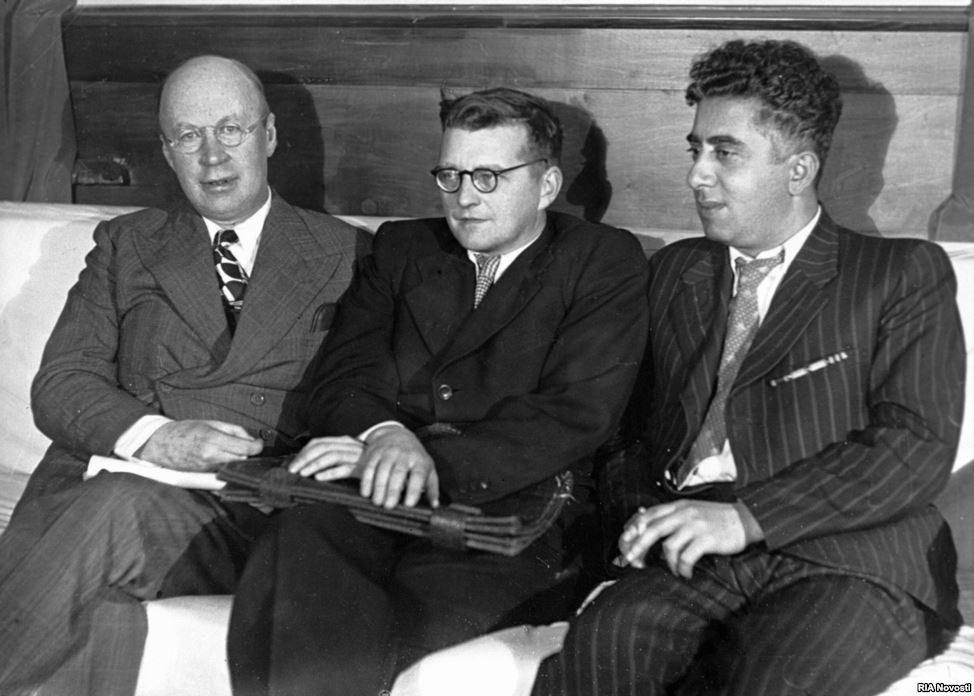
    PHOTO: Troika! (Right to left) Khachaturian with Shostakovich and Prokofiev
  • Rediscovering William Walton’s Genius

    Rediscovering William Walton’s Genius

    Sir William Walton is beloved for his coronation marches and film scores. But posterity has been woefully reductive. He also wrote operas, symphonies, concertos, chamber music, and choral works.

    This Sunday night on “The Lost Chord,” we’ll hear two long-out-of-print recordings of works composed more than three decades apart.

    At the time of the premiere of his Symphony No. 2, in 1957, Walton was perceived as something of a musical throwback. Indeed, despite the fact that it is more tightly argued, the piece has always been regarded as a poor stepsister of the Symphony No. 1, composed in 1935, a work full of grand gestures, written under the spell of Sibelius.

    What apparently escaped critics of the day was the subtlety of its craftsmanship. The finale, in particular, is a set of variations based on a twelve-note row, a technique not unlike that employed in the kind of serial composition so much in vogue at the time.

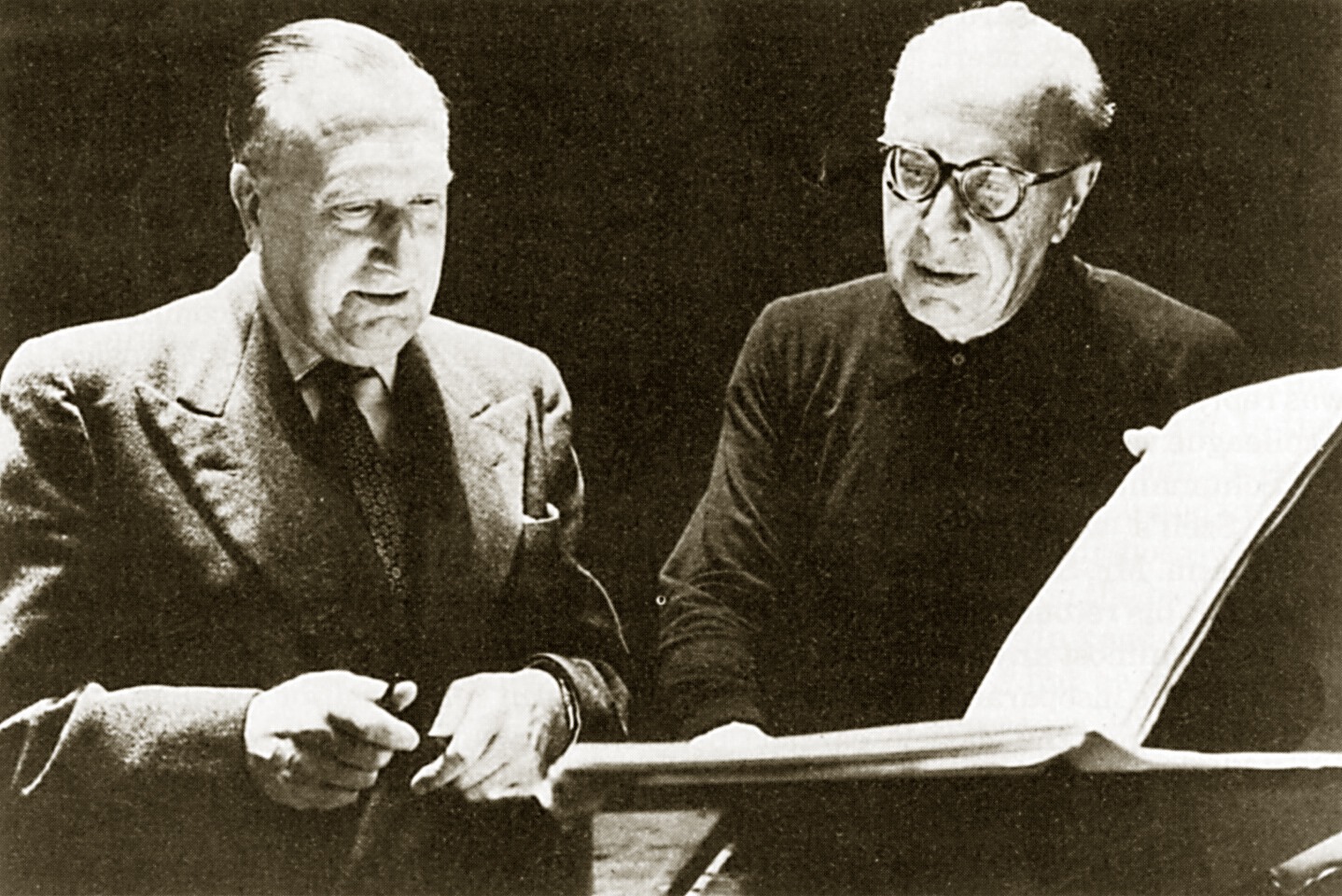
    George Szell (pictured, with the composer) gave the American premiere of the symphony, with the Cleveland Orchestra, in December of 1960. A few months later, they made the first recording.

    More than three decades earlier, Walton was viewed as an enfant terrible, when he set Edith Sitwell’s poetry as an entertainment, titled “Façade.” The work was first performed publicly in 1923. The premiere was a succès de scandale, with Sitwell herself speaking her poems into a megaphone protruding from the mouth of a painted face by John Piper, Walton conducting an ensemble of six instruments.

    The displeasure of performers, audience, and critics was evident, with Noel Coward ostentatiously marching out. However, the work quickly caught on, even becoming downright popular in a variety of arrangements. Within a decade, a purely orchestral version was choreographed by Frederick Ashton.

    We’ll hear selections from a treasured recording, unavailable in this country for many years, featuring Dame Peggy Ashcroft and Paul Scofield as the reciters. Both were noted Shakespearean actors, who did much of their best work on stage. Ashcroft received an Academy Award for Best Supporting Actress in 1985, for her part in David Lean’s final film, “A Passage to India,” and Scofield was honored with an Academy Award for Best Actor two decades earlier, in 1966, for his performance in “A Man for All Seasons.”

    I hope you’ll join me for “Will’s Wonders Never Cease” – rarely heard recordings of the works of William Walton – this Sunday night at 10:00 EDT, on WWFM – The Classical Network and wwfm.org.

  • Beethoven’s 2nd Symphony on WWFM

    Beethoven’s 2nd Symphony on WWFM

    BEETHOVEN BIRTHDAY BASH

    WWFM – The Classical Network’s symphony marathon continues!

    NOW PLAYING: Symphony No. 2 in D major (Vienna Philharmonic/Claudio Abbado)

    Beethoven’s 2nd Symphony is distinguished by an energetic scherzo (replacing the standard minuet) and a finale full of musical jokes that ruffled the feathers of a good number of his contemporaries. One critic described it as “a hideously writhing, wounded dragon that refuses to die… writhing in its last agonies and, in the fourth movement, bleeding to death.”

    Please support it by calling 1-888-232-1212, or by donating online at wwfm.org.

    Thank you for your generous contribution!


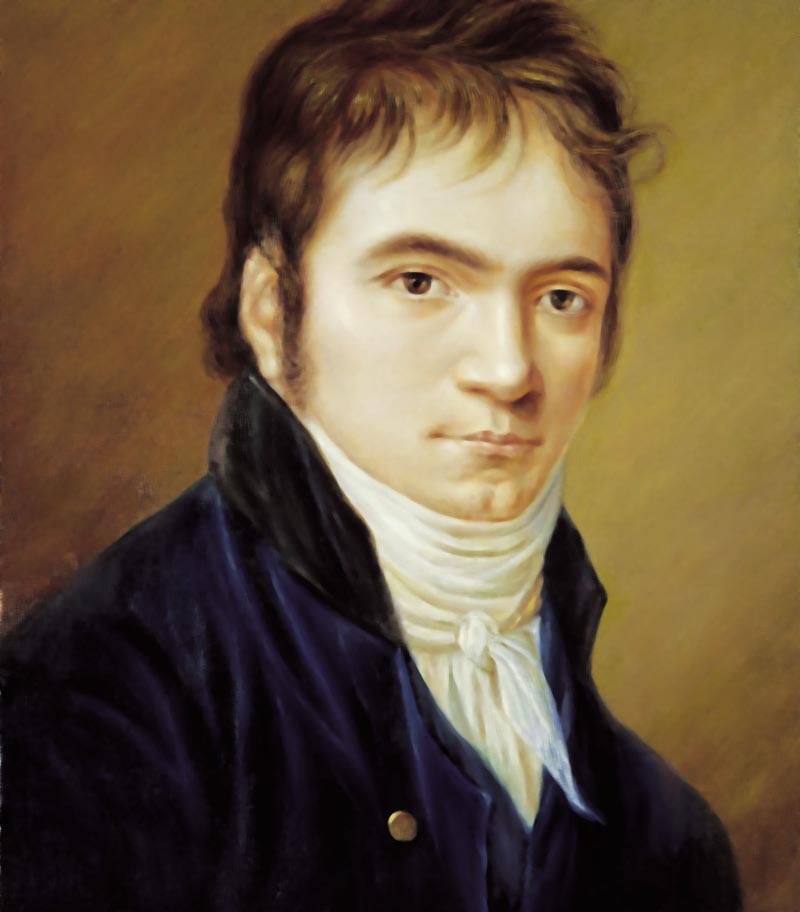
    Portrait (1803), Christian Horneman

  • Howard Hanson Romantic Composer Remembered

    Howard Hanson Romantic Composer Remembered

    Howard Hanson, you incurable Romantic, you. I wish I really had time to write about you today, on this, your birthday – but I don’t.

    For four decades, you were the director of the Eastman School of Music; you were the recipient of a Pulitzer Prize in 1944 for your Symphony No. 4; and you were the champion of hundreds of American composers as conductor of the Eastman-Rochester Orchestra. Your Symphony No. 2, subtitled “Romantic,” is still one of the most frequently encountered of all American symphonies.

    We’ll enjoy some of your recordings today, and save you a little cake, between 4 and 7 p.m. EDT, on WWFM – The Classical Network and wwfm.org.

  • Happy Birthday Charles Ives A Musical Celebration

    Happy Birthday Charles Ives A Musical Celebration

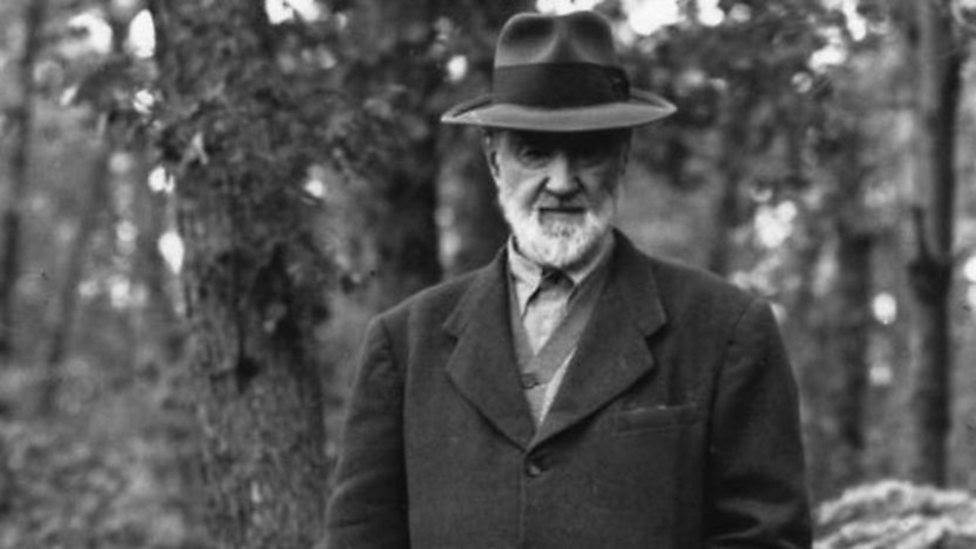
    Happy birthday, Charles Ives!


    Ives’ “Hallowe’en” for string quartet and piano (though I miss the big drum):

    https://www.youtube.com/watch?v=NVnU4t5hMI4

    Leonard Bernstein on the Symphony No. 2:

    My preferred recording of the symphony, so beautiful (though not always entirely accurate, in regard to Ives’ intentions), with Bernstein and the New York Philharmonic in 1960.

    The Yale-Princeton Football Game:

    Ives sings!

Tag Cloud

Aaron Copland (92) Beethoven (94) Composer (114) Conductor (84) Film Music (109) Film Score (143) Film Scores (255) Halloween (94) John Williams (184) KWAX (228) Leonard Bernstein (98) Marlboro Music Festival (125) Movie Music (124) Opera (196) Philadelphia Orchestra (85) Picture Perfect (174) Princeton Symphony Orchestra (106) Radio (86) Ross Amico (244) Roy's Tie-Dye Sci-Fi Corner (290) The Classical Network (101) The Lost Chord (268) Vaughan Williams (98) WPRB (396) WWFM (881)

DON’T MISS A BEAT

Receive a weekly digest every Sunday at noon by signing up here


RECENT POSTS