Tag: Symphony No. 9

  • My First Bruckner Easton PA

    My First Bruckner Easton PA

    I remember the first time I encountered the music of Anton Bruckner. It was in the middle of the night in an attic bedroom in Easton, Pennsylvania.

    While growing up in Easton in the 1970s and ‘80s, I always regarded it as a small town. Technically, it’s classified as a city, the third largest in the Lehigh Valley, but the downtown is not all that large and most of the population was distributed across what was then several semi-rural townships. A drifting snow would be enough to close the schools for days.

    Easton is about 70 miles outside Philadelphia. In the car, WFLN, Philadelphia’s 24-hour classical music station, when it still existed, would sometimes cut in and out, depending on where you were driving. But I always had the radio antennae in the house trained to pick up 95.7 FM. And as a teenager, my brain was absorbent enough that I internalized most of the standard repertoire.

    Back in the day, WFLN used to broadcast its overnights ad-free. So other than the distinctive voice of Henry Varlack, it was non-stop music from midnight to 6 a.m. This made it easy to sleep with the radio on, and I did so out of habit in those days, my consciousness rising to the surface now and again to take note of the music.

    On one of those occasions, I emerged right in the middle of an insinuating, sinister scherzo. It made such an impression that I hung around to hear the back-announcement: Bruckner’s Symphony No. 9.

    The word “scherzo” literally means “joke.” In Bruckner, there are no jokes. The early symphonies may flirt with folksy ländler. But once Bruckner knows what he’s about, these are transmogrified into supernatural gallops across moonless skies, Odin leading his warrior band in the Wild Hunt. The symphonies are often compared to “cathedrals in sound.” Bruckner was an organist; once you know that, it’s easy to imagine his structures and textures elucidated on the King of Instruments. But there is nothing sacred about the scherzos.

    From that first encounter, I’ve always been fond of them. So ferocious can these become, so terrible in their sublimity, that it’s hard to associate them with the man who, on the one hand, aspired to convey the ineffable in his heavenly adagios, and on the other, could be so malleable as to allow anyone to make changes to “improve” his music. He was almost perversely humble. Because of this, there are multiple Bruckner performance traditions, with some conductors and scholars divided between the Haas and Nowak editions and others groping toward elusive Brucker urtexts.

    For the Bruckner faithful, no matter how it’s been processed, the music transcends human tampering. With its hypnotic repeating cells, its punctuating silences, its spiritual depth, and its breathtaking grandeur, Bruckner’s art communicates with an unwavering clarity. But as with his instrument of choice, there’s always a lot going on behind the scenes and beneath the surface.

    Still, I’m aware not everyone is a convert. I think wryly back on Simon Roberts, who stocked and held court in the basement of Nathan Muchnick’s (a Philadelphia audio store with a superb classical music compact disc selection), and his withering dismissal of “deranged Bruckner fanatics,” which I recall now, even decades after he uttered it.

    Gustav Mahler, who took lessons with Bruckner at the Vienna Conservatory and considered him his precursor and friend, described him as “half simpleton, half God.”

    Those who love Mahler don’t necessarily feel the same way about Bruckner, and vice versa. So if Grandpa loves his cycle of Bernstein Mahler symphonies (Sony or DG), don’t expect him to turn handsprings for your generous gift of Eugen Jochum’s Bruckner set (EMI or DG). Unless Grandpa happens to be me. I love all these recordings!

    I can’t believe that today marks the 200th anniversary of Bruckner’s birth. I remember when 200 years ago meant powdered wigs.

    In any case, thank you, WFLN, God rest Henry Varlack, and happy bicentennial, Anton Bruckner!


    Bruno Walter conducts Bruckner’s 9th (my first Bruckner recording). The scherzo begins about 24 minutes in.


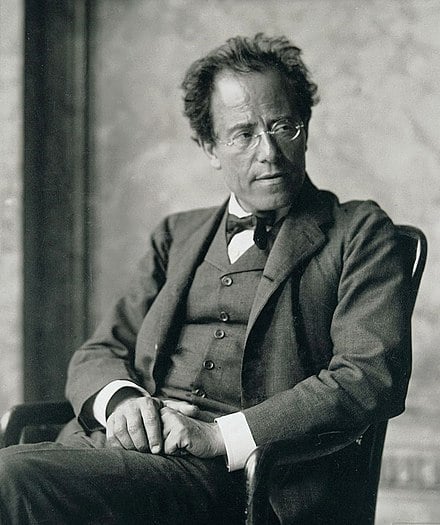
    PHOTO: Anton Bruckner, babe magnet

  • RVW Symphony No 9 Premiere 65 Years On

    RVW Symphony No 9 Premiere 65 Years On

    Ralph Vaughan Williams died 65 years ago today. Here’s the world premiere recording of his Symphony No. 9 of 1956-57. Critics of the day were largely dismissive of the work, finding it enigmatic, and puzzled by the composer’s decision to include among his orchestration three saxophones and a flügelhorn. Horrors!

    In recent decades, it seems the very characteristics that confounded the gatekeepers – the symphony’s visionary, violent, elusive, and ambiguous nature – are some of the very qualities for which it is now praised. This is not the kind of valedictory anyone was expecting from the octogenarian so famous for the “Fantasia on a Theme by Thomas Tallis” and “The Lark Ascending.”

    RVW had been scheduled to attend the recording session, which, in the event, took place only hours after his passing, on August 26, 1958. The performance is prefaced by a brief, spoken introduction by his great champion, the conductor Sir Adrian Boult.

    .youtube.com/watch?v=gpiXjrxRrlY&t

  • Bruckner’s Triumph Phones and All

    Bruckner’s Triumph Phones and All

    Johannes Brahms described the mighty musical edifices of Anton Bruckner as “symphonic boa constrictors.” But at last night’s concert of The Philadelphia Orchestra, it was the audience that put on the squeeze.

    Music and artistic director Yannick Nézet-Séguin conducted a fascinating experiment, presenting a joint concert, without break, of Bruckner’s valedictory Symphony No. 9 and his almighty “Te Deum” (literally a dedication to God).

    He was not the first to do so. The symphony was presented that way at its first performance, in 1903, six years after the composer’s death. Bruckner, sensing the end was near, sanctioned the “Te Deum” as a makeshift finale for his symphony, the fourth movement of which he ultimately left unfinished – though most conductors, in their mature wisdom, grasp the poetic justness of simply letting the third movement trail away like incense on a reflective note. (Bruckner’s Roman Catholic faith was central to his life and work.)

    But it was Yannick’s own inspired idea to also affix one of Bruckner’s motets for a cappella chorus, “Christus factus est,” as a kind of preamble to the whole. The motet quotes material from the “Te Deum” and, thanks to a fortuitous key relationship, happens to dissolve seamlessly into the opening of the symphony. Then, on the other side, just as the mystic atmosphere of the symphony’s third movement is about to dissipate, the cathedral doors are blown wide open by the heaven-storming eruption that launches the sublime “Te Deum.”

    This conception of the three works as a kind of Holy Trinity transformed the evening into an epic parallel of Beethoven’s 9th Symphony, a work Bruckner clearly admired. And what a journey it was!

    Yannick’s evident mastery was all the more remarkable in that yesterday afternoon, he had just conducted his first ever “La bohème” – under the scrutiny of an international radio audience, no less – at New York’s Metropolitan Opera. The opera ended around 4 p.m. Yannick is well-known for his phenomenal energy. At 48, he goes and goes and goes until he can’t do it anymore, and then once in a blue moon he takes time off to recuperate from exhaustion – which is why he is one of the few conductors who can oversee both the Met and a major symphony orchestra – and yesterday was quite the demonstration of his superhuman stamina.

    The orchestra played like gods, and Yannick guided them like a diminutive Zeus, with a strength and an authority belying his 5-foot-five frame. The conductor later wore a wry, self-deprecating expression, acknowledging the physical contrast with choral director Joe Miller, who towered over him as the two took their bows during the rapturous ovations at the end of the concert.

    But before they could get there, there was some unexpected turbulence.

    Yannick and the orchestra were about half-way through the evening and totally in the zone – in the middle of what was shaping up to be the musical equivalent of a no-hitter – when, only about a minute into the symphony’s lofty third movement, at a particularly ethereal moment, someone in the row behind me and off to one side cried out. (I was sitting in row B in the orchestra tier.) Whether he was displeased with something he heard onstage or had a beef with somebody else in the audience or was unable to contain himself during a moment of personal disturbance is unclear, but it was disruptive enough that Yannick stopped the orchestra and began the movement over.

    A little uncomfortable, to be sure, but everyone was determined to carry on as if nothing had happened. Then, wouldn’t you know it, when the musicians arrived at the very same passage, from the other side of the hall, someone’s cell phone ringer went off. Loudly.

    At that point, Yannick let his baton arm drop to his side, his body went limp, and he turned resignedly to face that portion of the audience from which the disruption had originated. With evident exasperation, he remarked, “Can we just spend one hour of our lives without our DAMN PHONES????” To this, he added another sentence or two, while a large segment of the audience applauded. I wholeheartedly agree with the sentiment, but the applause only further served to break the spell cast by Bruckner.

    Nevertheless, Yannick raised his wand and the orchestra attempted to weave its magic a third time. Of course, by then the sustained atmosphere had been spoiled. I’m not sure if the musicians had difficulty regaining their involvement or if it was the natural aftermath of the disturbance that altered the mood in the hall, but it took a few minutes for everyone to slip back into Bruckner’s spiritual world.

    Thankfully, they did. It was a gorgeous performance. More fiery than usual, perhaps, in the ferocious scherzo (the symphony’s second movement), but if you’ve got it, flaunt it. This was young man’s Bruckner.

    I held my breath as the orchestra neared the transcendent final bars – the symphony ends quietly – feeling myself grow tense against the possibility of an overeager listener stomping the mood with a premature bravo, but after a mere pause, the Philadelphia Symphonic Choir again rose to its feet, on the tiered balcony behind the stage, where it had been sitting unobtrusively throughout the duration of the symphony, to join orchestra and organist in the explosive opening of the sublime “Te Deum.”

    It couldn’t have been easy for the soloists – soprano Elza van den Heever, mezzo-soprano Michelle DeYoung, tenor Sean Panikkar, and bass-baritone Ryan Speedo Green – who had also been sitting quietly. An awfully long time had passed since backstage warm-ups. Some of the singers drew water from metal thermoses, no doubt to ensure their voices wouldn’t catch in their throats. They sang beautifully, the individual and combined voices alternately blending and ringing out like silver clarions. The evening ended on a hair-raising tutti, with soloists, chorus, orchestra, and organ blazing. Goosebumps were palpable all across the auditorium. The audience reception was long, thunderous, and much deserved. The orchestra had overcome a double disruption in the symphony’s third movement to attain a lasting triumph.

    It is too bad that this rare Brucknerian experiment couldn’t be sustained quite as planned, as it really was something magnificent to experience. But looking back this morning, I find a touch of irony in Yannick’s wholly understandable expression of consternation at the disruption of a cell phone, as 15 minutes before the concert was scheduled to begin, I spotted him entering the lobby (as opposed to the stage door around the back of the building), smiling in a powder blue track suit and trailed by an assistant – or perhaps his husband – who was filming him, yes, on his phone.

    Hey, I’ve got no beef with that. Just noting that the damn phones are with us everywhere. But no doubt put to better use documenting Yannick, mid-marathon, on his way from the pit of the Metropolitan Opera to the podium of the Philadelphia Orchestra, than in the middle of Bruckner’s Ninth Symphony.

    Not all the drama was onstage, then, but all’s well that ends well. Flaws and all, this was one of the great Bruckner concerts of my life. Bravo, Philadelphia!

  • Vaughan Williams Late Bloom Colorful Genius

    Vaughan Williams Late Bloom Colorful Genius

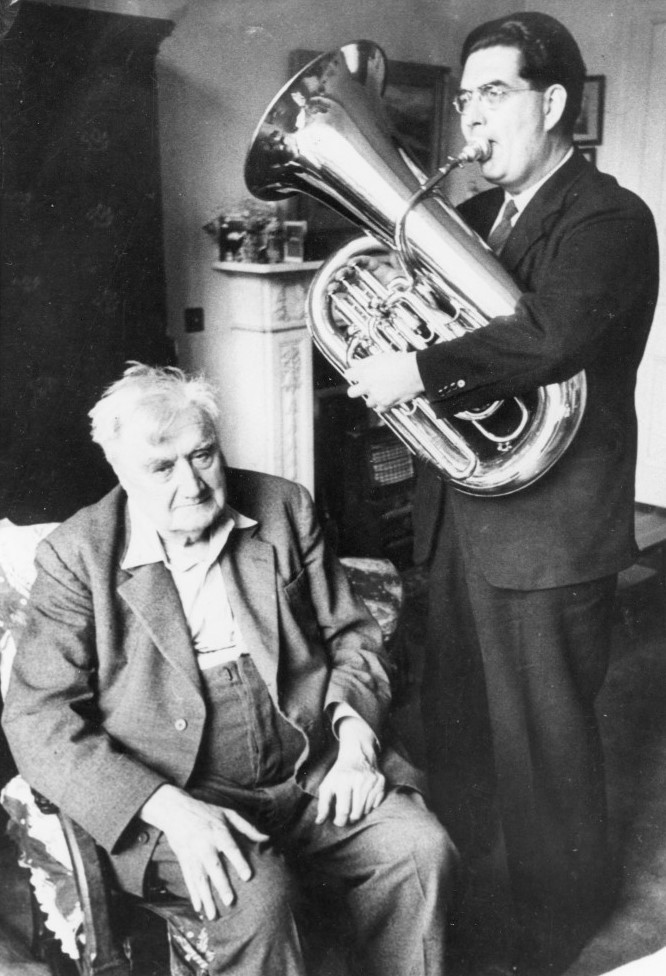
    Here’s Ralph Vaughan Williams, looking as miserable as you would imagine, being serenaded by the tuba. The composer wrote the first ever concerto for the instrument in 1954. A late and unusual work, the piece was dedicated to Philip Catelinet, principal tubist of the London Symphony Orchestra. “Glorious John” Barbirolli conducted the premiere. These are the forces heard on the work’s first recording. Listen here, for a tubby start to your Friday.

    BONUS! Vaughan Williams’ “Romance for Harmonica,” composed in 1952.

    Vaughan Williams seemed often to be in search of unusual timbres in his later years. Rather ironic, since by then he was severely deaf, the result of prolonged exposure to heavy artillery during World War I. But he was a true composer, a master of his craft, who didn’t have to hear what he wrote in order to know the sound. Moreover, as a pupil of Maurice Ravel, he never lost his sense of color.

    Take for example the exotic percussion in the outer movements of his Symphony No. 8, composed in 1953-54. (The second movement is scored for brass and the third for strings alone.) It’s heard here in a superb performance from perhaps an unlikely source, given the pervasive claims that the music of this quintessentially English composer does not “travel.” Nobody told Charles Munch and the Boston Symphony Orchestra.

    Or the insinuating saxophones and mysterious harps in the valedictory Symphony No. 9, written in 1956-57. Vaughan Williams died on the eve of the first recording session, with Sir Adrian Boult and the London Philharmonic Orchestra. Boult’s brief eulogy appears at the beginning of this world premiere recording.

    It’s extraordinary that a composer in his 80s would remain so vital and so full of invention. (RVW was 80 back when 80 was REALLY 80!) His symphonies, in particular, are among the greatest of the 20th century. And he never repeated himself. All nine have such a distinctive character, and there’s not a weak link in the bunch. Would that more of our music directors would get to know them.

  • Mahler’s Huts: Solitude & Symphony

    Mahler’s Huts: Solitude & Symphony

    One of my most popular posts, written in 2014, was about composers’ huts – creative spaces that sit apart from a principal house so that an artist can work in solitude, free from distraction.

    Because of his busy schedule as a conductor, Gustav Mahler composed mostly in the summers. Here’s an amusing but also disheartening video, made in 2011, about Mahler’s composing hut in Altschluderbach, near Toblach, in South Tyrol, Italy. Here, during the summers of 1908 through 1910, he created the song-symphony “Das Lied von der Erde” (“Songs of the Earth”), the Symphony No. 9, and what he was able to complete of the Symphony No. 10. Allegedly, he kept three pianos in this hut, but I don’t see how that would be possible. Maybe they were uprights!

    A music festival is held in his honor every summer in Toblach, yet somehow this hut wound up in a wildpark (!), where it has been allowed to fall into ruin. So we have the chicken house… the pig house… and the house of Gustav Mahler. See if you can tell them apart. The videographer makes some pointed allusions to “world cultural heritage.”

    Mahler loved nature, but come on!

    Happily, there are two other composing huts, which have been treated with a little more respect. Mahler spent the summers of 1893 through 1896 in Steinbach, at Lake Attersee, in Upper Austria. Here he worked at his song settings “Des Knaben Wunderhorn” (“The Youth’s Magic Horn”), as well as on the Symphonies Nos. 2 and 3.

    Even so, restoration and preservation were not considered until 1985. In the meantime, it had been used variously as a washing house, a sanitary facility, and a slaughterhouse!

    https://en.wikipedia.org/wiki/Composing_hut_of_Gustav_Mahler_(Attersee)

    From 1900 through 1907, Mahler’s summers were spent in Maiernigg, near Maria Wörth, in Carinthia, Austria. Here too his hut is much better tended. Mahler composed his Symphonies Nos. 4 through 7 on the premises, as well as portions of the Symphony No. 8.

    Again, the composing hut was declared a cultural heritage only in 1981. It was renovated in 1985 and opened to the public in 1986.

    1901-1907 House Gustav Mahler Maiernigg – Villa Mahler No. 31 (Composing cottage)

    The world continues to do its damnedest to promote mediocrity, as too often reminders of our greatest achievements are allowed to collapse. But for now, anyway, provided orchestras have enough money in their budgets, Gustav Mahler’s symphonies endure.

    Happy birthday, Gustav Mahler.


    PHOTOS: Mahler regards his composer cottages in (top to bottom) Altschluderbach, near Toblach (1908-10), Maiernigg, near Maria Wörth (1900-07), and Steinbach, at Lake Attersee (1893-96)

Tag Cloud

Aaron Copland (92) Beethoven (95) Composer (114) Film Music (120) Film Score (143) Film Scores (255) Halloween (94) John Williams (185) KWAX (229) Leonard Bernstein (100) Marlboro Music Festival (125) Movie Music (135) Opera (198) Philadelphia Orchestra (88) Picture Perfect (174) Princeton Symphony Orchestra (106) Radio (87) Ralph Vaughan Williams (85) Ross Amico (244) Roy's Tie-Dye Sci-Fi Corner (290) The Classical Network (101) The Lost Chord (268) Vaughan Williams (103) WPRB (396) WWFM (881)

DON’T MISS A BEAT

Receive a weekly digest every Sunday at noon by signing up here


RECENT POSTS