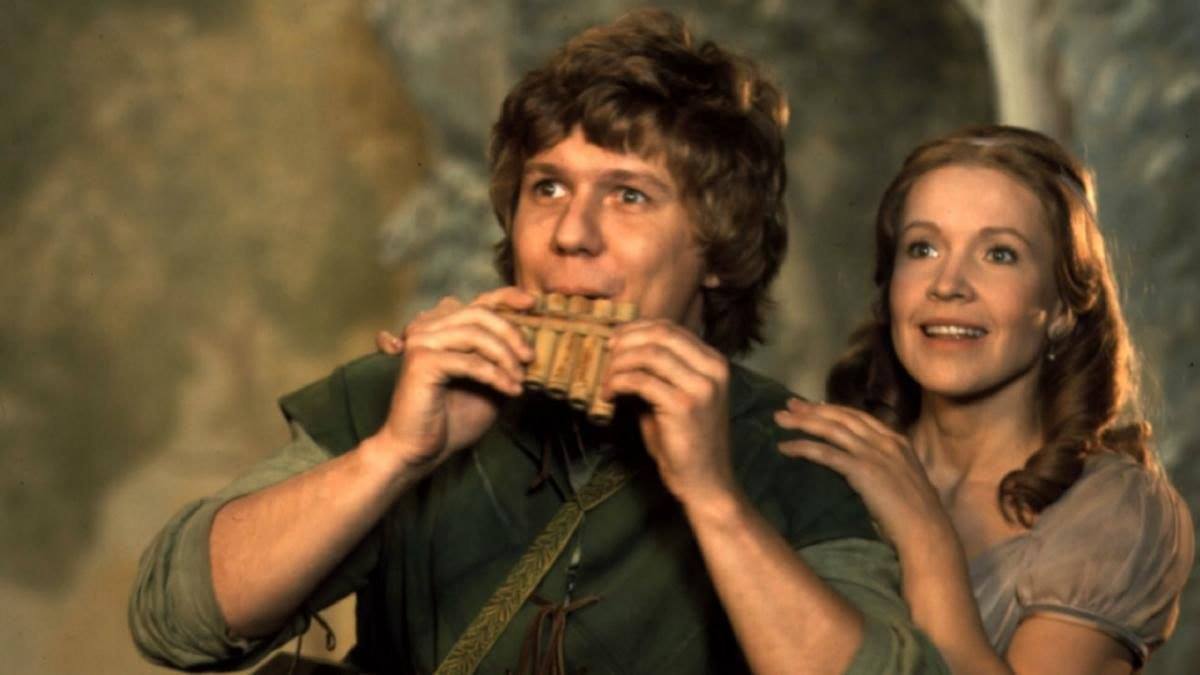
From time to time, I guess even Ingmar Bergman needed a break from existential dread. How else to explain his delightful adaptation of “The Magic Flute?” Originally intended for television, Bergman’s playful and inventive 1975 film of Mozart’s 1791 singspiel had a lot to do with setting me on the path to become an opera lover.
The conceit, to set the action as a live performance in the historic Drottningholm Palace Theater (a reproduction, since there were concerns about the actual theater safely accommodating a film crew), is disarming and inspired. All the stagecraft is laid bare. The scenery is evidently painted plywood, the animals are all people in suits, and the characters pause from time to time to hold up little signs with moralistic aphorisms on them as they sing their arias.
Bergman’s film begins outside the actual theater and then enters the hall during the overture to register the facial expressions of a audience members as they anticipate the curtain rising. Most especially the camera lingers on the eager face of an impressionable young girl. It’s evident that the director would like us to experience it all from her perspective, through a lens of innocence.
By contrast, we’re also taken backstage, to glimpse Papageno, fallen asleep and nearly missing a cue, Sarastro between acts studying the score to “Parsifal,” and one of Monostatos’ minions reading a Donald Duck comic book.
Sure, there are moments of despair even here, as a couple of the characters contemplate suicide (we also get a memorable vision of hellfire), but it’s all dispelled in a decisive victory of good over evil, an endorsement of universal brotherhood, and a resolution of unalloyed joy.
It was Mozart’s librettist, Emanuel Schikaneder, who suggested during rehearsals that Papageno stammer in excitement at the recognition of his desired Papagena, in their famous duet. Here’s what Bergman does with it.
On Mozart’s birthday anniversary, I think it’s time to revisit this film.
I’m a jaded old bastard, but a fair one, I hope, so I’ll be the first to admit I haven’t always given Mozart a fair shake. There have been times when I’ve had the privilege to attend an all-Mozart concert, and I’ve taken a look at the program and rolled my eyes. What a jerk thing to do. One of the greatest composers who ever lived, whose gift to posterity has been one of sublime beauty, and I’m that ungrateful? The fault, dear Brutus, is not in Mozart, but in myself.
Part of the problem is that he’s so damned overexposed. Mozart is everywhere. How often in movies has “Eine kleine Nachtmusik” been used as shorthand to signify stuffy lawn parties thrown by the snooty rich? Yet, as a teenager, the music delighted me so, I remember bringing the record with me to school. (The bulk of the album was devoted to the “Jupiter” Symphony.)
Mozart makes our babies smarter. He’s had chocolates named after him. He’s underscored romantic interludes in “Elvira Madigan” and jealous rivalry in “Amadeus.” He’s reminded prisoners of the persistence of beauty in “The Shawshank Redemption.” His music has been used to sell cars, sneakers, and coffee. It’s been quoted, sampled, and parodied. It’s been assimilated into a collage of our collective cultural detritus.
On the surface, It’s so easy to digest. And there’s nothing wrong with that. Much of our greatest art tends to appeal on more than one level. It’s accessible on first acquaintance, but it’s also capable of conveying more profound truths. The more you live with it, the more it reveals. That’s what makes it “classic.”
Beneath the enchanting veneer of beauty, conjured with seeming inevitability – an ordered universe, always fresh, out of the Enlightenment – Mozart reminds us of our humanity, plumbing emotional depths and scaling spiritual heights, affirming the meaning of our existence in manner that cannot be captured in words, all the while delighting the ear.
The first opera I really got to know (after devouring Gilbert & Sullivan) was “The Magic Flute.” The last concert I ever heard with my mother was of the last three symphonies. I’d go so far as to say that “The Marriage of Figaro” saved my life. For an entire month, I had the great good fortune to work as an intern on a professionally staged production with some major singers, and I got to know the score extraordinarily well. The music was like a life buoy tossed to me across the centuries at a time I struggled to keep my head above choppy waters. To this day, it remains my favorite opera.
Of course, Mozart has been around for a long time, and as human beings, one of our more regrettable attributes is that even the most breathtaking vistas tend to lose their grip on our attention if we see them every day. We decorate our walls with artwork and pictures and memorabilia, but how often do we notice them? We play music on the radio, but how often do we focus enough to truly listen? It’s nice to have these things in our lives, of course. They lend color to a workaday existence. But we tend to be creatures of the moment, and it doesn’t take much to divert our attention.
Mozart, we are undeserving of your gifts. Thanks for everything, and happy birthday.
Today is the birthday of Emmanuel Schikaneder (1751-1812). Schikaneder was the impresario who provided the libretto for Mozart’s “Die Zauberflöte,” or “The Magic Flute.” He was also the driving force behind the construction of the Theater an der Wien, the better to house his lavish spectacles. “The Magic Flute” received its first performance there in September 1791. Schikaneder created one of the opera’s lead roles, that of the fallible, if sympathetic birdcatcher Papageno. Mozart’s untimely death occurred only two months later. He was 35 years-old.
Schikaneder enjoyed life. During his leisure hours, he was also known to play at bölzlschiessen (dart-shooting) with the Mozarts. Projectiles were launched at paper targets hand-decorated with satirical images and verse about each of the game’s participants. Schikaneder was parodied for his fondness for the ladies.
Interestingly, “The Magic Flute” was not unique among Schikaneder’s productions, merely the apex of a vogue for allegorical fairy tale operas, frequently incorporating Masonic symbols. Some of these were collaborative efforts, with Mozart, only one in a veritable bullpen of Schikaneder composers, providing music for a few of the numbers. (“The Philosopher’s Stone,” recorded on the Telarc label, is a blast!)
In all, Schikaneder wrote 56 libretti and 45 spoken-language plays. Among the other composers he attempted to woo was Beethoven, even to the extent of providing him with free housing within the theater. Ultimately, Beethoven would reject the project, though by then he had already set the opening scene, which he later incorporated into his opera “Fidelio” (as the duet “O namenlose Freude”). Beethoven being Beethoven, he continued to live in the theater for as long as possible.
Although many of Schikaneder’s productions were popular successes, the sheer expense of realizing his fanciful visions eventually drove the company into debt. In the end, he wound up selling the theater to a consortium of nobles and fled Vienna for the provinces. He died insane and impoverished at the age of 61.
Schikaneder’s memory is preserved in statuary as part of the so-called Papagenotor, or Papageno Gate, immortalized in character, complete with feathers and panpipe, over a side portal of his former theater. He was also memorably played by Simon Callow in the film version of Peter Shaffer’s play, “Amadeus” (1984). Callow had created the role of Mozart, opposite Paul Scofield as Salieri, in the original London production in 1979.
Here’s a Schikaneder text that was set by Arnold Schoenberg, of all people. Schoenberg, the dour father of dodecaphony, wrote a number of cabaret songs. This one is called “Aria from ‘The Mirror of Arcadia.’” Schikaneder’s complete libretto was set in 1794 by Franz Xaver Süssmayr, as the opera “Der Spiegel von Arkadien.” Süssmayr is remembered primarily for having completed Mozart’s unfinished Requiem. Schoenberg’s setting dates from 1901.
The refrain of “Boom… boom… BOOM boom boom…” signifies the heartbeat of an ardent, if indiscriminate lover – more in line with a character like Cherubino than Papageno!
Since seeing so many women,
My heart beats so ardently,
It hums and buzzes here and there,
Just like a swarm of bees.
And if her ardour resembles mine,
And her eyes are lovely and limpid,
Then my heart, like a hammer,
Beats on and on.
Boom, boom, boom, etc.
I wish I could have a thousand women,
If it so pleased the gods,
I’d dance like a marmot
In every direction.
That would be a life worth living,
Then I’d have joy and fun,
I’d hop like a hare through the field,
And my heart would skip along.
Boom, boom, boom, etc.
A man who does not value women
Is neither cold nor warm,
And lies like a block of ice
In a young girl’s arms.
I’m a different sort of man,
I circle women in a dance;
My heart beats happily against hers,
Going boom, boom, boom, etc.
Schikaneder employs a similar gimmick in “The Magic Flute.” Allegedly, it was his suggestion, made during rehearsals, that Papageno stammer in excitement at his recognition of Papagena, during their famous duet, as seen here in the classic Bergman film.
Papageno plays his bells in “Amadeus”
A precursor to “The Magic Flute”: “The Philosopher’s Stone” (1790), with musical contributions by Johann Baptist Henneberg, Benedikt Schack, Franz Xaver Gerl, Mozart, and Schikaneder himself
Today marks the 100th anniversary of the birth of Ingmar Bergman. Bergman, not exactly known for his lightness of spirit, filmed one of the most consistently delightful adaptations of any opera (or singspiel, for that matter) in a Swedish television version of “The Magic Flute” (1975). The production’s Papageno, Håkan Hagegård, went on to enjoy an international career.
“The Magic Flute” also figures in the puppet play featured in “Hour of the Wolf” (1968).