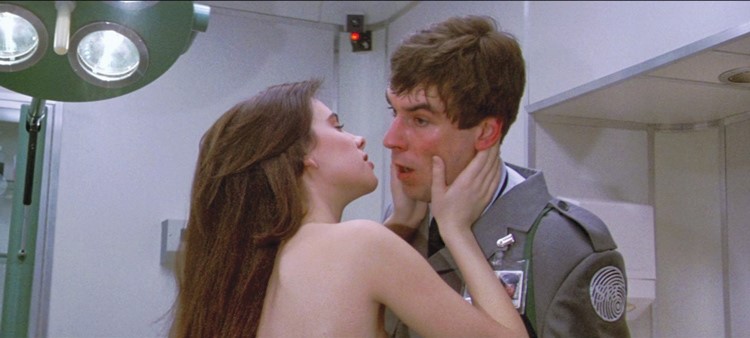
Full-frontal vampires from outer space? This is an existential threat that needs to be encountered head-on! And Roy and I are just the guys to do it. Our blather about “Lifeforce” (1985) has been posted here:
Is there anything creepier than creepy kids? Especially when they turn out to be the spawn of Satan? Next week, Halloween month continues with a Revelatory conversation about Richard Donner’s diabolical hit “The Omen” (1976).
Join us in a chorus of “Ave Satani” in the comments section – this is Jerry Goldsmith’s only Oscar-winning score – as we count to 666 on the next Roy’s Tie-Dye Sci-Fi Corner, when we livestream on Facebook, next Friday evening at 7:30 EDT!
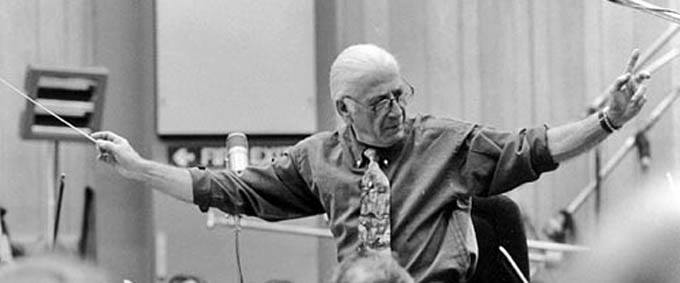
Poor Jerry Goldsmith. He wrote some of the great film scores of his time, including those for “The Sand Pebbles” (1966), “The Blue Max” (1966), “The Flim-Flam Man” (1967), “Planet of the Apes” (1968), “Patton” (1970), “Papillon” (1973), “Chinatown” (1974), “The Wind and the Lion” (1975), “MacArthur” (1977), “The Boys from Brazil” (1978), “The Great Train Robbery” (1979), “Alien” (1979, butchered in the sound editing), and “Star Trek: The Motion Picture” (1979).
For television, he wrote for “Dr. Kildare,” “The Twilight Zone,” “Gunsmoke,” “The Man from U.N.C.L.E.” and “The Waltons.”
By the 1980s, the films began to get weaker. It seemed like Goldsmith was always getting tossed the projects John Williams passed on, or cheap knockoffs of Williams’ successes. By his final decade, he was stuck writing for such garbage as “The Mummy” (1999), “The Haunting” (1999), and “Looney Tunes: Back in Action” (2003). A notable exception was “L.A. Confidential” (1997), but rarely were his later projects up to his talent.
Goldsmith had a reputation for being able to compose at white heat, so he was frequently called upon to write replacement scores for films like “The River Wild” (1994), “Air Force One” (1997) and “The 13th Warrior” (1999). He composed and recorded the score to “Chinatown,” one of the best of the 1970s, in only ten days.
Incredibly, he was honored with only a single Academy Award, for his influential score to “The Omen” (1976). Goldsmith died in 2004, at the age of 75. If he were to come back today, he would mop the joint with all the Hans Zimmer clones of the world.
Happy birthday, Jerry Goldsmith. I sure does miss you.