Tag: The Thief of Bagdad

  • Thief of Bagdad Rozsa’s Enchanting Score Recorded

    Thief of Bagdad Rozsa’s Enchanting Score Recorded

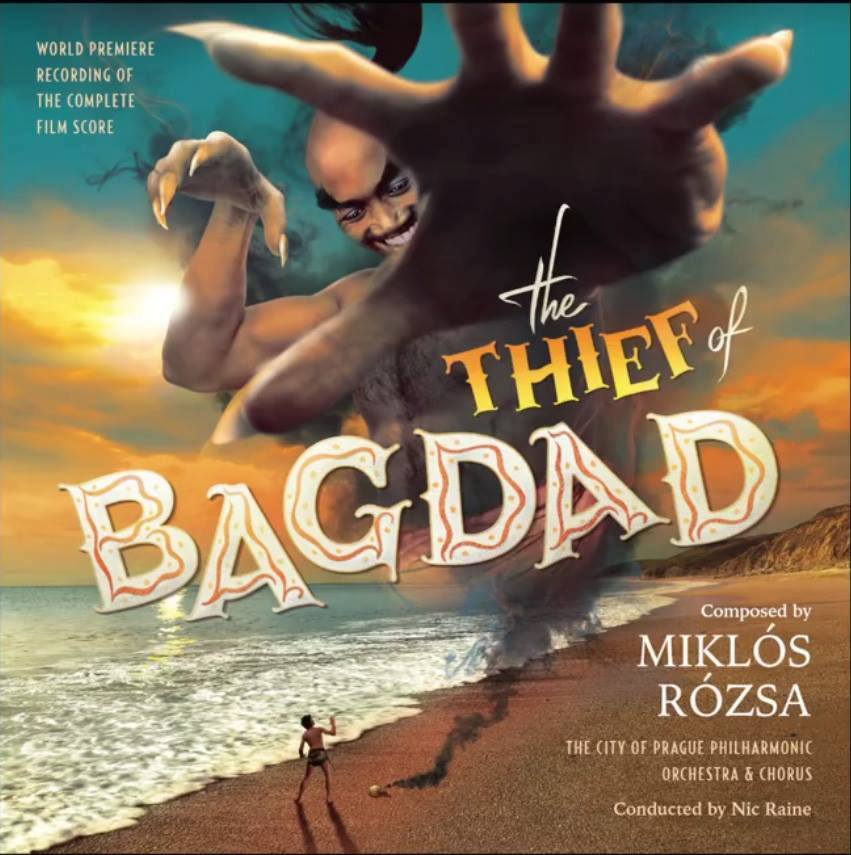
    If your three wishes would include a complete recording, in up-to-date sound, of one of the most enchanting film scores of Miklós Rózsa, you needn’t yearn for the chance discovery of a magic lamp.

    This week on “Picture Perfect,” join me for selections from a 2017 release, a two-CD collaborative effort between Prometheus Records and Tadlow Music, of Rózsa’s score for the classic 1940 fantasy-adventure “The Thief of Bagdad.” The City of Prague Philharmonic and Nic Raine recorded the music, note-complete, with ample bonus material.

    It’s a magic carpet ride through the fantastical world of the Arabian Nights. Surrender to the enchantment, on “Picture Perfect,” music for the movies, now in syndication on KWAX, the radio station of the University of Oregon!


    Clip and save the start times for all three of my recorded shows:

    PICTURE PERFECT, the movie music show – Friday at 8:00 PM EDT/5:00 PM PDT

    SWEETNESS AND LIGHT, the light music program – Saturday at 11:00 AM EDT/8:00 AM PDT

    THE LOST CHORD, unusual and neglected rep – Saturday at 7:00 PM EDT/4:00 PM PDT

    Stream them, wherever you are, at the link!

    https://kwax.uoregon.edu/

  • Exotic Scores: Movie Music from the East

    Exotic Scores: Movie Music from the East

    As a long-time local radio host only recently set adrift, I am thankful for the life raft of syndication. Which means armchair travelers can still join me, via internet streaming, on KWAX, the radio station of the University of Oregon.

    Orientalism is a term used to describe evocations of the East by Western writers, artists, and designers. This week on “Picture Perfect,” while I acknowledge the complexities and pitfalls inherent to “exoticism,” I hope you’ll enjoy musical selections from four films set in faraway lands.

    Two of these are loosely based on tales from “The Arabian Nights,” depicting the East as a kind of fairy world. The Alexander Korda production of “The Thief of Bagdad” (1940) features Sabu as the thief, Conrad Veidt as a slippery vizir, and a scene-stealing Rex Ingram as the djinn. The score is one of the earliest and most charming of Miklós Rózsa.

    “The Seventh Voyage of Sinbad” (1958) is really a showcase for the special effects of Ray Harryhausen. In particular, it contains a kind of rehearsal, in the skeleton duel, for the classic sequence in “Jason and the Argonauts” (in which Harryhausen ups the ante to seven skeletons!). The alternately sinuous and percussive music, by Bernard Herrmann, fits the images like a Persian slipper.

    Director David Lean was inspired by the historical exploits and complex character of T.E. Lawrence, in the undertaking of “Lawrence of Arabia” (1962). The film won seven Academy Awards and made international superstars of Peter O’Toole and Omar Sharif. Maurice Jarre won the first of his three Oscars for his music. Jarre himself conducted on the film’s soundtrack, even though, for contractual reasons, Sir Adrian Boult received the screen credit.

    Finally, Sean Connery is Mulay Ahmed Muhamed Raisuli the Magnificent, sharif of the Riffian Berbers, in John Milius’ “The Wind and the Lion” (1975). The score represents composer Jerry Goldsmith at his finest. In fact, so happy was he with the effort that he was convinced that he finally had a lock on the Oscar. Then he went to see “Jaws.” Goldsmith would receive his only Academy Award, finally, the next year for his music to “The Omen.”

    I hope you’ll join me for these examples of Orientalism at the movies – a theme that’s really an excuse for me to play some of my favorite scores – this Friday evening on KWAX!

    See below for streaming information.


    Keep in mind, KWAX is on the West Coast, so there’s a three-hour difference for the Trenton-Princeton area. Here are the respective air-times of my recorded shows (with East Coast conversions in parentheses):

    PICTURE PERFECT, the movie music show – Friday on KWAX at 5:00 PACIFIC TIME (8:00 PM EDT)

    THE LOST CHORD, unusual and neglected rep – Saturday on KWAX at 4:00 PACIFIC TIME (7:00 PM EDT)

    Stream them here!

    https://kwax.uoregon.edu/


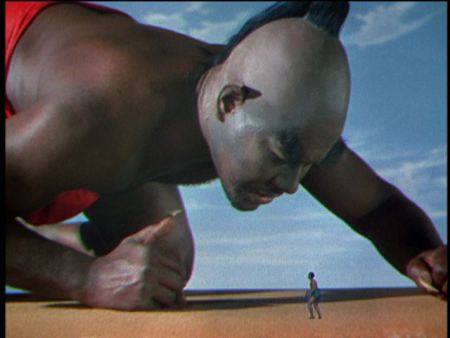
    PHOTO: Rex Ingram as the Djinn in “The Thief of Bagdad”

  • Arabian Nights Cinematic Delights

    Arabian Nights Cinematic Delights

    Open sesame! It’s an Aladdin’s Cave of cinematic delights.

    This week on “Picture Perfect,” the focus is on tales from “The Arabian Nights.”

    These traditional folk stories from the Orient have come down to us filtered through the sensibilities of Western translators. Further translation was required to get the stories from page to screen; so it’s hardly surprising to find Sinbad, for instance, fighting a giant walrus at the North Pole.

    The film versions are often showcases for the work of production designers and special effects artists, but composers have certainly gotten in on the act with appropriately imaginative scores.

    Bernard Herrmann lent plenty of color and wit to the skeleton duel in “The Seventh Voyage of Sinbad” (1958) by employing a battery of castanets, xylophone and brass. Stop motion artist Ray Harryhausen was responsible for the memorable effects. “Sinbad” proved to be a dry run for the climax of “Jason and the Argonauts,” in which Harryhausen outdid himself by animating not one, but seven skeletons, and again, Herrmann supplied the music.

    Harryhausen animated two further Sinbad adventures – “The Golden Voyage of Sinbad” (1974), and “Sinbad and the Eye of the Tiger” (1977). Over the course of the three “Sinbad” films, audiences were treated to fantastic encounters with, in addition to the skeleton, a Cyclops, a roc, a dragon, a statue of the goddess Kali, a centaur, a giant walrus, and a saber-tooth tiger, among others.

    “Sinbad and the Eye of the Tiger” was scored by Roy Budd. Budd’s reputation was largely that of a jazz musician and composer. He wrote scores for over 50 films, including “Get Carter” and “The Wild Geese,” before his early death of a brain hemorrhage at the age of 46, in 1993.

    Walt Disney created a modern classic in “Aladdin” (1992). The music was by Alan Menken, with lyrics by Howard Ashman and Tim Rice. “Aladdin” won Academy Awards for Best Original Score and Best Original Song (“A Whole New World”). Menken has a whole shelf full of Oscars for his work for Disney. Need I say, Robin Williams was the voice of the manic, freewheeling Genie?

    Rex Ingram’s Genie steals the show in “The Thief of Bagdad” (1940). Ingram emerges from his magic lamp and looms over a cowering Sabu, whom he addresses as “Little Master of the Universe.” The beach resounds with his maniacal laughter. There had been an earlier, justly celebrated, silent version of “Thief,” with Douglas Fairbanks. The remake splits the thief and the prince into two separate characters. Sabu plays the incorrigible Abu (the thief), and Conrad Veidt is his nemesis, the treacherous vizier Jaffar.

    The score is by three-time Academy Award winner Miklós Rózsa. Rózsa was in London, in the employ of Alexander Korda, when the lavish Technicolor production was moved to Hollywood on account of the Blitz. Rózsa would go on to become one of Hollywood’s greatest composers. His music for “Ben-Hur” alone has earned him a place in the film music pantheon. He never wrote a more charming score, however, than he did for this.

    I hope you’ll join me for an hour of cinematic enchantments. It’s “A Thousand and One Nights at the Movies,” on “Picture Perfect,” this Friday evening at 6:00 EDT, on WWFM – The Classical Network and wwfm.org.

  • Thief of Bagdad Rozsa Score Rediscovered

    Thief of Bagdad Rozsa Score Rediscovered

    If your three wishes would encompass a complete recording, in up-to-date sound, of one of the most enchanting film scores by Miklós Rózsa, you needn’t hold out for the discovery of a magic lamp. I hope you’ll join me for a recent release of a two-CD set, on the Prometheus label, of music from the classic 1940 fantasy-adventure “The Thief of Bagdad.” The City of Prague Philharmonic and Nic Raine have recorded the score, note-complete, with ample bonus material. Tune in to be transported. Take the magic carpet ride, this Friday at 6 p.m. EDT, on WWFM – The Classical Network and wwfm.org.

  • Orientalism in Film: A Musical Journey

    Orientalism in Film: A Musical Journey

    Orientalism is a term used to reflect evocations of the East by Western writers, artists and designers. This week on “Picture Perfect,” we’ll take a look at Orientalism in the movies, with musical selections from four films set in faraway lands.

    Two of them are loosely based on tales from “The Arabian Nights,” depicting the East as a kind of fairy world. The Alexander Korda production of “The Thief of Bagdad” (1940) features Sabu as the thief, Conrad Veidt as a slippery vizir, and a scene-stealing Rex Ingram as the djinn. The score is one of the earliest and most charming of Miklós Rózsa.

    “The Seventh Voyage of Sinbad” (1958) is really a showcase for the special effects of Ray Harryhausen. In particular, it contains a kind of rehearsal, in the skeleton duel, for the classic sequence in “Jason and the Argonauts.” The alternately sinuous and percussive music, by Bernard Herrmann, fits the images like a Persian slipper.

    Director David Lean turned to the historical exploits of T.E. Lawrence for “Lawrence of Arabia” (1962). The film won seven Academy Awards and made international superstars of Peter O’Toole and Omar Sharif. Maurice Jarre won the first of his three Oscars for his music. Jarre himself conducted on the film’s soundtrack, even though, for contractual reasons, Sir Adrian Boult received the screen credit.

    Finally, Sean Connery is Mulay Ahmed Muhamed Raisuli the Magnificent, sherif of the Riffian Berbers, in John Milius’ “The Wind and the Lion” (1975). The score represents composer Jerry Goldsmith at his finest. In fact, so happy was he with the effort that he was convinced that he finally had a lock on the Oscar – then he went to see “Jaws.” Goldsmith would finally be honored the next year for his music to “The Omen.”

    I hope you’ll join me for these examples of Orientalism at the movies – a theme that’s really an excuse for me to play some of my favorite scores – this Friday evening at 6 ET, with a repeat Saturday morning at 6; or that you’ll listen to it later as a webcast at wwfm.org.


    The skeleton duel from “The Seventh Voyage of Sinbad”:

    PHOTOS: Ingram in “The Thief of Bagdad” (top), with, left to right, Connery and Candice Bergen in “The Wind and the Lion,” Kerwin Matthews fighting the skeleton in “The Seventh Voyage of Sinbad,” and Peter O’Toole with Omar Sharif in “Lawrence of Arabia”

Tag Cloud

Aaron Copland (92) Beethoven (95) Composer (114) Film Music (120) Film Score (143) Film Scores (255) Halloween (94) John Williams (185) KWAX (229) Leonard Bernstein (100) Marlboro Music Festival (125) Movie Music (135) Opera (198) Philadelphia Orchestra (88) Picture Perfect (174) Princeton Symphony Orchestra (106) Radio (87) Ralph Vaughan Williams (85) Ross Amico (244) Roy's Tie-Dye Sci-Fi Corner (290) The Classical Network (101) The Lost Chord (268) Vaughan Williams (103) WPRB (396) WWFM (881)

DON’T MISS A BEAT

Receive a weekly digest every Sunday at noon by signing up here


RECENT POSTS