Tag: The Three Stooges

  • A Still Presence Behind the Stooges

    A Still Presence Behind the Stooges

    For his many achievements – as the first Black American composer to write a symphony, the first to conduct a major U.S. orchestra, and the first to compose an opera, among other things – William Grant Still would be recognized as the “Dean of Afro-American Composers.” But face it, even under the best of circumstances, a full-time composer has to scramble to make ends meet. Still was not alone in seeking employment in Hollywood, which could always be counted on, once you were in, for a decent paycheck.

    However, unlike some of his peers, he was employed mostly as an orchestrator and a composer of “additional music.” One of the films he worked on was Dimitri Tiomkin’s “Lost Horizon” in 1937. John Williams did the same kind of work for Tiomkin on “The Guns of Navarone” in 1961, and we all know how that worked out for him. Still was never given his shot to break into the upper echelon, the way so many white composers who did the same kind of grunt work were. To my knowledge, he never even received a screen credit, but if you know differently, please correct me!

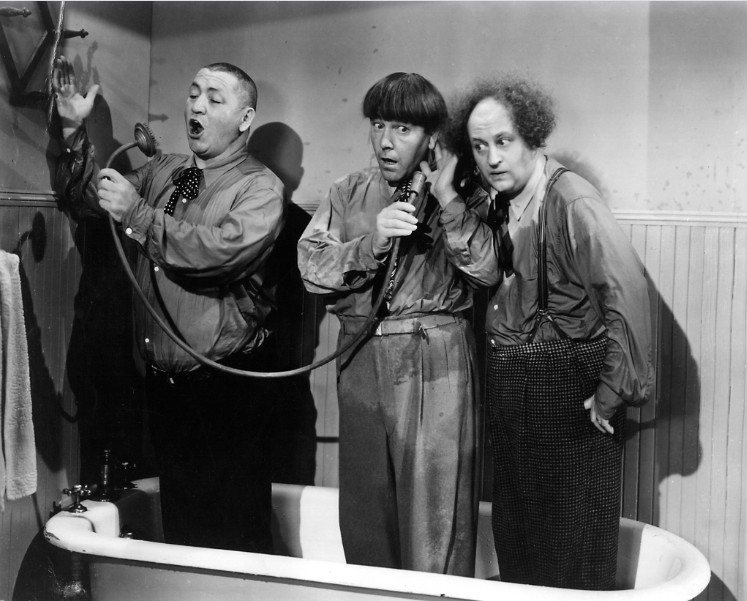
    A number of his cues were recycled as “library music” to fill out scores for B-movies and television shows. I was reminded of this yesterday by my friend (and former editor) Dan Aubrey, who will be accompanying me tonight to The Three Stooges Film Festival at the Princeton Garden Theatre, when he made a quip about Still’s music accompanying “eye gauging and cranium pounding.” Allegedly, Still’s work was indeed used in some of the Stooges’ shorts. I’m not sure which ones, and IMDB is no help in this regard, but I will listen more carefully, whenever I go back and watch them.

    In the 1950s, he compiled his “Laredo Suite” for use in television westerns, such as “Gunsmoke,” “Have Gun, Will Travel,” and “Rawhide.” (He had written music for a number of film westerns starring Charles Starrett.) Still was far from the only composer to do this. Bernard Herrmann put together some suites of mood music and action cues to be dropped into CBS westerns. The difference is that, even if he wasn’t always credited on the shows, Herrmann was a headliner at the movies.

    Still’s involvement with the Stooges is funny and sad at the same time. During the 1930s and ‘40s, Aaron Copland (the “Dean of American Composers”) was scoring prestige pictures such as “Our Town” and “Of Mice and Men.” He was even recognized with an Academy Award for his work on “The Heiress.”

    Of course, Still wasn’t alone among talented composers who toiled on the Hollywood production line, but as a Black musician, it’s doubtful he would have been able to rise much higher in mainstream movies until at least the 1960s, after Otto Preminger hired Duke Ellington to score “Anatomy of a Murder,” in 1959, and Quincy Jones made his mark with “The Pawnbroker,” in 1964. And even then, would he have been accepted if the music he wrote wasn’t “jazz”?

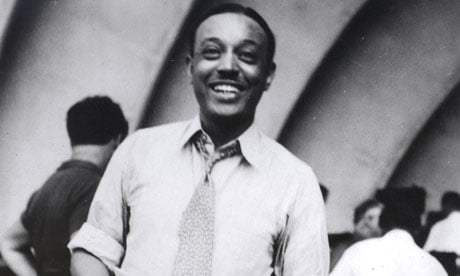
    While laboring anonymously in motion pictures of the 1930s, Still conducted a concert at the Hollywood Bowl with the Los Angeles Philharmonic. On July 23, 1936, he presented his “Afro-American Symphony.” It was the first time a Black man would conduct a major American orchestra. The next year, in August 1937, the work would be repeated on the first Hollywood Bowl program ever to be devoted exclusively to works by American composers.

    Still’s “Afro-American” remains one of my favorite American symphonies.

    https://www.youtube.com/watch?v=b9iGFLpO5Nk

    Fascinating reconstruction of Still’s “Laredo Suite,” library music for westerns, although I suspect the cuts have been posted out of sequence:

    https://www.youtube.com/watch?v=CpJQK1miHV4&list=PLgK8FIC-dBq-qGKj5r3vXlGSP3nd9jfq-

    Information on The Three Stooges Film Festival, tonight at the Princeton Garden Theatre:

    https://www.princetongardentheatre.org/films/three-stooges-garden
    ———-

    PHOTO: William Grant Still at the Hollywood Bowl
  • Larry Fine The Stooge From Philly

    Larry Fine The Stooge From Philly

    Porcupine!

    Larry Fine was born on this date in 1902. It’s been scientifically proven that all men know who Larry Fine is. For the benefit of the rest of you, Larry Fine was the bushy-haired, reactive Stooge. You know, the guy who stood there and mostly underplayed as Moe slapped the hell out of Curly. Until he himself became collateral damage.

    Fine was born Louis Feinberg at 3rd and South Streets in Philadelphia. The son of a watch repairman and jewelry shop owner, he was encouraged to take up the violin to counteract the effects of an acid burn, which damaged the muscles in his forearm when he was boy. The acid had been used by his father to test jewelry for gold content. Young Larry was about to drink the stuff, when his father slapped it away.

    Larry showed such dedication to the violin that his parents wanted to send him to study the instrument at a conservatory in Europe, but with the outbreak of World War I, he remained in Philadelphia. He took up boxing to further strengthen his arm and won his only professional fight, before his father put a stop to it.

    Larry brought his violin to the vaudeville circuit. It was there that he met Shemp Howard and the problematic Ted Healy. Healy, who was a raging alcoholic and notoriously abusive, would eventually come to a bad end under mysterious circumstances, possibly at the hands of Wallace Beery (the original onscreen “Champ”). These days, Healy is remembered, if at all, as the man who introduced The Three Stooges.

    Shemp was looking to take a break from Healy’s act for a few months, so he asked Larry if he might be interested in being a substitute “stooge.” The pay was good (Healy offered him an extra ten dollars a week if he would “throw that fiddle away”), so Larry was amendable.

    At first, he was tossed in with Bob Pinkus and Sam “Moody” Braun. Once Shemp returned, however, Larry, Shemp, and Shemp’s brother Moe – who had worked with Healy from the beginning – were brought together for the first time.

    Shemp would depart to pursue a solo career in film, working with W.C. Fields, Fatty Arbuckle, and Abbott and Costello. He was replaced by his and Moe’s younger brother, Jerome – better known as Curly.

    The reconfigured Stooges followed Healy to the big screen. Soon Healy was being groomed by MGM for a career as a solo comedian. The Stooges signed their own contract with Columbia and left their abrasive former boss in the dust. From the mid-1930s through the late-‘40s, The Three Stooges were the movies’ most popular short subject attractions. Shemp would return to the team after Curly suffered a stroke in 1946.

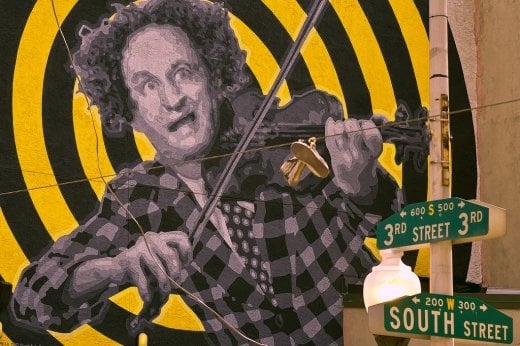
    Larry, Philadelphia’s native Stooge, is commemorated in a mural near his birthplace at 3rd & South. We’re coming up on the 20th anniversary of the original mural’s dedication on October 26, 1999. The mural was overpainted with another Larry mural in 2006.

    While we’re on the subject of boxers and violinists, Curly is unstoppable in his ascent to the championship, thanks to Larry’s stirring rendition of “Pop Goes the Weasel,” in “Punch Drunks” (1934):

    https://vimeo.com/60991844

    Happy birthday, Larry Fine!


    PHOTO: Larry, as immuralized in 2006

Tag Cloud

Aaron Copland (93) Beethoven (95) Composer (114) Film Music (141) Film Score (143) Film Scores (255) Halloween (94) John Williams (195) KWAX (229) Leonard Bernstein (103) Marlboro Music Festival (125) Movie Music (156) Mozart (89) Opera (212) Philadelphia Orchestra (89) Picture Perfect (174) Princeton Symphony Orchestra (108) Radio (88) Ross Amico (244) Roy's Tie-Dye Sci-Fi Corner (290) The Classical Network (101) The Lost Chord (268) Vaughan Williams (103) WPRB (396) WWFM (881)

DON’T MISS A BEAT

Receive a weekly digest every Sunday at noon by signing up here


RECENT POSTS