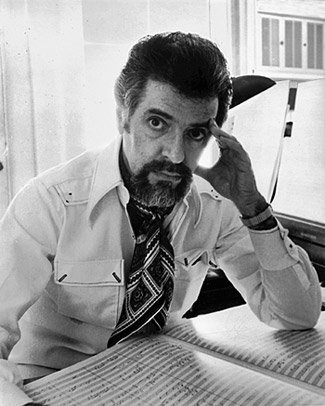
Today marks the 100th anniversary of the birth of Jerry Fielding.
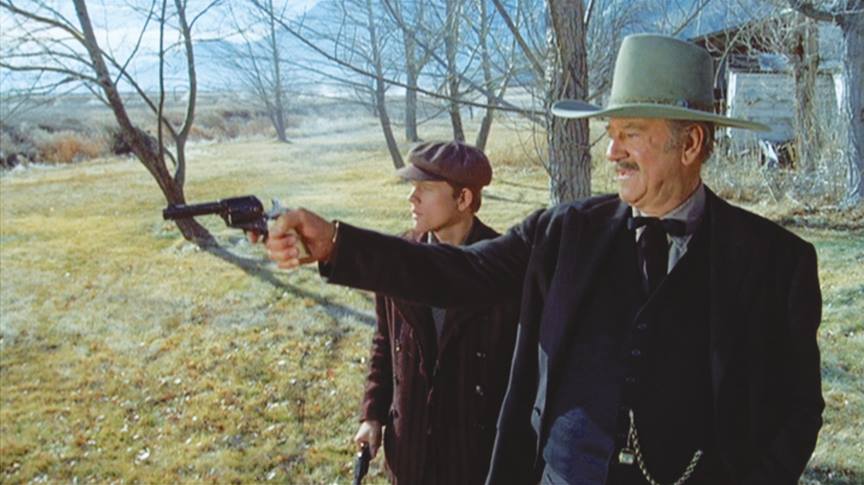
Fielding was Sam Peckinpah’s composer of choice, though things didn’t always go smoothly between them. (Fielding claimed they resolved their differences with their fists.) Fielding is probably most celebrated for his score to Peckinpah’s landmark revisionist western “The Wild Bunch” (1969), for which he received his first Academy Award nomination. He was also nominated for his work on Peckinpah’s “Straw Dogs” (1971) and his first collaboration with Clint Eastwood, “The Outlaw Josey Wales.” (1976).
Another frequent collaborator was director Michael Winner, whose biggest hit was “Death Wish” (which Fielding did not score). For Winner, he wrote music for “Lawman” (1971), the first jazz-inflected western, the period drama “The Nightcomers” (1971), in which Marlon Brando shares a cigarette with an ill-fated frog, and “The Big Sleep” (1976), with Robert Mitchum.
Other notable films included “Scorpio” (1973), “The Bad News Bears” (1976), “The Demon Seed” (1977), “The Gauntlet (1977), and “Escape from Alcatraz” (1979).
Fielding was born Joshua Itzhak Feldman to Russian immigrant parents who settled in Pittsburgh. By 1930, “Joshua Itzhak” had already been discarded, but it was in 1947, when he went to work for Jack Paar, that he was asked to change his surname, which he was told was too Jewish. Fielding later stated he was frequently conscious of anti-Semitic prejudice while working in the entertainment industry, which is ironic since many of his employers and colleagues were Jewish.
In high school, he picked up the trombone, then switched to clarinet. He did well enough that he earned a scholarship to the Carnegie Institute of Instrumentalists. However, his attendance there was cut short by a mysterious illness that left him bedridden for two years. The radio was a constant companion, and he developed preferences for big band and Bernard Herrmann (who was then music director at CBS). Decades later, Fielding’s Oscar nomination for “Outlaw Josey Wales” placed him in direct competition with his early hero, as Herrmann was also nominated for his scores to Brian De Palma’s “Obsession” and Martin Scorsese’s “Taxi Driver.” Both composers lost to Jerry Goldsmith for “The Omen,” Goldsmith’s only Oscar.
Fielding began working as a freelance musician in Pittsburgh, where he played in a pit band with the likes of Henry Mancini, Errol Garner, and Billy May, and cut his teeth as an arranger. He left Pittsburgh to work for Alvino Rey’s swing band. When war broke out, he was deemed too frail for service. Instead, he became the chief arranger for Kay Kyser, whom he followed to radio.
He became the band leader for several shows. He worked with Groucho Marx as his music director on “You Bet Your Life,” both on radio and television. Though he himself was never a communist, he was called to testify before the House Un-American Activities Committee. He later joked that all the committee really wanted was to get him to name Groucho Marx as a communist, which he refused to do. Instead, he took the Fifth, and he was blacklisted. He suspected the real reasons for the Committee’s hostility had to do with his support for FDR, his joining the Radio Union (which all radio performers did), and his hiring of racially-integrated musicians for his bands. He survived the next decade, and even thrived, by playing regularly in Vegas, touring, and recording.
It was Betty Hutton, with the backing of Desilu Productions (i.e. Lucille Ball), who insisted on hiring him as music director for “The Betty Hutton Show.” Otto Preminger, who had escaped Nazism and possessed no love for the methods of the Committee, made it a point to hire blacklisted artists. Fielding gained entrance into motion pictures when Preminger asked him to score “Advise and Consent” (1962).
This also got him back onto television. Among his other TV credits were “McHale’s Navy” and “Kolchak: The Night Stalker.” He scored a couple of “Star Trek” episodes, including “The Trouble with Troubles.” He also wrote the theme music for “Hogan’s Heroes” and “The Bionic Woman.”
Fielding died of a heart attack in 1980 at the age of 57.
Hats off to Jerry Fielding on what would have been his 100th birthday.
“The Wild Bunch”
“The Nightcomers”
“Scorpio”
“The Outlaw Josey Wales”
“Hogan’s Heroes”
“The Bionic Woman”
Blacklisted Jerry throws a dance party
Rare interview with Jerry Fielding