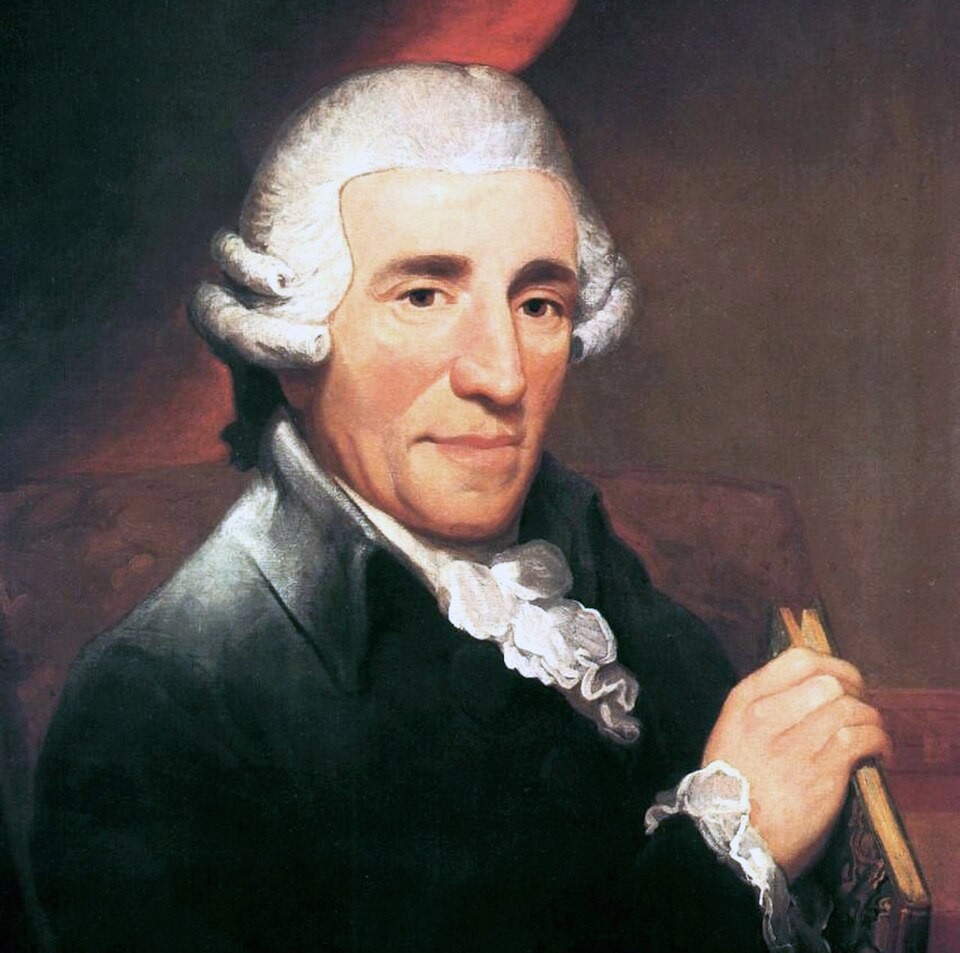
I got to know Franz Joseph Haydn through his symphonies. Although his oratorios aired on the radio occasionally, I was still too young to appreciate their excellence. It wasn’t until after I won Christopher Hogwood’s recording of “The Creation” in a drawing at one of Tower Records’ epic Presidents Day sales that I began to grasp their genius.
The location was the late, lamented Tower Classical Annex, at 6th & South Streets in Philadelphia. On Presidents Day, the doors would be propped open in an attempt to mitigate the heat generated by teeming shoppers crazed at the prospect of rare deals on labels that never went on sale. This was before the proliferation of internet outlets destroyed the industry and quashed the thrill of the chase.
The event was simulcast over Philadelphia’s classical music station of nearly 50 years, WFLN (now defunct). I quickly deduced that the time to cram the submissions box was whenever announcer Henry Varlack began to weave his way across the sales floor to retrieve a handful of slips. I won many treasures over the years (a friend of mine, who doesn’t even really listen to classical music, followed my example and won some audio equipment), but none more cherished than Hogwood’s “The Creation.” I saw the light with the chorus’ resounding “Let there be light!”
The L’Oiseau-Lyre release features Emma Kirkby, Anthony Rolfe Johnson, and Michael George, in their respective prime(s), at a time when historically-informed period instrument recordings were still gaining traction in the mainstream. It’s a set I enjoy to this day.
I can’t find the complete recording posted as a single file on YouTube, but here’s a contemporaneous concert performance, artfully illustrated by footage of our miraculous world and the wondrous creatures that inhabit it.
I first encountered Robert Moran’s music while browsing through the bins at Tower Records Classical Annex, then located at 6th & South Streets in Philadelphia. As was the custom, new recordings would be played over the sound system on the sales floor. On this particular occasion, one of the clerks put on “Arias, Interludes and Inventions,” a suite from the opera “Desert of Roses,” Bob’s take on the Beauty and the Beast fairy tale, premiered at Houston Grand Opera in 1992. Before I was wholly aware of what was happening, my heart had melted all over the polished hardwood floor. I floated to the counter to inquire what it was we were listening to, and an instant sale was made.
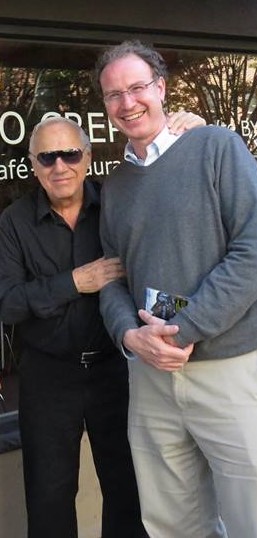
I first encountered Robert Moran in person a few years later, when he wandered into my original bookshop on South 17th Street. I didn’t recognize who he was until he handed me his credit card. “Robert Moran?” I said. “Any relation to the composer?” That kind of question has led to its share of enduring friendships. It turns out people like being recognized. (The exception was a certain principal of the Philadelphia Orchestra, who slinked out as soon as he could, never to return again!)
Although a small business owner, with all of the nightmarish zoning and tax obligations that entailed, I was also still very much a bohemian, with my living space extending off the back of the building, all German Expressionist-like, at the end of a long, crooked hallway, separated from the sales floor only by a magic curtain. On certain winter afternoons, you could smell the crock pot percolating in the kitchenette, not far from a mass of black mold that had formed around one of the many leaks in the stucco ceiling. (No stucco in the immaculately redone retail space.)
My record collection, already substantial, was rather modest by comparison to today’s library (which continues to expand with a tenacity any mold would envy). I laid my hand on Bob’s CD and was back in a flash.
He took the booklet and inscribed in his florid hand:
For Ross –
What a lovely
Surprise!! Wonderful
Luck – your
splendid Bookstore –
Robert Moran
Oct. 15, 1997
Phila
Bob gained notoriety in the late 1960s and early ‘70s through a series of “events” incorporating, respectively, the cities of San Francisco (“39 Minutes for 39 Autos”), Bethlehem, PA (“Hallelujah”), and Graz, Austria (“Pachelbel Promenade”). These involved tens of thousands of performers.
For “39 minutes for 39 Autos,” he enlisted skyscrapers, airplanes, radio stations, musicians, dancers, and yes, automobiles, to create a one-of-a-kind, purely-of-the-moment spectacular of light and sound. Sooner or later, such a thing was bound to occur to a composer living in San Francisco in 1969.
But he actually could could write music, too. Classical music’s merry prankster studied twelve-tone technique with Hans Erich Apostel in Vienna, before being accepted into a composition class of four at Mills College, where he was taught by Darius Milhaud and Luciano Berio. His classmates included Steve Reich, Phil Lesh, and Tom Constanten. Lesh and Constanten went on to play for The Grateful Dead. And Reich? Who knows what happened to that guy.
Bob was also influenced by Minimalism and became a friend and collaborator of Philip Glass. (On my wall is a signed poster for their collaborative opera “The Juniper Tree.”)
Last year, he composed a monodrama for God – yes, you read that correctly (in case you’re interested, God is a baritone) – and a 20-minute choral work, “Circles of Iron.”
He continues to experiment with aleatory, or chance elements. With Robert Moran, you never know what you’re going to get. In his more puckish moments, he might write for 39 autos, giant puppets, or an electric popcorn popper. But then there are times when his natural gift for lyricism will melt your heart.
Happy birthday, Bob! Let Bob eat cake!
Lo and behold, Robert Moran is the subject of today’s Composers Datebook, broadcast on classical music stations nationwide. Listen here.
As someone who lived and purchased records in Philadelphia for some 32 years, I hope you will enjoy reading this as much as I did. Anyone else remember Simon Roberts, who held court in the basement of Nathan Muchnik’s? I was just thinking about him the other day, recollecting his withering putdown of “deranged Bruckner fanatics,” even though it must be decades since he uttered it. How wonderful record shopping in Philadelphia used to be. Thank you, Princeton Record Exchange, for keeping the spark alive!
At the core of this blog post, at the first link, is a reminiscence by Mark Obert-Thorn. If you’re unfamiliar with him, look more closely at the credits of any vintage reissues in your collection. Philadelphia-born Obert-Thorn and Ward Marston have dominated the field of historical restoration for decades. I believe Obert-Thorn’s musings, reprinted here, originally ran in the Philadelphia Inquirer in 2016.
With the impending close of F.Y.E., this elegy for Center City record stores also ran in the Inky in 2016. I believe Peter Dobrin means the Schwann Catalog, not Schaum. I’m linking to Yahoo News, because the article in its Inquirer incarnation is paywalled.
Personally, I found F.Y.E. a mite soulless. You had to brave whatever head-splitting commercial swill they were pumping into the cavernous primary sales floor in order to reach the classical oasis in the back (once it was ejected from upstairs to make way for DVDs). I did, however, meet Wolfgang Sawallisch there and hear a mini-Liszt recital performed by Lang Lang. Come to think of it, that may have been when the store, located at Broad & Chestnut, was still Tower Records. As it was, that Tower never filled the hole in my heart left by the Tower Records Classical Annex at 6th & South. When that store closed, part of me went with it.
The line in Dobrin’s article that for me most resonates:
“Back when music was harder to get, listeners valued it more. When you spent a lot of time hunting for something, you reveled in the triumph of finding it.”
How many hours I spent on my back as a teenager, just listening to LPs and gazing at the cardboard sleeves, with their liner notes and eye-catching cover art. I learned as much about painting as I did about music back then, I think. When I only had a couple of crates of records, I knew every nuance, every crackle and pop so intimately. And intelligent classical music programming that honored the integrity of the music by broadcasting it in its entirely was available on the radio 24 hours a day. I miss those days so very, very much.
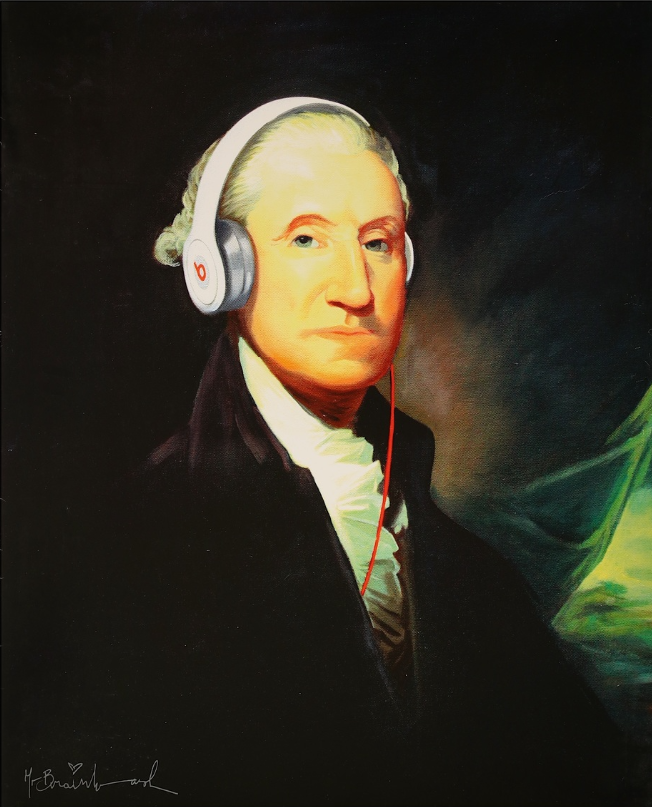
When I was a kid, Presidents Day brought heartfelt patriotic acknowledgements of the contributions of Washington and Lincoln. But in my 20s, it meant the biggest CD sale of the year at Tower Records!
During its heyday, Tower Records’ Classical Annex, at 6th and South Streets, was a beacon for classical music lovers in Philadelphia. Sure, there was the subterranean crevasse at Nathan Muchnick’s, near 18th and Walnut, where on an average day, the CDs were cheaper. And if Barnes & Noble, at Broad and Chestnut, had a sale, you could certainly pick up a bargain. But Tower was the only record store in Center City that was open until midnight, 365 days a year – which meant you could drop by after Philadelphia Orchestra concerts – and it could be counted on to carry all the new releases and much else beside.
Furthermore, it introduced a tantalizing cut-out bin that spanned the entire back of the store, in which overstocked items would be marked down to $6.99. In the days when full-priced CDs at Tower averaged around $16.99, this innovation had the effect of sending me into a delirium. How many Czech operas did I mine from that rack? How my pulse would quicken as I flipped through the superfluous blister packs. (Parenthetically, the New York branch at 4th and Broadway, with an entire store devoted to cut-outs, brought me one plane closer to Nirvana!)
When Tower Records had a sale on a major label (that is to say, Angel/EMI, Deutsche Grammophon, RCA/BMG, or Sony), the prices would drop to $11.99. But Presidents Day was something else entirely. That’s when the store would prop its doors – invariably, it was unseasonably mild, and the sun beating against the glass display windows only lent to the kinetic intensity of the roiling shoppers – and the perspiring crowds would flow in to partake of for-one-day-only, deeply-discounted merchandise, on arcane, seldom-marked-down-ever labels like BIS, Chandos, CPO, Lyrita, and Unicorn-Kanchana. And the majors would be marked-down even further.
I would scarf a slice of pizza beforehand to keep my blood sugar up and then essentially stage-dive into the crowd. Representatives from all the CD distributors were there, with name tags and ties, and hosts from WFLN, Philadelphia’s now-defunct classical music station, would broadcast live from a platform about three-quarters of the way toward the back of the sales floor.
On a counter in the front of the store was a kind of ballot box, in which you would stuff slips of paper bearing your personal information, and periodically these would be drawn for giveaways of free stuff. This is how I came to own Christopher Hogwood’s superlative recording of Haydn’s “The Creation,” among other treasures. It was very easy to win. All you had to do, as I explained to my friends, is wait until you saw WFLN’s Henry Varlack pushing toward the front of the store, and then cram in all your slips. Henry never went very deep into the box, and whoever was closest to the top usually walked away with a bounty. One of my friends, who wasn’t even a classical music guy, took home some stereo components.
Of course, I was still living something of a bohemian existence back then. It was a lot for me to be able to scrape together a hundred or maybe a hundred-twenty dollars to blow on Presidents Day. This was also before secondhand record shops acquired a large influx of used classical CDs. Nowadays, a store like Princeton Record Exchange deals in volume, so to keep up the turnover, most discs are priced only a buck or two.
Viewed from the perspective of 2022, the Tower Records of decades ago might strike one as rather thin brew by comparison. But in those now-distant times, it was like an invitation to drift through Elysium for a day, and to return home elated with all your purchases and free stuff. There were always abundant catalogues and wish books and plenty of swag.
Nevermind the white sales. I never changed my sheets, anyway. For me, Presidents Day will always bring with it memories of Tower Records!
I just learned that today is the birthday of my friend, composer Robert Moran. I first encountered Bob’s music while I was scouring the bins at the now-defunct Tower Records Classical Annex, at 6th and South Sts., in Philadelphia. At a point, the suite, “Arias, Interludes and Inventions,” from his opera “Desert of Roses,” came out over the speakers, and my heart broke a little bit. I added it to my collection immediately.
A number of years later, unbeknownst to me, Bob was browsing in my bookshop. I think he tried to pay with a credit card, which is the kiss of death when dealing with Classic Ross Amico. I inquired if he happened to be the composer, and we’ve been pals ever since. Naturally, I had my recording of “Desert of Roses” on hand, and Bob penned me a very nice inscription.
Happy birthday, Bob. Whether you’re writing for Houston Grand Opera, 39 autos, giant puppets, or electric popcorn popper, the music is always vital and worth getting to know.
An aria from “Desert of Roses”:
Selections from “Trinity Requiem”:
“Obrigado” for Iowa Percussion:
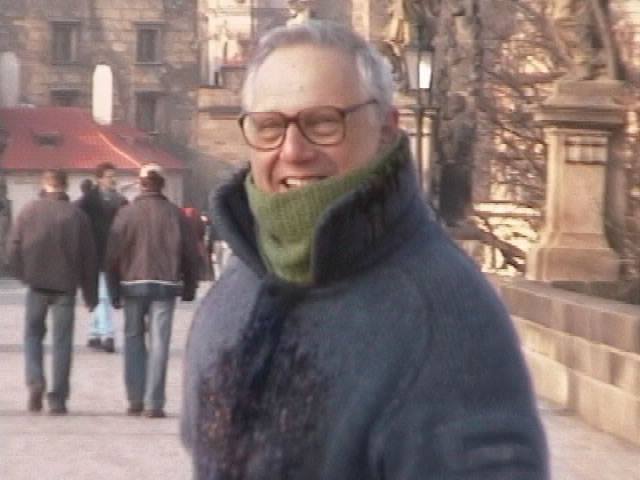
Bob, looking groovy in merry prankster mode, introducing his “Lunchbag Opera” for the BBC: