
This week on “The Lost Chord,” our ears will burn from the haughty and profane response of the Zaporozhy Cossacks to an ultimatum from Sultan Mehmad IV. The Sultan demanded the peaceful surrender of the Cossacks, after they had scored a glorious defeat against his Ottoman forces. To his giddy and inebriated foes, he was not exactly negotiating from a position of power.
Among Reinhold Glière’s works steeped specifically in Ukrainian lore is the symphonic poem/ballet “The Zaporozhy Cossacks,” based on the famous canvas by Ilya Repin. Glière, born in Kyiv in 1875, is best known for his ballet “The Red Poppy,” with its ubiquitous “Russian Sailor’s Dance,” and perhaps for his epic Symphony No. 3, “Ilya Muromets.”
In 1913, Glière attained an appointment to the school of music in Kyiv, which was raised to the status of conservatory shortly thereafter. Glière served as director of the conservatory from 1914 to 1920.
One of his pupils there was Boris Lyatoshynsky, who lived from 1895 to 1968. Lyatoshynsky was a student at the conservatory at the start. The first movement of his Symphony No. 1 was written as a graduation work. The other two movements followed in 1919.
The first performance of the piece took place under Glière’s direction in 1923. If you get all sweaty listening to the orchestral works of Alexander Scriabin, you certainly won’t want to miss this, an opulent work by a young man determined to impress.
I hope you’ll join me for “Steppe Lively” – classical music from Ukraine – on “The Lost Chord,” now in syndication on KWAX, the radio station of the University of Oregon!
——–
Clip and save the start times for all three of my recorded shows:
PICTURE PERFECT, the movie music show – Friday at 8:00 PM EST/5:00 PM PST
SWEETNESS AND LIGHT, the light music program – Saturday at 11:00 AM EST/8:00 AM PST
THE LOST CHORD, unusual and neglected rep – Saturday at 7:00 PM EST/4:00 PM PST
Stream them, wherever you are, at the link!
https://kwax.uoregon.edu/
——–
If you aren’t too squeamish, you can read more about the Cossacks’ reply, with a rough (and I do mean rough) translation here. The translation was removed from a Wikipedia page about the painting, but preserved in a screenshot taken for the purpose of Ukrainian studies by the Department of Slavic Languages and Literatures at the University of Toronto.
https://tarnawsky.artsci.utoronto.ca/courses/Cossacks/Reply%20of%20the%20Zaporozhian%20Cossacks%20-%20Wikipedia,%20the%20free%20encyclopedia.pdf
——–
IMAGE: Ilya Repin’s “Reply of the Zaporozhian Cossacks” (1880-1891)
Tag: Ukraine
-

Carol of the Bells Ukraine’s Cry for Freedom
After generations as one of the most hypnotic of Christmas songs, “Carol of the Bells” regains the political significance of its first appearance here in the United States 100 years ago.
This most indelible of carols was originally conceived by Mykola Leontovych (1877-1921) as “Shchedryk,” a New Year’s carol, in 1914. Traditionally, it is sung in Ukraine on the eve of the Julian New Year (January 13). The title is derived from the Ukrainian word for “bountiful.” The original text is about a swallow that foretells great fortune with the arrival of spring:
A little swallow flew
and started to twitter,
to summon the master:
“Come out, come out, O master,
look at the sheep pen,
there the ewes have yeaned
and the lambkins have been born
Your goods are great,
you will have a lot of money.
If not money, then chaff:
you have a dark-eyebrowed wife.”
Shchedryk, shchedryk, a shchedrivka,
A little swallow flew.The song was popularized in the West, following a performance at Carnegie Hall in October 1922 by the Ukrainian Republic Cappella (a.k.a. Ukrainian National Chorus ), a group that Leontovych co-founded. The concert was the first stop of a North American tour, designed to assert Ukraine’s independence and affirm its cultural identity. Two months later, Ukraine was part of the Soviet Union.
American choral master Peter Wilhousky, himself of Ukrainian stock, was in the Carnegie Hall audience. He later outfitted the melody with English lyrics to create “Carol of the Bells.”
Ironically, Christmas secured not only Leontovych’s immortality, but also his doom. He happened to be visiting his parents’ house at Christmas in 1921, when a traveler came to the door and requested lodging for the night. The stranger was put up in a room with Leontovych. At sunrise, Leontovych was shot and the family robbed.
The murder may have been politically motivated. As noted, the Ukrainian Republic Cappella was active in promoting Ukrainian independence, and Leontovych had made his share of enemies. His eldest daughter recalled him saying that he had documents that would allow him to leave the country for Romania. He claimed those papers had been rifled through. Also, the stranger turned out to be an agent of the secret police.
“Carol of the Bells” was brought back to Carnegie Hall earlier this month, performed by the Ukrainian Bandurist Chorus of North America and Ukrainian Shchedryk Children’s Choir, as part of a program to support Ukraine in its latest struggle.
Peace on earth and good will toward men is an ongoing project.
PHOTOS: St. Sophia Cathedral tower bells, Kyiv; Ukrainian National Chorus on tour in 1922 (one of the stops, Princeton University); Ukrainian Shchedryk Children’s Choir at Carnegie Hall in 2022
-
Ukraine: Culture Under Attack in Kharkiv and Odessa
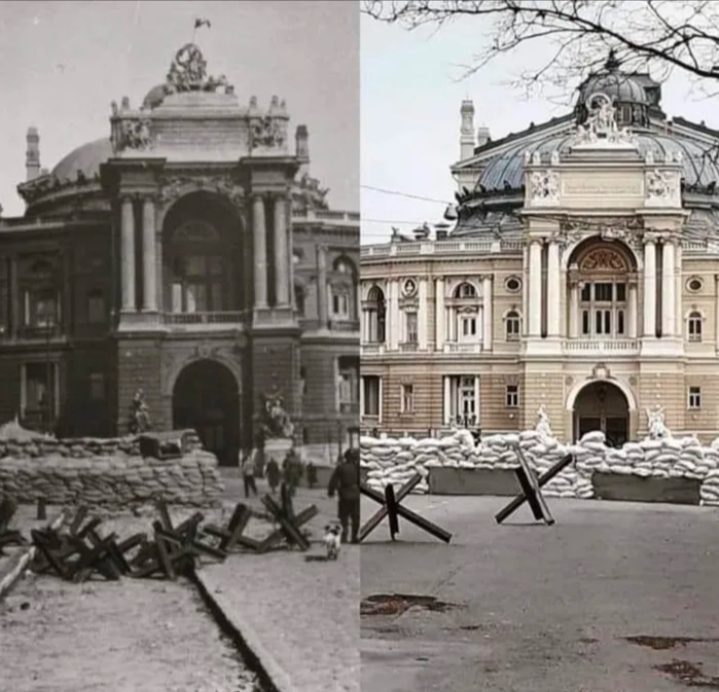
Kharkiv’s opera house and neighboring Philharmonic have been shelled. The opera house in Odessa is behind sandbags.
Of course, these are centers of leisure. They are not residences or hospitals or schools or marketplaces. Their loss may seem insignificant beside atrocity, misery, and mounting loss of life.
But as centers of culture, they are also powerful symbols, as culture is the very opposite of war. It implies cultivation, provides inspiration, and celebrates aspiration. It embodies the highest ideals, the very apex of what separates civilization from barbarity. When the opera houses are going full-steam, the only strife is on-stage. Okay, and maybe a little backstage.
But a strike on “Freedom” Square? Seriously? The next thing you’re going to tell me is that they’ve shelled Babi Yar.
Oh, wait a minute…
https://www.washingtonpost.com/world/2022/03/01/ukraine-russia-babyn-yar/
What would Shostakovich think?
TOP: Odessa National Academic Opera and Ballet Theatre (left, during World War II; right, today)
BOTTOM: Kharkiv State Academic Opera and Ballet Theatre
-
Ukrainian Classical Music Gliere and Lyatoshinsky
As you may know, WWFM is in the middle of its “Around the World in 80 Hours” pledge drive. On Wednesday, Rachel Katz and I were given one hour in Ukraine, which is hardly enough time to scratch the surface of such a rich musical heritage. It’s especially frustrating in the context of a pledge drive, when all of the selections need to be short and preferably upbeat.
This Sunday night on “The Lost Chord,” I attempt to assuage some of the frustration by revisiting Ukraine and programming lengthier pieces by two important omissions.
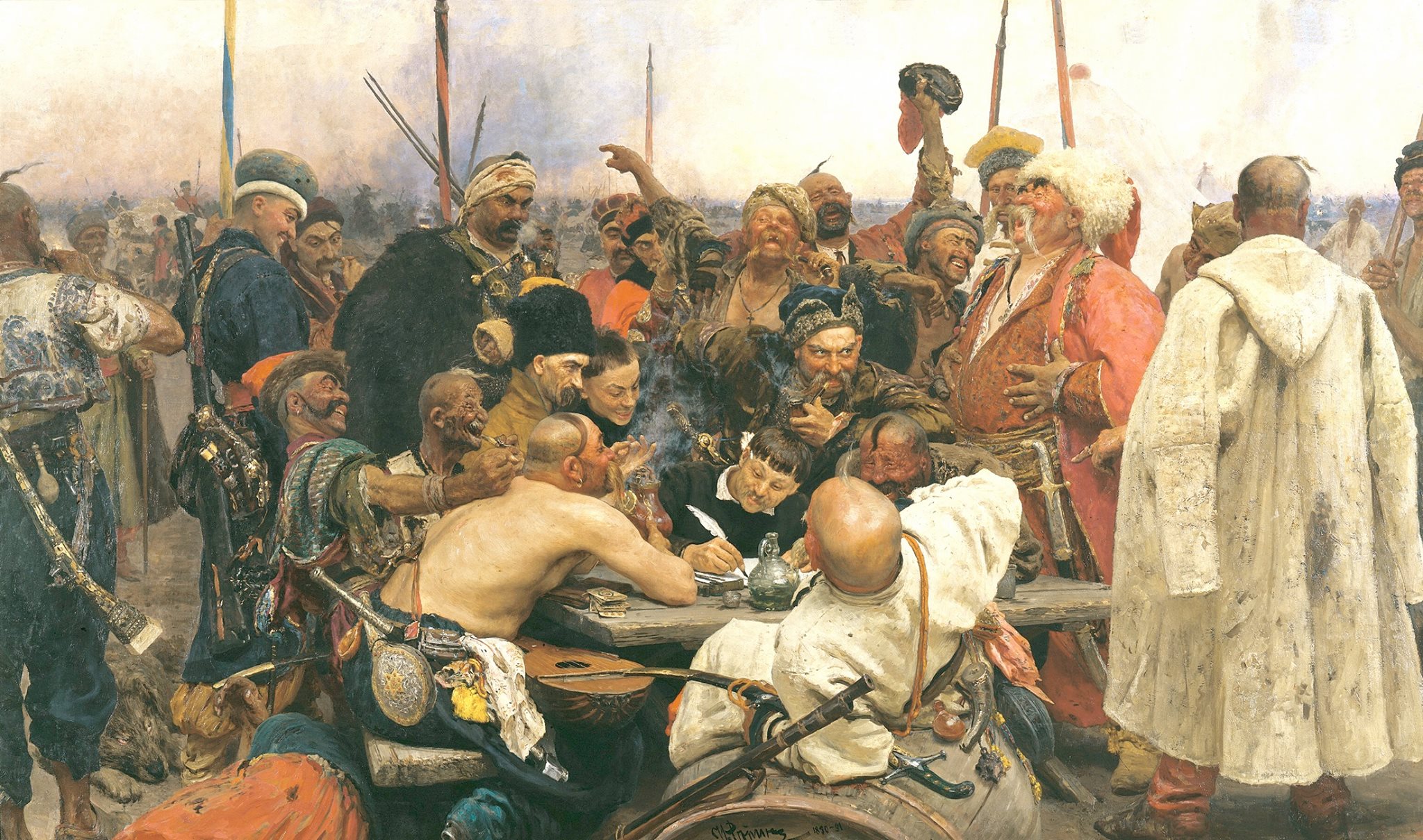
Reinhold Glière, best known for his ballet “The Red Poppy,” with its ubiquitous “Russian Sailor’s Dance,” and perhaps for his Symphony No. 3, “Ilya Muromets,” was born in Kiev in 1875. Among his works steeped specifically in Ukrainian lore is the symphonic poem/ballet “The Zaporozhy Cossacks,” based on the famous canvas by Ilya Repin.
In 1913, Glière attained an appointment to the school of music in Kiev, which was raised to the status of conservatory shortly thereafter. Glière served as director of the conservatory from 1914 to 1920.
Among his pupils there was Boris Lyatoshinsky, who lived from 1895 to 1968. Lyatoshinsky was a student at the conservatory at the start. The first movement of his Symphony No. 1 was written as a graduation work. The other two movements followed in 1919.
The first performance of the piece took place under Glière’s direction in 1923. If you get all sweaty listening to the orchestral works of Alexander Scriabin, you certainly won’t want to miss this, an opulent work by a young man determined to impress.
I hope you’ll join me for “Steppe Lively” – classical music from Ukraine – tonight at 10 ET. PLEASE NOTE: because of the pledge drive, the show will not be repeated on Wednesday. However, if you miss it tonight, you can listen to it later as a webcast – and pledge online – at wwfm.org.
PHOTO: Ilya Repin’s “Reply of the Zaporozhian Cossacks”
Tag Cloud
Aaron Copland (93) Beethoven (95) Composer (114) Film Music (144) Film Score (143) Film Scores (255) Halloween (94) John Williams (195) KWAX (229) Leonard Bernstein (104) Marlboro Music Festival (125) Movie Music (159) Mozart (90) Opera (212) Philadelphia Orchestra (89) Picture Perfect (174) Princeton Symphony Orchestra (109) Radio (88) Ross Amico (244) Roy's Tie-Dye Sci-Fi Corner (290) The Classical Network (101) The Lost Chord (269) Vaughan Williams (105) WPRB (397) WWFM (881)