Tag: Undine

  • Carl Reinecke: A Forgotten Master

    Carl Reinecke: A Forgotten Master

    Today marks the bicentennial of the birth of Carl Reinecke (1824-1910). What, no fireworks? Perhaps there should be.

    Reinecke lived an unusually long life for his day. But it is the amount of incident crammed into that life that makes it seem even more so.

    A musical prodigy who composed from the age of 7, and performed in public from the age of 12, Reinecke lived and worked in Copenhagen, Paris, Cologne, and Leipzig. He studied with Felix Mendelssohn, Robert Schumann, and Franz Liszt. His concert tours took him all over Germany, Denmark, Sweden, and the British Isles.

    He taught in Cologne, Breslau, and Leipzig. Among his pupils were Isaac Albéniz, Max Bruch, Ferruccio Busoni, Mikalojus Čiurlionis, Edvard Grieg, Leoš Janáček, Julius Röntgen, Christian Sinding, Charles Villiers Stanford, Johan Svendsen, and Felix Weingartner. Furthermore, he was music director of the Leipzig Gewandhaus Orchestra for 35 years. (The final, seven-movement version of Brahms’ “Ein deutsches Requiem” was among the works he premiered.)

    Somewhere along the way, he found time to compose. I mean a lot. Look at the opus numbers on the links below! Operas, symphonies, concertos, chamber music, and instrumental works – some 300 pieces published. As if that’s not enough to make one sit up and take notice, it’s not far into the Opp. 200s that he’s writing in the 20th century. Think about that. I don’t know, it blows MY mind. It really brings home just how short music history is.

    At the time of his birth, Beethoven and Schubert were still alive. In fact, he was born the same year Schubert wrote his “Death and the Maiden” quartet. He died the year Alban Berg wrote HIS String Quartet. It was a totally different world.

    Toward the end of his life, between 1904 and 1907, Reinecke made some 27 piano rolls, 12 of which document performances of his own music. He was the earliest born musician to have his artistry as an interpreter preserved in any format. Among the other composers whose music he “recorded” were Haydn, Mozart, Beethoven, and Schumann.

    He died in 1910 at the age of 85.

    And where is he now? Flutists, I suppose, still know “Undine.” Pianists may be familiar with the cadenzas he wrote for the Mozart and Beethoven concertos. He also composed a fun “Toy Symphony” I used to enjoy broadcasting around Christmas.

    Mostly, however, his works remain cherished secrets for the blessed few, like holy relics preserved in the hearts and libraries of the most devout musical monastics.

    You’ll find plenty to enjoy below. Take a few minutes today to celebrate Carl Reinecke!


    Flute Sonata in E minor, Op. 167 “Undine” (1882) – the subtitle alludes to a novella by Friedrich de la Motte Fouqué, very popular among the Romantics, that tells the story of a water spirit who marries a knight in order to gain a soul

    Flute Concerto in D major, Op. 283 (1908)

    Harp Concerto in E minor, Op. 182 (1884)

    Piano Concerto No. 3 in C major, Op. 144 (1877)

    Violin Concerto in G minor, Op. 141 (1876), composed for Joseph Joachim

    Toy Symphony, Op. 239 (first 15 minutes of this LP)

    Piano Quartet in E-flat major, Op. 34 (1853)

    https://www.youtube.com/watch?v=R45wVXFx6ac

    Trio in A minor for Clarinet, Viola, and Piano, Op. 264 (1903)

    https://www.youtube.com/watch?v=bM1IG1Wm7nU

    Octet for Winds in B-flat major, Op. 216 (1892)

    Hupfeld piano roll, c. 1908, of Reinecke and his wife, Margharite, playing selections from his suite “Nutcracker and Mouse King,” composed in 1855 – predating Tchaikovsky’s ballet on the same subject by nearly 40 years

    More piano rolls

    https://www.forte-piano-pianissimo.com/carlreinecke.html

    Reinecke cadenza for Mozart Piano Concerto No. 21


    Carl Reinecke: He had the chops – mutton and otherwise
  • Telemann to Water Sprites via Henze

    Telemann to Water Sprites via Henze

    How does one get from Telemann to water sprites? By way of Hans Werner Henze, of course! Anyone who knows me knows that I’ve got rusalkas and mermaids on the brain anyway. Join me this afternoon on The Classical Network for a complete performance of Henze’s ballet “Undine” (more about that below).

    First, on today’s Noontime Concert, we’ll have a lovely and engaging program of Telemann duos, courtesy of Gotham Early Music Scene (GEMS). Telemann was as energetic as he was long-lived, learning instruments, radiating music, and even publishing a magazine, “Der getreue Music-Meister” (“The Faithful Music-Master”), in which he would introduce new instrumental pieces. The magazine appeared every two weeks. Deborah Booth and Louise Schulman will present some of these works on a concert of sonatas for recorder or traverso (Booth) and viola (Schulman).

    The program was given at St. Bartholomew’s Church, 50th Street and Park Avenue, in Midtown Manhattan, where free concerts are held every Thursday at 1:15 p.m. This Thursday, Bourbon Baroque will perform Luigi Boccherini’s “Stabat Mater.” To find a complete schedule of lunchtime performances, look online at midtownconcerts.org.

    GEMS also presents evening concerts. The Clarion Choir and period brass players will perform Palestrina’s “Missa Papae Marcelli” at the Metropolitan Music of Art on Friday at 7 p.m. Also on Friday, Empire Viols will present “Strictly Continental,” with music by Sainte-Colombe, Marais, Vivaldi, Schenck, and Krebs, at 7:30 p.m., at the Church of the Transfiguration, One East 29th Street, in the NoMad neighborhood of Manhattan. On Satuday, Collectio Musicorum will perform a program of music from the Renaissance and beyond, at 7 p.m., at Eltingville Lutheran Church, 300 Genesee Avenue, in Staten Island.

    Gotham Early Music Scene is a non-profit corporation that supports and promotes artists and organizations in New York City devoted to early music – music of the Middle Ages, Renaissance, Baroque, and early Classical periods. For more information and GEMS’ events calendar, look online at gemsny.org.

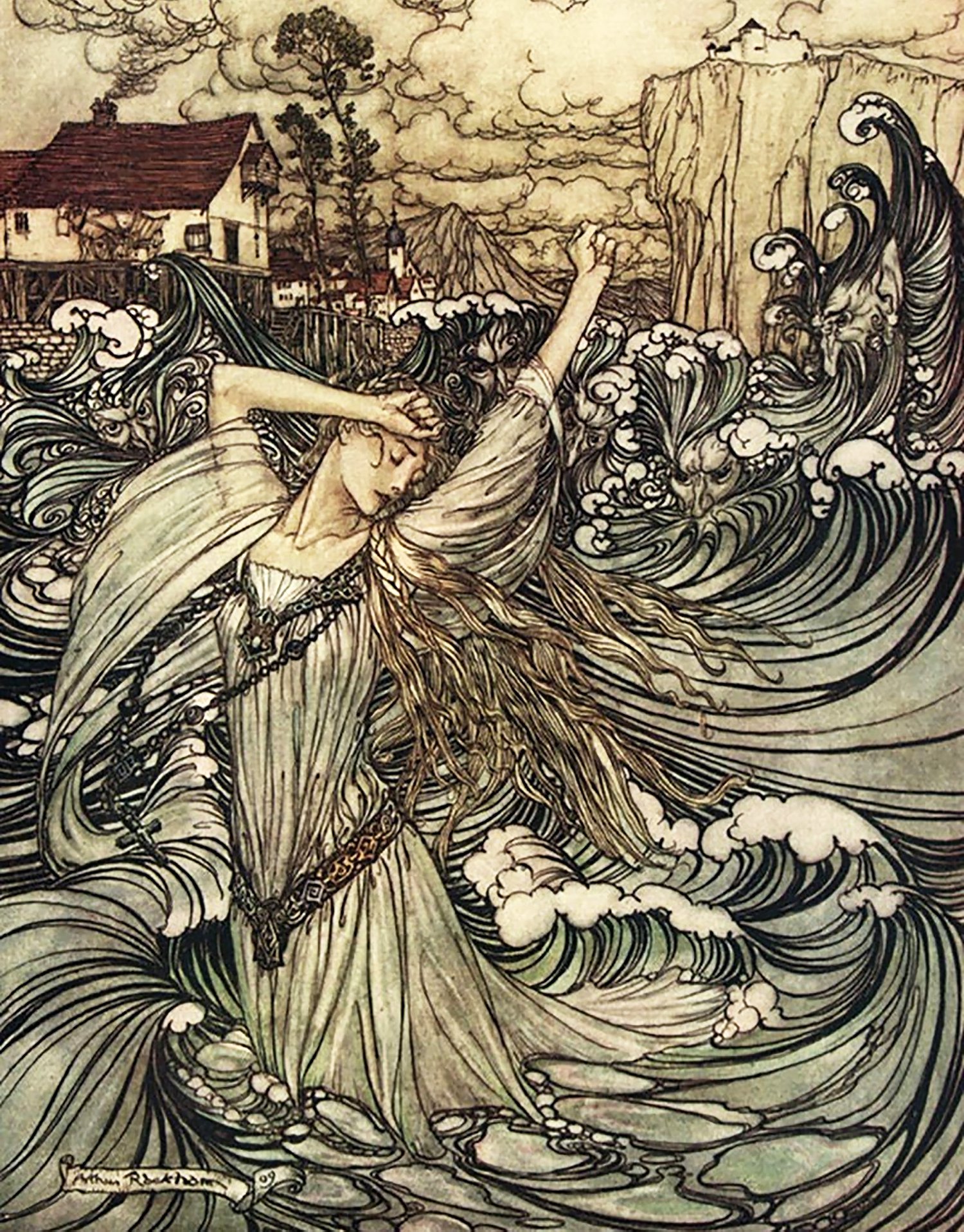
    To fill out the noon hour, we’ll hear Henze’s “Telemanniana.” That should provide a nice segue to the aforementioned ballet. Henze wrote the score for “Undine” on a commission from Frederick Ashton in 1958. (Ashton originally presented the ballet under the title “Ondine.”) The subject is the Romantic and influential novella by Friedrich de la Motte Fouqué. The tale is remarkably similar to the one told by Hans Christian Andersen, in “The Little Mermaid,” and Dvořák, in the opera “Rusalka.” All three deal with the ill-fated love between a water sprite and a mortal.

    Because of a scheduling conflict, Ashton’s first choice of composer, Sir William Walton, turned down the offered commission. Walton recommended Henze in his place. Ondine became one of the signature roles of the Royal Ballet’s prima ballerina, Margot Fonteyn.

    I hope you’re a strong swimmer. It will be water sprites and spritely Telemann, from 12 to 4 p.m. EDT, on WWFM – The Classical Network and wwfm.org.

  • Water Spirits in Music Rusalka Week Special

    Water Spirits in Music Rusalka Week Special

    There have been innumerable pieces of music written about water spirits – sirens, naiads, lorelei, undines, mermaids and melusinas. This Sunday night on “The Lost Chord,” we’ll sample just a couple of these for Rusalka Week.

    In Slavic mythology, a rusalka is a spirit that dwells at the bottom of a river or lake. She lures unsuspecting men with her song, invariably resulting in a watery doom. Rusalki are never more dangerous than in early June, when the spirits roam free.

    Rusalka Week plays a role in Rimsky-Korsakov’s opera, “May Night,” drawn from Gogol’s collection, “Evenings on a Farm Near Dikanka.” Alexander Dargomizhsky’s opera, “Rusalka,” is based on a dramatic poem by Pushkin. And the best known of the bunch, Dvorak’s “Rusalka,” was inspired by Czech fairy tales of Karel Jaromir Erben and Bozena Nemcova.

    Of course, we won’t be listening to any of these. (We’ve treated Rimsky and Dargomizhsky in the past.) Instead, we’ll have a flute sonata from 1882, by Carl Reinecke, which bears the subtitle “Undine,” an allusion to a novella by Friedrich de la Motte Fouqué, which was very popular among the Romantics. Fouqué’s Undine tells the tale of a water spirit who marries a knight in order to gain a soul.

    Then we’ll hear the complete ballet, “Les Sirènes,” from 1946, by Lord Berners. Berners, notorious for his sense of the absurd (a horse was a regular guest at his indoor tea parties) was a talented composer, writer and painter. “Les Sirènes,” on a scenario devised by Frederick Ashton, features mermaids combing their hair and singing on rocks at a seaside resort, where sirens of another sort behave coquettishly on shore.

    That’s “Come on in, the Water’s Fine.” PLEASE NOTE: Due to the egregious length of the Sunday opera (Wagner’s “Parsifal,” beginning at 3 p.m. ET), “The Lost Chord” will begin one hour later than usual, at 11. The repeat will air Thursday at the same time.

    You don’t want to be out walking during Rusalka Week anyway, so why don’t you stay indoors and enjoy the show? Or listen to it later as a webcast at http://www.wwfm.org.

Tag Cloud

Aaron Copland (92) Beethoven (95) Composer (114) Film Music (120) Film Score (143) Film Scores (255) Halloween (94) John Williams (185) KWAX (229) Leonard Bernstein (100) Marlboro Music Festival (125) Movie Music (135) Opera (198) Philadelphia Orchestra (88) Picture Perfect (174) Princeton Symphony Orchestra (106) Radio (87) Ralph Vaughan Williams (85) Ross Amico (244) Roy's Tie-Dye Sci-Fi Corner (290) The Classical Network (101) The Lost Chord (268) Vaughan Williams (103) WPRB (396) WWFM (881)

DON’T MISS A BEAT

Receive a weekly digest every Sunday at noon by signing up here


RECENT POSTS