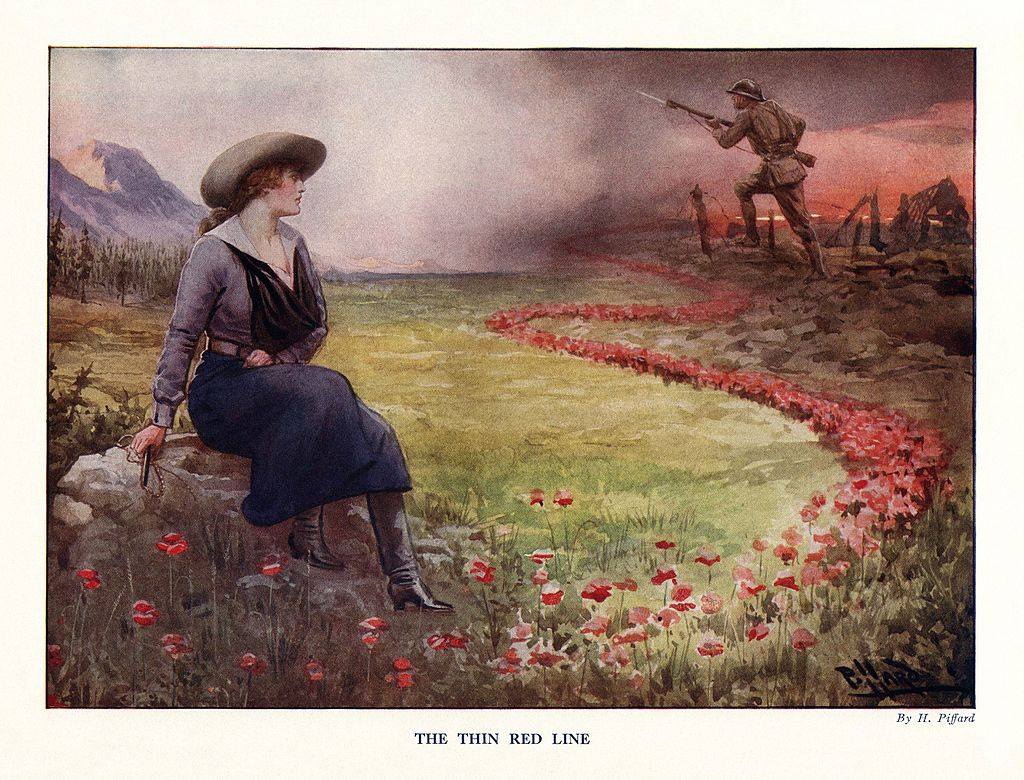
As federal offices lag behind on their observances of Veterans Day (which was yesterday, thank you very much), we’ll listen to works by American composers who served in the U.S. Armed Forces. Join me in the 5:00 hour for music by Romeo Cascarino, Samuel Barber, William Grant Still, and a new release on Navona Records/PARMA Recordings by Samuel A. Livingston of The Blawenburg Band.
We’ll also mark the birthday, beginning at 4:00, of everyone’s favorite chemist-composer, Alexander Borodin, with some of his music, as well as that of his colleagues of the Mighty Handful, or the Russian Five.
Finally, we’ll remember Slovak soprano Lucia Popp on the anniversary of her birth.
It’s a late afternoon and early evening of musical and military veterans, from 4 to 7 p.m. EST, on WWFM – The Classical Network and wwfm.org.
For Veterans Day, here’s a piece of music that could serve double-duty, for both today and Memorial Day. Sadly, it is almost never performed at all.
John Foulds composed his massive oratorio, “A World Requiem,” between 1919 and 1921 to honor the memory of all those – of whatever nation – who fell during WWI. The text, in English, was assembled by his wife, Maud MacCarthy, the work’s dedicatee, who compiled it from the Requiem Mass, sundry Biblical passages, selections from John Bunyan’s “The Pilgrim’s Progress,” a poem by Kabir, and her own original material.
The oratorio falls into 20 movements (in two parts of ten each) for soloists, massed choirs (including children’s choirs), large orchestra, offstage instrumentalists, and organ. A progressive tonal framework is spiced with quarter tones, cluster chords and certain repetitive sequences.
It was first performed on Armistice Night (now Veterans Day in the United States), November 11, 1923, in Royal Albert Hall, by up to 1,250 musicians. The work was embraced by the public, though critical reaction was mixed. Subsequent performances took place from 1924 to 1926 as part of a Festival of Remembrance. Then the work lay neglected for some 80 years until revived in 2007 by the forces in this recording, under the direction of the indefatigable Leon Botstein.
Part I
1 I Requiem – 8:44
2 II Pronuntiatio – 4:05
3 III Confessio – 5:46
4 IV Jubilatio – 5:06
5 V Audite – 7:04
6 VI Pax – 3:53
7 VII Consolatio – 5:08
8 XIII Refutatio – 0:38
9 IX Lux Veritatis – 1:19
10 X Requiem 3:25
45:08
Part II
1 XI Laudamus – 6:30
2 XII Elysium – 6:24
3 XIII In Pace – 3:17
4 Hymn of the Redeemed – 4:37
5 XIV Angeli – 3:27
6 XV Vox Dei – 3:07
7 XVI Adventus – 4:01
8 XVII Vigilate – 2:03
9 XVIII Promissio et Invocatio – 7:30
10 XIX Benedictio – 1:41
11 XX Consummatus 2:06
It’s Veterans Day. Nearly a century ago, in May 1915, Canadian military doctor Maj. John M. McCrae composed the poem “In Flanders Fields,” after treating victims of a German chemical attack in Belgium. It captured the imagination of millions so that red poppies became a widely recognized symbol of Veterans Day.
In Flanders fields the poppies blow
Between the crosses, row on row,
That mark our place; and in the sky
The larks, still bravely singing, fly
Scarce heard amid the guns below.
We are the Dead. Short days ago
We lived, felt dawn, saw sunset glow,
Loved and were loved, and now we lie
In Flanders fields.
Take up our quarrel with the foe:
To you from failing hands we throw
The torch; be yours to hold it high.
If ye break faith with us who die
We shall not sleep, though poppies grow
In Flanders fields.
The text became the basis for the second of “Three War Songs,” by Charles Ives:
On a lighter note, here’s Ives himself singing the third, “They Are There!”
My grandfather served in World War II. He was an engineer, a sergeant, who was involved in construction and demolition. Among other things, he and his men built and blew up bridges. My uncles had medical conditions that kept them out of Vietnam. I feel very fortunate never to have had to experience modern warfare. I can’t imagine what my grandfather had to endure. He didn’t have people shooting at him all the time, but the war was no picnic, and though he had lots of funny stories, he had some close calls and did some desperate things. There are things about the war he never talked about. Some he revealed to me only toward the end of his life.
He died in 1996. At his viewing, it was mostly family, until the door opened and in walked a stranger, an old man in uniform. He had come to say farewell to his sergeant and friend, someone he had not seen for 50 years. Those of us who weren’t there, in Europe, in the Pacific, can only imagine what it was like. A simple night’s sleep could be interrupted at anytime. Of course, you couldn’t smoke, because the glowing tip of a cigarette was as good as a target.
One night, a German plane malfunctioned. Everyone heard the engine sputter, but there was no moon, and there was nothing to do but scramble blindly for shelter. My grandfather took refuge under a jeep. After the explosion, the men went to look for the body. All they found were the pilot’s feet.
In the Pacific, they had to transport nitroglycerin over some rough terrain. I gather from one of his murkier stories that someone took a shot at them.
The flag that was draped over my grandfather’s coffin was displayed on our mantle until my mother passed. It is now in the possession of my aunt.
I think of my grandfather often. I wonder what it was like to leave a young wife behind to risk everything in Europe, only to be sent to the Pacific. He talked about waves so powerful, they would dent the hull of a ship. After the war, he saw to it that all of his men found a way home. There was no organization, so everyone had to hitch rides with cargo or whatever they could get. But in the end, he did make it back.
From his image, captured in black and white photographs of the time, everyone remarks how much I look like my grandfather. The similarity ends there.