It may seem like odd timing to drop a program about war right into the middle of the holidays, but I can’t change the timing of Pearl Harbor.
On the morning December 7, 1941, a Japanese strike force of 353 aircraft strafed and bombed the United States naval base in Hawaii, killing thousands of American servicemen and civilians, and precipitating the country’s entry into World War II.
It seems almost crass that such violence and massive loss of life would inspire so much popular entertainment, but such is the imprint of war, and especially a surprise attack on a nation at peace, on the American psyche.
This week on “Picture Perfect,” we’ll revisit some of John Williams’ music for films set during the war. While none of them take place during the actual attack, two of them are set in the Pacific theater, and one of them is a comedy (!) about mass hysteria gripping the people of Los Angeles and its environs in the days following. We’ll also hear a solemn hymn to those who sacrificed everything for a greater good.
Only six months after Pearl Harbor, America struck back, devastating the Japanese fleet in a battle that is regarded as one of the turning points of the war. “Midway” (1976) was a belated big-screen dramatization of the event, featuring an all-star cast of war movie standbys, including Charlton Heston, Henry Fonda, James Coburn, Glenn Ford, Hal Holbrook, Toshiro Mifune, Robert Mitchum, and Cliff Robertson.
Unfortunately, the cast of old-timers, combined with abundant stock footage from “Tora! Tora! Tora!” and actual period newsreels, may have saddled the film with an all-too-palpable sense of “been there, done that.” Williams does his best to freshen things up with a rousing, patriotic score and a crackerjack victory march. (Fun fact: “Midway” was one of only four films ever to be presented in theater-rumbling Sensurround.)
Days in advance of the birthday of Frank Sinatra (born December 12, 1915), we’ll also hear music written for the Chairman’s only project as a director. “None But the Brave” (1965) – in which he also starred – presents Japanese and American units forced to coexist, and even cooperate, after they are stranded on a Pacific island. The film is also notable for being the first Japanese-American co-production and bears a somewhat forward-looking anti-war message. The music is a fascinating glimpse of Williams’ work from ten years before his mega-success with “Jaws.”
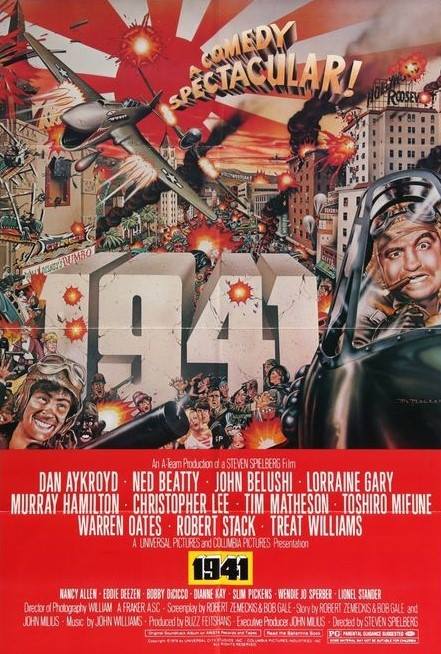
“1941” (1979) is just plain weird. Steven Spielberg’s too-big-to-fail to gamble stumbles pretty badly, following his back-to-back blockbusters, “Jaws” and “Close Encounters of the Third Kind.” The premise – a Japanese u-boat sighting off the coast of California triggering an overabundance of slapstick panic – posits, just because you’re paranoid doesn’t mean they’re not out to get you. It’s a mad, mad, mad, mad war.
“1941” employs an incredible amount of talent, from its behind-the-scenes effects artists, to screenwriters Robert Zemeckis and Bob Gale, to its dream cast pushing as hard as it possibly can. It also features a once-in-a-lifetime opportunity to see Toshiro Mifune and Slim Pickens in the same scene. But for the most part, perhaps unsurprisingly, it fails to deliver the laughs. What it does deliver is the most rousing of John Williams’ neglected scores.
Spielberg actually approached John Wayne about appearing in the film. Wayne was too ill to participate, but offered the following advice: “You know, that was an important war, and you’re making fun of a war that cost thousands of lives at Pearl Harbor. Don’t joke about World War II.” Whether or not audiences agreed, they didn’t exactly queue up as they did for Spielberg’s previous successes.
We’ll strike a more reverent tone with “Hymn to the Fallen” from “Saving Private Ryan” (1998) – not set in the Pacific, granted, but the U.S. may never have gotten to Normandy had it not been for the inexorable events set in motion by December 7, 1941.
Unfortunately, this is not “Star Wars,” but a real war that killed tens of millions and destroyed the lives of countless others. John Williams covers the subject from four different angles this week, on “Picture Perfect” – music for the movies – this Friday evening at 6:00 EST, on WWFM – The Classical Network and wwfm.org.
IMAGE: The Pearl Harbor comedy that will live in infamy