Last week was a really a crazy one for me. I had to so much to do in an abbreviated amount of time (since everyone had off on Friday, in anticipation of the holiday) and the madness only intensified yesterday, since not only was it the Fourth of July, but it was my birthday. And on my birthday, it’s never just about me. Because there are family obligations and entertaining to be done. And c’mon, it was America 250! However, my entire life it’s been like that, more or less. Never be born on a holiday! But at least I’ve always got off work. All the same, I’m always glad whenever the festivities are over and we can all just get back to our own routines.
I wasn’t even able to finish everything I *needed* to get done, so of course I neglected to promote a special marathon of American music that was broadcast yesterday of WHRB, the radio station of Harvard University. Every year, my friend Mather Pfeiffenberger makes the trek back to his alma mater to share a special Fourth of July program, and this year was set to be a doozy. Unfortunately, Mather wound up being stuck in D.C., but he was able to enlist a trusted colleague, Jonathan Lehrich, to share his thoughtfully curated playlist and some of his insights into the music.
I only got to catch a little of it yesterday, but I must say, the selections I heard were exceptional, and many of them are things you will never hear on the radio – live concert recordings, historic documents of such vintage they would never be considered for air play anywhere else, and more – alongside interesting performances of certified American classics, some of them offered in alternative editions. Seriously, if you care about American classical music and you think you just can’t listen to another performance of “Victory at Sea” or the “Grand Canyon Suite,” do check this out. I know an awful lot, and there were things on this show I have never heard.
But how can I listen, you say, if the show was yesterday? Surely, we ALL can’t fit into Classic Ross Amico’s time-traveling DeLorean…
Well, you’re in luck, because the show is archived at the WHRB website for the next two weeks. Visit whrb.org, run your cursor over PROGRAMMING, and from the dropdown box select BROADCAST ARCHIVE.
Ignore any pop-ups and DO NOT click the box (if you get it) that reads ACTIVATE YOUR ACCOUNT TO START. I’m not sure if it’s actually affiliated with the station, or if it’s just a phishing scam. Either way, you don’t need to register. Simply click the box under BROADCAST ARCHIVE that says YESTERDAY (if you’re seeing this after Sunday, the box will read JULY 4). Then click 1:00 to start. The program ran from 1:00 to 10:00 p.m.
I am eager to hear it myself. Enjoy!
To learn more, here’s a link to Mather’s Facebook post about the broadcast:
https://www.facebook.com/permalink.php?story_fbid=pfbid0zt9jCsuZdjT7ZNAd4m1a8JyMQQ7zqMPwHSVjay8hKGWp4R4SaLFwbJcSNmpuMg4El&id=100093688583899
Tag: WHRB
-
Worthwhile American Music Marathon Archived for a Limited Time on WHRB
-

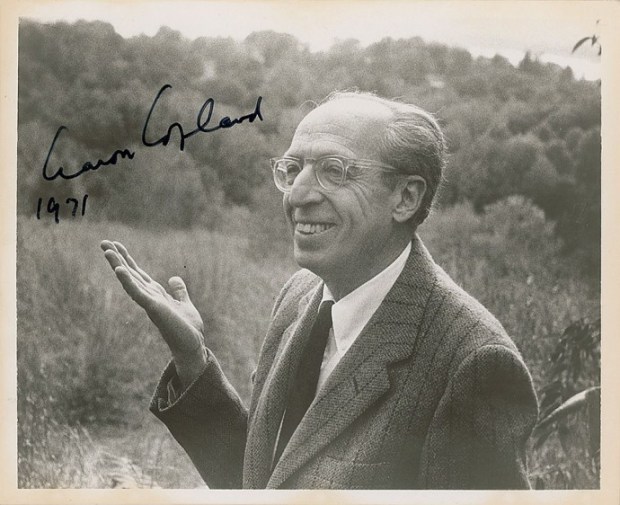
Aaron Copland, on the 35th Anniversary of His Death
Aaron Copland died on this date in 1990. By that time, the grand old man of American music was deep in my heart. I can’t believe there was ever a time that I didn’t care for his cowboy ballets, but I didn’t like them when I first encountered them. Where was my soul?
Yeah, I liked “Appalachian Spring” and of course “Fanfare for the Common Man,” but it wasn’t until I left my small town for college in the big city that listening to Copland tore my heart out. In a good way. The man was the voice of an idealized America. 35 years later, I wonder if he still is?
Unquestionably, he was the most prominent and influential American classical music composer of his generation. He helped distill and elevate the variety and dynamism of our distinctly American idioms and for the first time place them on a competitive footing with most of what Europe had to offer.
He himself was quintessentially American. Born in Brooklyn in 1900 to hard-working Jewish immigrants, he lived through Tin Pan Alley and the Jazz Age, the Great Depression, and two world wars. In between, he studied in France, where he was exposed to and assimilated influences from the best of Europe. He experimented with modernist techniques, immersed himself in jazz and American folk song, and internalized the brave new world of serialism. Despite this restless curiosity, he never lost his own, distinctive voice.
I always marvel, when viewing documentaries about prominent figures who emerged from that era, at just how much people of Copland’s generation lived through. We see black and white photos of kids dressed like sailors or rolling hoops with sticks for entertainment – and then, decades later, here they were, in suit and tie, still walking among us. At least, that’s the way it was back then. In the 1980s, we were maybe 40 years from their most important achievements. Now we’re 40 years from the 1980s. Do younger people, in the field or otherwise, care anymore? Do they even remember?
1990 was a rough year for American music. Leonard Bernstein, who smoked too much, died in October at the age of 72. We had a good thing going here, in terms of building on what seemed to be a solid foundation for a domestic art music. Certainly artists continue to compose, but there doesn’t appear to be any centralized school of composition anymore. It’s a diverse country, so I suppose it was inevitable that our music would return to the eclecticism from which it emerged. Historical “lines” are often constructs anyway, as there is always significant activity going on outside the mainstream, beyond that which is endorsed by the establishment.
I love Copland, and he could be a generous man, but I can’t help but feel bad about his public humiliation of Alan Hovhaness. Hovhaness had received a scholarship to study at Tanglewood. It was in Bohuslav Martinů’s composition class that a record of Hovhaness’ “Exile Symphony” was played. The work, like much of Hovhaness’ music, is steeped in Eastern influences. The whole while, Copland was transparently disinterested, carrying on conversations in Spanish with his Latin American students. Afterward Bernstein mocked it at the piano, characterizing it as “ghetto music.” The comment, which was met with derisive laughter, was especially insensitive, as the work was Hovhaness’ response to the Armenian genocide. But none of us is perfect, and this was a rare lapse for Copland, who did so much to help so many.
Americans are still underrepresented on the podiums of this country’s major orchestras, and American music comprises the merest fraction of what is performed in our concert halls. Things are better for the living than for those of the “Greatest Generation.” It’s not uncommon for a new work to open a concert. But you’re not going to encounter too many full-length American symphonies on the second half of a program.
Contrast that with the American composers who came up during the Depression and were active at mid-century. Copland has certainly been luckier than most. We still encounter a number of the major works on concert programs, but these are selected largely from a narrow span of some 20 years, give or take, out of his overall output. And that’s probably about as good as it gets. But it’s not all that different from what we hear of most of the European masters. The same handful of works, played over and over. It’s a big deal if somebody programs a Haydn symphony that doesn’t bear a nickname.
On October 2, 1990, I remember listening to WFLN, Philadelphia’s (now-defunct) classical music station, which had been in existence since 1949 – the year Copland composed his Academy Award winning film score for “The Heiress.” My future WWFM colleague Bill Shedden came on that evening to share the sad news that Aaron Copland had died. It’s difficult to describe the emotions I felt, as Shedden broadcast, by way of memorial, Copland’s second set of “Old American Songs.” It was the classic recording with baritone William Warfield and the composer conducting. It was a beautiful choice. I remember regretting that I never wrote him – an actual letter, in those pre-internet days – to tell him just how much his music meant to me.
Anyway, it’s always been a part of me, and I am looking forward to the listening to the quixotic, 5-day, 41-hour marathon of his music coming up on Harvard’s radio station, WHRB, beginning at 1:00 this afternoon, EST. If you’d like to know more about it, I wrote about it yesterday. Here’s a link to the post.
https://rossamico.com/2025/12/01/fanfare-for-an-uncommon-copland-broadcast
Stream the signal at https://www.whrb.org/
And spread the word among your music-loving friends!
———-
PHOTO: Copland and Bernstein with the score to “El Salón México”
-
Fanfare for an Uncommon Copland Broadcast
Brace yourself for an uncommon fanfare for America’s musical master.
Harvard University’s undergraduate-run radio station, WHRB, will present a 41-hour AARON COPLAND ORGY® to commemorate the 125th anniversary of the composer’s birth. The five-day marathon will begin tomorrow – the 35th anniversary of Copland’s death – and will be broadcast at the following times:
Tuesday, December 2, through Friday, December 5, from 1 pm-10 pm EST, and Saturday, December 6, from 4:15pm-9 pm EST. The programs will be livestreamed at whrb.org and the listings made available at whrb.org/guide.
YOU WILL HEAR THINGS ON THESE BROADCASTS YOU WILL NOT ENCOUNTER ANYWHERE ELSE.
Sure, there will be the usual suspects: “Fanfare for the Common Man,” the ballets on Western and pioneer themes, “Lincoln Portrait,” and the Symphony No. 3. However, some of these will be presented in their original or rarely-heard complete versions. Some will be played from unusual and/or historical documents.
There will also be exclusive performances and selections from talks and interviews with the composer taken from the station’s own archive. Even if you think you know Copland, I guarantee you will hear things on this series you have never heard before.
My friend, Mather Pfeiffenberger, who conducted one of those interviews back in 1977 and produced Copland orgies in 1975, 1980, and 2000, was instrumental in mobilizing the WHRB Classical Music Department to embrace this unmissable opportunity to celebrate this watershed composer, who has been described by conductor Leon Botstein as “the undisputed central figure of American 20th century classical music.” Mather has returned to his alma mater for the week to anchor some of the historical segments and provide talking points for the spoken introductions.
These broadcasts will trace Copland’s creative development, from his early, European-influenced works, through his jazz-tinged modernist pieces of the 1920s, the more abstract works of the late ‘20s and early ‘30s, the spacious Americana of his “populist” period of the ‘30s and ‘40s, and his excursions into serialism in the 1950s and ‘60s.
Copland’s style was incredibly eclectic and evolved constantly throughout his life. He distilled an indelible “American” sound, with his open harmonies, active rhythms, lean textures, economy of means, and directness of expression. At the same time, his engagement with most of the major musical trends of the 20th century – European, and later American modernism, jazz, folksong, music for use, and serialism – evinced an openness to the world that we like to think of as a quality that exemplifies America at its best.
With the impending 250th anniversary of the United States’ declaration of independence, in 2026, this is a good time to delve deep into the “Dean of American Composers.”
WHRB has been presenting Orgies (and yes, Orgy® is a registered copyright), exhaustive, exhausting celebrations of given artists’ compositions and recordings and explorations of different genres and themes, since 1943, when, legend has it, a certain Harvard student, in a burst of euphoria, chose to mark the completion of his exams by sharing all nine of the Beethoven symphonies from 78 rpm records (which would have involved side changes every few minutes). The stunt caught on, and the Orgy® concept expanded to include jazz, rock, hip-hip, blues, and even sports.
I wonder what Copland, always a reserved man, would have thought about being the focus of a five-day Orgy®?
Can’t stop the Copland, starting tomorrow at 1 pm EST on WHRB!
The broadcasts will be available for streaming for up to two weeks after the original air dates at https://whrb.org/stream-archive/
Tag Cloud
Aaron Copland (94) Beethoven (95) Composer (114) Film Music (149) Film Score (143) Film Scores (255) Halloween (97) John Williams (197) KWAX (232) Leonard Bernstein (105) Marlboro Music Festival (125) Movie Music (164) Mozart (91) Opera (215) Philadelphia Orchestra (90) Picture Perfect (174) Princeton Symphony Orchestra (110) Radio (90) Ross Amico (244) Roy's Tie-Dye Sci-Fi Corner (290) The Classical Network (101) The Lost Chord (269) Vaughan Williams (107) WPRB (397) WWFM (881)