This week on “Picture Perfect,” with the arrival of spring, we travel to “England’s green and pleasant land” for an hour of documentary music. The playlist will include scores by some of the country’s most respected composers.
We’ll hear selections by Ralph Vaughan Williams, from “The People’s Land” (1941), Benjamin Britten, from “The King’s Stamp” (1935), William Alwyn, from “The Green Girdle” (1941), and Master of the Queen’s Music, Sir Arthur Bliss, from “The Royal Palaces of Britain” (1966). All four films are patriotic utterances on distinctly English themes.
Historically, in the United States, writing music for the movies has often been regarded as “hack work,” but overseas it has been accepted as just another aspect of what it means to be a working artist. There is no disgrace in a composer earning a living, and some of the nation’s greatest musicians – including those in the employ of the Royal Family – have contributed finely-crafted scores to its body of cinema.
You may not have seen any of these shorts, but the music sure is beautiful. I hope you’ll join me for music from English documentaries, on “The Lost Chord,” now in syndication on KWAX Classical Oregon!
——–
Clip and save the start times for all three of my recorded shows:
PICTURE PERFECT, the movie music show – Friday at 8:00 PM EDT/5:00 PM PDT
SWEETNESS AND LIGHT, the light music program – Saturday at 11:00 AM EDT/8:00 AM PDT
THE LOST CHORD, unusual and neglected rep – Saturday at 7:00 PM EDT/4:00 PM PDT
Stream them, wherever you are, at the link!
https://kwax.uoregon.edu
——–
In the meantime, if you’re having a slow day, why not get a taste of the films themselves?
“The People’s Land,” score by Vaughan Williams:
https://film.britishcouncil.org/resources/film-archive/the-peoples-land
“The King’s Stamp,” score by Benjamin Britten:
https://www.dailymotion.com/video/x21r04k
“The Green Girdle,” score by William Alwyn:
https://www.youtube.com/watch?v=YOlnnshTsvQ
Tag: William Alwyn
-

Spring Into Documentary Music from England’s Green and Pleasant Land
-
Doreen Carwithen Unsung Film Composer
This week on “Picture Perfect,” we’ll shine a light on the shamefully underutilized talent of Doreen Carwithen.
In 1941, Carwithen studied harmony and composition with William Alwyn at London’s Royal College of Music. For both, it was love at first sight. Their fateful pairing led to a decades-long romance that culminated in their marriage, finally, in 1975.
The reason for the delay was, unfortunately, at the time of their meeting, Alwyn happened already to be married. The double-life caused tremendous stress. Alwyn, in particular, descended into alcoholism and suffered a nervous breakdown. Finally, his doctor urged him that, if he was going to live at all, he should get on with it already and live honestly.
In the concert hall, Alwyn – a contemporary of William Walton and Michael Tippett – enjoyed comparative success as a symphonist. Carwithen, too, got off to a promising start. Her overture “ODTAA (One Damn Thing After Another)” was conducted by Adrian Boult at Covent Garden in 1947. She also wrote two award-winning string quartets. But the cinema promised more lucrative employment. Carwithen was the first selected by J. Arthur Rank to enter the college’s new film music program.
Combined, during their heyday, in the 1940s and ‘50s, Alwyn and Carwithen wrote the music for over 100 films. Alwyn, in particular, scored such high-profile projects as “The Crimson Pirate,” “A Night to Remember,” and “The Swiss Family Robinson.” Carwithen, although groomed for the very purpose, was not given the same opportunities. In all, she scored only six dramatic features. The rest were documentaries and shorts.
Neither were her concert works, though well-received, met with the same enthusiasm or eagerness by either programmers or publishers. In 1961, she became Alwyn’s secretary and amanuensis, and following his death in 1985, devoted herself to the preservation of his legacy.
Following her own death, in 2003, discovered among her papers were sketches for an unfinished string quartet (her third), a symphony, and a cello concerto. One can only imagine that, as an artist, her potential remained unfulfilled.
We’ll do our best to level the playing field for an hour, anyway, dividing the program between Alwyn and Carwithen, 50/50, this week, on “Picture Perfect,” music for the movies, now in syndication on KWAX, the radio station of the University of Oregon!
Clip and save the start times for all three of my recorded shows:
PICTURE PERFECT, the movie music show – Friday at 8:00 PM EST/5:00 PM PST
SWEETNESS AND LIGHT, the light music program – Saturday at 11:00 AM EST/8:00 AM PST
THE LOST CHORD, unusual and neglected rep – Saturday at 7:00 PM EST/4:00 PM PST
Stream them, wherever you are, at the link!
-

Alwyn’s Autumn Legend Grief and Rossetti
On William Alwyn’s birthday, the desolation of this piece seems particularly apt. Scanning some online commentary, I’m surprised to find some hear in it calm and nostalgia. More expectedly, others detect in it seasonal intimations, no doubt suggested by the title, “Autumn Legend.” The composer himself described it as “unashamedly romantic.” I don’t hear it, unless he means it very much in the 19th century sense, the exquisite melancholy of pining at a loved one’s tomb. I detect only grief.
Alwyn claimed that as he wrote the piece he felt the presence of Dante Gabriel Rossetti (the walls of his studio were hung with Rossetti’s paintings). The score is prefaced by a quote from Rossetti’s poem “The Blessed Damozel,” inspired in part by Edgar Allan Poe’s “The Raven.” Poe’s poem embodies earthly grieving for the departed; Rossetti flips the perspective, and conveys the damozel looking down on her lover from the beyond and yearning for their reunion in heaven.
As he sometimes did, Rossetti went on to illustrate the episode with a painting. The painting is something of a diptych, with a smaller, bottom panel depicting the damozel’s reclining lover.
“The Blessed Damozel” inspired several other pieces of music. Most frequently encountered is Debussy’s cantata “La Damoiselle élue.”
Alwyn prefaces his score with these lines from Rossetti’s poem:
Surely she leaned o’er me – her hair
Fell all about my face….
Nothing: the Autumn fall of leaves
The whole year sets apace.Here’s Alwyn’s “Autumn Legend.”
Personally, I find more consolation in Debussy’s “Damoiselle.”
Michelle Kwan skated to Alwyn’s lovely harp concerto, “Lyra Angelica,” at the Nagano Olympics in 1998. Contrast this with any of the music heard at the Paris Olympics this past summer. The central section is actually from one of Erik Satie’s “Gymnopédies” (1:57-2:45), Kwan’s addition, not Alwyn’s.
The work in its entirety
My personal favorite of Alwyn’s five symphonies
Happy birthday, William Alwyn (1905-1985).
-
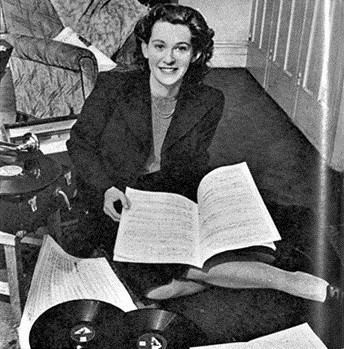
Doreen Carwithen Rediscovered?
On the centenary of her birth, is Doreen Carwithen finally ready for her close-up?
Carwithen has been lauded as the first female film composer. She was certainly the first to study in the Royal Academy of Music’s film program, instituted by J. Arthur Rank in 1946. Could she have been the first woman in the world to have made film music a career? In all, she composed scores for some 30 films, many of them shorts and documentaries, but six of them were features.
Alas, her concert works, while well-received, were not embraced with particular enthusiasm by either programmers or publishers.
Carwithen entered the Royal Academy as a cellist, who could also play violin and piano, in 1941. There, she enrolled in William Alwyn’s harmony class. Before long, he was also teaching her composition. Their mutual attraction was instantaneous, sparking a 30-year romance that culminated in their marriage in 1975.
Unfortunately, at the time of their meeting, Alwyn happened already to be married. The affair proved deleterious to everyone – Carwithen, Alwyn, and Alwyn’s wife – with stress, depression, and physical health issues all around.
When they finally did marry (after Alwyn’s doctor gave him a talking to, pointing out that he was killing everyone by not living honestly), Carwithen preferred to be recognized by her middle name. She had always disliked Doreen. Thereafter, she went by Mary.
In 1961, as her career never really seemed to get off the ground, Carwithen began acting as Alwyn’s secretary and amanuensis. Increasingly, she shifted her focus to supporting and promoting his music at the expense of her own. After all, he was by that time a symphonist of stature, while she wasn’t gaining any traction.
Following Alwyn’s death in 1985, she devoted herself purely to the preservation of his legacy. When she herself died in 2003, she left sketches for a string quartet (which would have been her third), a symphony, and a cello concerto. One can only imagine that, as a creative artist, Carwithen withered on the vine.
Now it seems her time has come. Her overture, “Bishop Rock,” was performed at this year’s BBC Proms (alongside Grace Williams’ “Sea Sketches” and Ralph Vaughan Williams’ “A Sea Symphony”). On a separate concert, her Second String Quartet was also played. Another scheduled overture, “ODTAA (One Damn Thing After Another)” was not heard, as the Last Night of the Proms was cancelled because of the Queen’s death.
I expect, with the increased interest in music by composers marginalized because of race or gender, that we’ll be seeing more recordings and concerts featuring Carwithen’s works.
Here’s an interesting write-up that contains a lot of information about the composer, beyond that usually drawn from her Wikipedia page:
I’ve also been looking for an excuse to post this video of her Piano Sonatina for the last few weeks.
“ODTAA (One Damn Thing After Another),” introduced by Sir Adrian Boult and the London Philharmonic in 1947
Concerto for Piano and Strings, first performed at the Proms in 1952
“Bishop Rock”
String Quartet No. 1
“Suffolk Suite” (1964)
Carwithen wrote the score for the documentary “Elizabeth is Queen” (1953) at white heat. The film was released in theaters three days after Elizabeth’s coronation. The music under the opening credits is arranged from Walton’s “Crown Imperial.” Keep in mind, this is only reel one!
https://www.britishpathe.com/video/elizabeth-is-queen-reel-1-1
Carwithen and Alwyn were the focus of my film music show, “Picture Perfect,” this past Saturday on WWFM – The Classical Network. You can listen to the webcast by following the link below.
Happy birthday, Doreen Carwithen.
-

Doreen Carwithen Unsung Film Composer
This week on “Picture Perfect,” we’ll shine a light on the shamefully underutilized talent of Doreen Carwithen.
In 1941, Carwithen studied harmony and composition with William Alwyn at London’s Royal College of Music. For both, it was love at first sight. Their fateful pairing led to a decades-long romance that culminated in their marriage, finally, in 1975.
The reason for the delay was, unfortunately, at the time of their meeting, Alwyn happened already to be married. The double-life caused tremendous stress. Alwyn, in particular, descended into alcoholism and suffered a nervous breakdown. Finally, his doctor urged him that, if he was going to live at all, he should get on with it already and live honestly.
In the concert hall, Alwyn – a contemporary of William Walton and Michael Tippett – enjoyed comparative success as a symphonist. Carwithen, too, got off to a promising start. Her overture “ODTAA (One Damn Thing After Another)” was conducted by Adrian Boult at Covent Garden in 1947. She also wrote two award-winning string quartets. But the cinema promised more lucrative employment. Carwithen was the first selected by J. Arthur Rank to enter the college’s new film music program.
Combined, during their heyday, in the 1940s and ‘50s, Alwyn and Carwithen wrote the music for over 100 films. Alwyn, in particular, scored such high-profile projects as “The Crimson Pirate,” “A Night to Remember,” and “The Swiss Family Robinson.” Carwithen, although groomed for the very purpose, was not given the same opportunities. In all, she scored only six dramatic features. The rest were documentaries and shorts.
Neither were her concert works, though well-received, met with the same enthusiasm or eagerness by either programmers or publishers. In 1961, she became Alwyn’s secretary and amanuensis, and following his death in 1985, devoted herself to the preservation of his legacy.
After her own death, in 2003, discovered among her papers were sketches for an unfinished string quartet (her third), a symphony, and a cello concerto. One can only imagine that, as an artist, her potential remained unfulfilled.
In anticipation of the centenary of Carwithen’s birth (on November 15, 1921), we’ll do our best to level the playing field, dividing the hour between Alwyn and Carwithen, 50/50, this week, on “Picture Perfect,” music for the movies, this Saturday evening at 6:00 EST, on WWFM – The Classical Network and wwfm.org.
Watch this space: I’ll be writing more about Carwithen and her efforts for the concert hall this Tuesday!
If you enjoy either of my weekly shows (or both!), or any of the other music you hear on The Classical Network, please consider making a contribution today. We’re celebrating our 40th anniversary on the air and online. If you’re in a position to do so, why not make a donation right now at wwfm.org. Thank you in advance for your generosity and for your continued support of WWFM The Classical Network!
Tag Cloud
Aaron Copland (93) Beethoven (95) Composer (114) Film Music (144) Film Score (143) Film Scores (255) Halloween (94) John Williams (195) KWAX (229) Leonard Bernstein (104) Marlboro Music Festival (125) Movie Music (159) Mozart (90) Opera (212) Philadelphia Orchestra (89) Picture Perfect (174) Princeton Symphony Orchestra (109) Radio (88) Ross Amico (244) Roy's Tie-Dye Sci-Fi Corner (290) The Classical Network (101) The Lost Chord (269) Vaughan Williams (105) WPRB (397) WWFM (881)