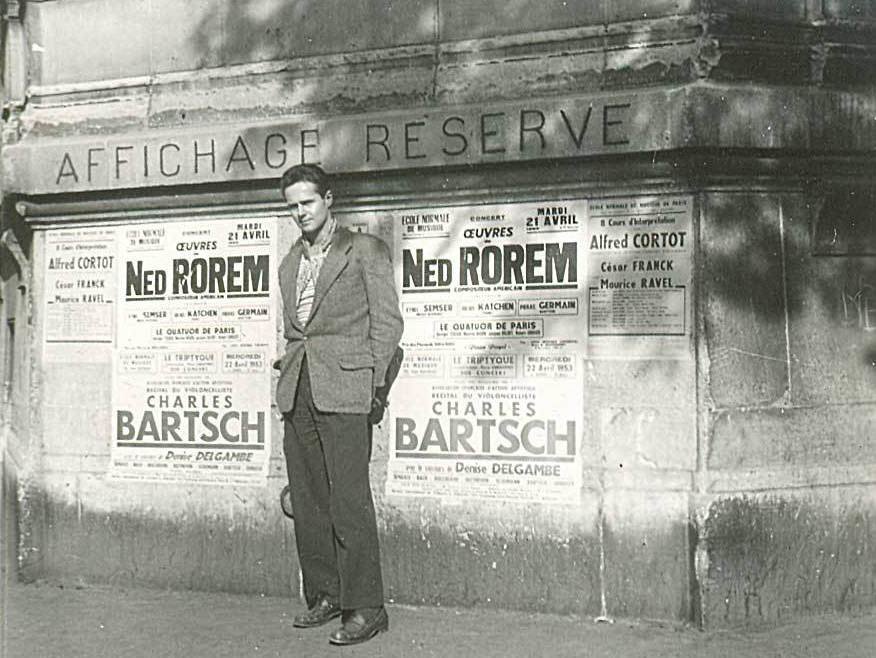
I’m up to my ears in housecleaning, digging through stacks of old boxes, exhuming all sorts of interesting concert programs and program guides, theater schedules, and personal writings, documents, and artwork, some of them dating back 40 years. The chain I’ve forged in life!
Leave it to me not to throw anything away…
But more on that in another post.
For now, I wanted to quickly acknowledge American composer Ned Rorem, who would have been 100 today. Rorem died last year on November 18.
I hope you’ll pardon me for stacking up a few links from last year.
I apologize if, when writing about Howard Pollock’s Copland biography the other week, I may have come across as a tad immodest, when stating that, because of my lifelong mania for classical music, I was likely to have a more rounded understanding of the material than your average reader. As always, pride comes before the fall, as I’ve since encountered at least one name in the book that was entirely unfamiliar to me.
On the anniversary of the birth of Virgil Thomson, here’s a photo of the composer, left, with his assistant and copyist, Ned Rorem, right. New to me is the figure at center, the composer William Flanagan.
In his day, Thomson was an extraordinarily important figure in American music, both as a composer and as critic at the New York Herald-Tribune. Rorem, who died earlier this month, at the age of 99 (outliving even Thomson, who died at 92), is regarded one of the foremost composers of American art song.
Rorem provided the entry for Flanagan in the “New Grove Dictionary of Music and Musicians.” In his book, “Music and People,” he described his musical style thusly: “Flanagan yearns… for the more easy communicative style that ripened in America nearly twenty years ago [in the 1940s]…. Flanagan’s musical ‘birth’ is of that time, and in growing he has remained faithful to its premise, if not to the specific mannerisms of the period.”
Flanagan wrote a lot of music for the plays of Edward Albee, who was his longtime companion, as well as an opera with Albee after Melville’s “Bartleby the Scrivener.” At the time of his death, at 46, he was planning an artists’ colony in Montauk. This is now the William Flanagan Memorial Creative Persons Center (commonly referred to as “The Barn”), maintained by the Edward F. Albee Foundation.
Flanagan was unusual among composers of his generation in expressing an unqualified and heartfelt enthusiasm for Copland’s music. He was among Copland’s students at Tanglewood in 1947.
From Pollock’s book:
“[A]ccording to Ned Rorem, Copland was, along with Ravel, “the twentieth-century musician closest to his heart.” “You know well that I have always been hopelessly addicted to your music,” Flanagan once wrote to Copland. “But addicted or not, I couldn’t be convinced that there is a composer living who could move ME, at any rate, as you do with the music of the mother’s closing song [in ‘The Tender Land’].” He also defended “Connotations” against the widely circulated “Total gloom descriptions” surrounding the work. In 1962, he described Copland as “the guy whose work has been the most important single influence on one’s way of thinking about the profession he has chosen to occupy his life.” Over the years, Copland regularly offered Flanagan advice and guidance; after Flanagan took his life in 1969, Copland eulogized him at a memorial concert.”
Later in the book, Pollock writes:
“William Flanagan similarly thought that whatever its strengths and weaknesses, the libretto [for ‘The Tender Land’] “falls into its properly subordinate place and the music moves in – a phenomenon that has occurred with many works in the standard operatic repertory. And this music is almost without question the finest composed for an American opera.”
Flanagan managed to resist the dueling gravitational forces of both Stravinsky’s neoclassicism and Schoenberg’s dodecaphony. In common with Rorem, though less prolific, he was best-received as a song composer. His songs “Horror Movie” and “The Upside-Down Man” have been recorded, but so far I have been unable to locate any sound files. In fact, the only one of Flanagan’s pieces I’ve been able to find on the internet is “A Concert Ode” (1951):
Happy birthday, Virgil Thomson; R.I.P., Ned Rorem; and hello, William Flanagan!
The perfect Thanksgiving music? Virgil Thomson’s “Symphony on a Hymn Tune.”
Another seasonal work: the Concertino for Harp, Strings and Percussion, “Autumn” – according to Thomson, actually more of a “portrait of an artist aging.”
A fairly recent production of Thomson’s Susan B. Anthony opera “The Mother of Us All,” on a libretto by Gertrude Stein