Tag: William Henry Fry

  • William Henry Fry Birthday Fry Day?

    William Henry Fry Birthday Fry Day?

    When is Saturday “Fry Day?” Why, when it’s the birthday of William Henry Fry, of course!

    Fry was born in Philadelphia in 1813. A pioneering figure in American music, he was the first native-born composer to write on a large scale. He composed orchestral works and the first opera by an American to be performed publicly in his lifetime (“Leonora,” in 1845). He was an outspoken advocate of American music – that is, music composed by Americans – at a time when German imports ruled the roost. It would be decades before American music would gain a toehold in the concert halls, which makes Fry an even more remarkable figure.

    He studied music with a former bandleader in Napoleon Bonaparte’s army, who went on to become the head of Philadelphia’s Musical Fund Society. Fry himself would become the society’s secretary.

    Fry was also a journalist, a writer on music, and the first music critic to write for a major American newspaper. He was a foreign correspondent for the Philadelphia Public Ledger and acted as music critic for the New York Herald Tribune.

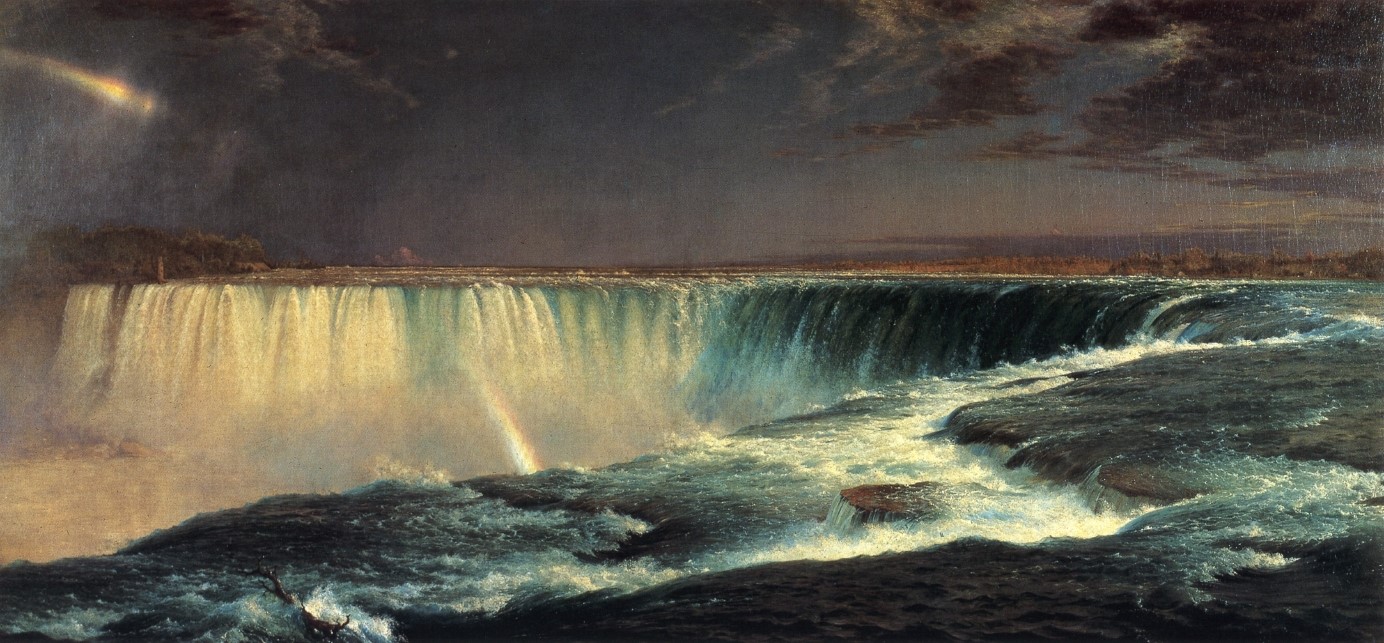
    He composed seven symphonies, all of them of a descriptive nature. His “Santa Claus Symphony,” after Clement Moore, is more of a Straussian tone poem. My personal favorite is the “Niagara Symphony,” written for P.T. Barnum, conceived for enormous forces augmented by a mindblowing eleven timpani.

    Fry died of tuberculosis, “accelerated by exhaustion,” in Santa Cruz (Saint Croix) in the Virgin Islands in 1864, at the age of 51.

    There is some discrepancy regarding the date of his birth, with some sources giving August 10, and others August 19. So maybe it’s not Fry Day, after all.

    Happy birthday (perhaps belatedly), William Henry Fry.

    The “Niagara Symphony” (it begins quietly):
  • St. Nicholas: From Saint to Santa in Song

    St. Nicholas: From Saint to Santa in Song

    The character of St. Nicholas underwent a remarkable transformation over the centuries from an austere though generous religious figure, to a gift-giving, jolly old elf. This Sunday night on “The Lost Chord,” we’ll have music reflective of both.

    The historical and legendary Nicholas, fourth century Bishop of Myra, is the patron saint of sailors, merchants, travelers, brewers, prisoners, prostitutes, Russia, and of course children. THAT Nicholas is celebrated for his secret acts of charity, even if he could be rather short-tempered and a bit severe. Nicholas is said to have punched a few heretics, on occasion.

    One famous episode tells of Nicholas saving three daughters of a poor man from a life of prostitution by tossing bags of gold down their chimney, thereby providing them with proper dowries. The episode is reflected in the familiar pawnbrokers’ symbol of three gold spheres suspended from a bar (and also the practice of hanging stockings by the chimney with care).

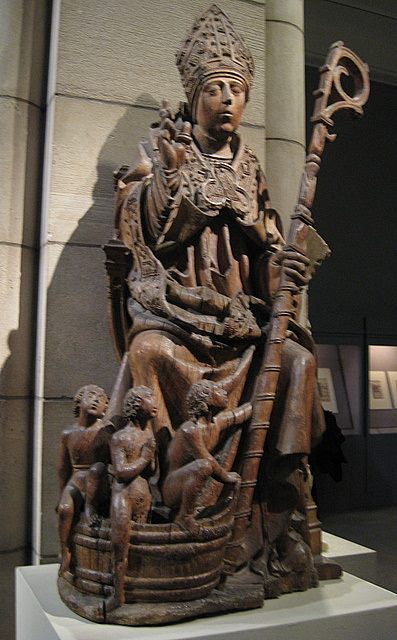
    Composer Joseph-Guy Ropartz, a native of Brittany, and a pupil of Jules Massenet and César Franck, focuses on another famous Nicholas legend, in “Le Miracle de Saint Nicholas,” composed in 1905 on a text by René Avril. Three boys are slain by a butcher, chopped up and pickled in brine, with the goal of passing them off as ham. Nicholas restores the youths, and the butcher repents. The same story would be set some 40 years later by Benjamin Britten, as part of his cantata, “Saint Nicholas.”

    Clement Moore’s poem, “A Visit from Saint Nicholas,” exemplified, and in many ways codified, the modern perception of St. Nicholas as Santa Claus. The work inspired, among other things, a symphony by William Henry Fry.

    Fry was born in Philadelphia in 1813. A pioneering figure in American music, he was the first native-born composer to write on a large scale. He composed orchestral works and the first opera by an American to be performed publicly in his lifetime (that would be “Leonora,” in 1845). He was an outspoken advocate of American music – that is, music composed by Americans – at a time when German imports ruled the roost. It would be decades before American music would gain a toehold in the concert halls, which makes Fry an even more remarkable figure.

    Fry studied music with a former bandleader in Napoleon Bonaparte’s army, who went on to become the head of Philadelphia’s Musical Fund Society. Fry himself would become the society’s secretary.

    He was also a journalist, a writer on music, and the first music critic to write for a major American newspaper. He was a foreign correspondent for the Philadelphia Public Ledger and acted as music critic for the New York Herald Tribune.

    Fry composed seven symphonies, all of them of a descriptive nature. His “Santa Claus Symphony,” of 1853, is more of a precursor to the Straussian tone poem, a detailed blow-by-blow of incidents enshrined in Moore’s verse.

    Both recordings were issued on the Naxos label (with the Ropartz originally appearing on Marco Polo). Interestingly, I’m noticing for the first time that the liner notes to the Fry disc are by my good friend Kile Smith!

    I hope you’ll join me for two faces of St. Nick, “Dr. Nicholas and Mr. Claus,” tonight at 10 ET, with a repeat Wednesday evening at 6; or that you’ll listen to it later as a webcast, at wwfm.org.


    PHOTO: After resurrecting dismembered boys from the dead, Saint Nicholas kicks back with a Coke and a smile

  • Grumpy Saint Nick Hidden History

    Grumpy Saint Nick Hidden History

    ADVENT CALENDAR – DAY 7

    December 6. Saint Nicholas Day. Yay! Jolly old Saint Nick, right? Wrong!

    While it would be impossible to deny Saint Nicholas having done a lot of good in the world, with a reputation for miracles and outstanding generosity, his modesty was so extreme as to sometimes verge on the sociopathic. In fact, he suffered fools grudgingly and became cantankerous if thanked.

    Nicholas is one of those rare all-purpose saints, who seems to watch over everyone – sailors, merchants, archers, prostitutes, women seeking husbands, repentant thieves, wrongly condemned prisoners, travelers, pawnbrokers, students, and of course children. Is it any wonder he’s grouchy?

    The historic Nicholas served as Bishop of Myra (part of modern day Turkey) in the 4th century. When his parents died, he gave away his inheritance to the poor.

    To avoid uncomfortable scenes, he developed a reputation for secret gift-giving. In one famous incident, he rescued three daughters of an unfortunate man who could not afford a proper dowry. In that time and place, it would have made them unmarriageable, and with no opportunity for honest employment, they would have had no alternative but to enter into a life of prostitution.

    Nicholas learned of their plight and under the cloak of darkness passed their house three times, each time tossing a purse of gold through a window. Some traditions say he dropped the purses down the chimney; others claim he left coins in stockings left out to dry. When the elated father tried to thank him, Nicholas responded gruffly that it is God he should thank.

    The next time you pass a pawnbroker’s shop, take a look at the symbol with the three spheres. Its significance is attributed to Nicholas’ gift of three bags of gold.

    On another occasion, during a sea voyage, Nicholas’ ears were assailed by a cacophony of oaths and blasphemies lustily exchanged by the crew. When he tried to get them to mind their language, the sailors laughed and mocked him, and took to swearing with renewed vigor. Nicholas responded by praying for stormy seas, until the sailors dropped to their knees in repentance, effectively scared straight.

    He was also wholly intolerant of pagans and heretics. He sent Arius, the father of Arianism, sprawling with a box on the ears, for his assertion that Jesus Christ is subordinate to the entity of God.

    The creepiest Nicholas tale concerns the murder of three boys by a butcher during a time of famine. The butcher placed their remains in a barrel to cure, hoping to pass them off as ham(!). Not surprisingly, this didn’t go down well with Nicholas, who resurrected the three children. The episode is captured most eerily by Benjamin Britten in his cantata, “Saint Nicholas.”

    While he’s not a “Bad Santa,” exactly, he’s also not the jolly old elf Clement Moore, Thomas Nast and Coca Cola would have us believe.

    That said, more in that vein, here’s the “Santa Claus Symphony,” really an ambitious symphonic poem, by the Philadelphia composer William Henry Fry (1813-1864):

    https://www.youtube.com/watch?v=Dz8UzYe6SRk

  • William Henry Fry American Music Pioneer

    William Henry Fry American Music Pioneer

    Remember the big celebrations last year for the bicentennial of the birth of William Henry Fry? Neither do I.

    Fry was born in Philadelphia in 1813. A pioneering figure in American music, he was the first native-born composer to write on a large scale. He composed orchestral works and the first opera by an American to be performed publicly in his lifetime (“Leonora,” in 1845). He was an outspoken advocate of American music – that is, music composed by Americans – at a time when German imports ruled the roost. It would be decades before American music would gain a toehold in the concert halls, which makes Fry an even more remarkable figure.

    He studied music with a former bandleader in Napoleon Bonaparte’s army, who went on to become the head of Philadelphia’s Musical Fund Society. Fry himself would become the society’s secretary.

    Fry was also a journalist, a writer on music, and the first music critic to write for a major American newspaper. He was a foreign correspondent for the Philadelphia Public Ledger and acted as music critic for the New York Herald Tribune.

    Fry composed seven symphonies, all of them of a descriptive nature. His “Santa Claus Symphony,” after Clement Moore, is more of a Straussian tone poem. My personal favorite is the “Niagara Symphony,” written for P.T. Barnum, conceived for enormous forces augmented by a mindblowing eleven timpani.

    Fry died of tuberculosis, “accelerated by exhaustion,” in Santa Cruz (Saint Croix) in the Virgin Islands in 1864, at the age of 51.

    There is some discrepancy regarding the date of his birth, with some sources giving August 10, and others August 19.

    Happy birthday, perhaps belatedly, William Henry Fry.

    The “Niagara Symphony” (it begins quietly):
    https://www.youtube.com/watch?v=SNe4IiuMhJ0

Tag Cloud

Aaron Copland (92) Beethoven (95) Composer (114) Film Music (123) Film Score (143) Film Scores (255) Halloween (94) John Williams (187) KWAX (229) Leonard Bernstein (101) Marlboro Music Festival (125) Movie Music (138) Opera (202) Philadelphia Orchestra (89) Picture Perfect (174) Princeton Symphony Orchestra (106) Radio (87) Ralph Vaughan Williams (85) Ross Amico (244) Roy's Tie-Dye Sci-Fi Corner (290) The Classical Network (101) The Lost Chord (268) Vaughan Williams (103) WPRB (396) WWFM (881)

DON’T MISS A BEAT

Receive a weekly digest every Sunday at noon by signing up here


RECENT POSTS