The day after 9/11, I’m sure we’re all ready to put it behind us. But 25 years is a landmark, and I didn’t have a show yesterday on which I could share some appropriate music. There’s only so much one can do with a film music program!
The anniversary is especially sobering this year, as I realize that we are now as far away from the World Trade Center attacks as my birth was from Pearl Harbor. That’s the perspective from which younger generations now perceive 9/11. It’s something that happened a long time ago.
While I understood that abstractly, it only really registered a year or two ago, when I noticed all these irreverent 9/11 posts on social media. Now, I can be as irreverent as the next guy, but these are obviously people who were not old enough to remember 9/11. There are still plenty of folks out there, who aren’t all that old, who experienced the terror first hand or continue to suffer loss, debilitating illness, or even lasting trauma just from having witnessed it on TV. All of us are living now with the legacy of 9/11. The world was forever changed that day, and not for the better. September 11, 2001 was the dawn of a new century of anxiety and dark uncertainty. We are living in unkinder times.
There’s really very little I can add to the countless memorials and reflections surrounding the surreal, unforgettable events of that September morning – a morning that, for those of us old enough to have lived through it, still feels like yesterday. But I’m a radio host, and I have a platform, and I would like to use it to try to encourage some reflection and maybe even offer a little solace. To this end, this Saturday on “The Lost Chord,” I will be presenting an hour of music of remembrance and consolation.
Pulitzer Prize winner Kevin Puts addresses the horrendous imprint of the attacks in his Symphony No. 2, which in a single movement traces an emotional arc from comparative innocence of an almost cinematic benignity, shocked by a sudden, violent upheaval, from which emerges a more reflective epilogue of uncertainty and fluctuating hope. It certainly does not leave one feeling uncompromisingly desolate in the manner of Ralph Vaughan Williams’ Symphony No. 6, the last movement of which some have compared to a world laid waste by atomic warfare.
Philadelphia composer Robert Moran wrote his “Trinity Requiem” to mark the tenth anniversary of the attacks. Moran rises to the occasion to provide an ethereal masterpiece, a 30-minute journey into paradise worthy to stand alongside the transcendent Requiem of Gabriel Fauré.
“Trinity Requiem” received its first performance in 2011 at Trinity Wall Street, the so-called “Ground Zero church” in Lower Manhattan. Miraculously, a hundred-year-old sycamore tree preserved the church’s St. Paul Chapel, constructed in 1766, from destruction by debris from the World Trade Center, including what would have been a direct hit from a falling I-beam. A recording of Moran’s work was released on the Innova label, featuring the Trinity Youth Chorus and members of the Trinity Wall Street Choir under the direction of Robert Ridgell.
“Trinity Requiem” is scored for treble voices, four cellos, organ, and harp. Handbells are employed in the “Pie Jesu.” And, following in the steps of Fauré, Moran includes a setting of “In Paradisum,” emphasizing a desire to attain peace at last.
Listen for a remarkable moment that occurs in the “Offertory” – the fourth movement (built on a bass line employed by Johann Pachelbel in his famous Canon) – when a siren appears. It was not written into the score, but rather actual street noise that bled into the recording session – an eerie bit of serendipity, unavoidably conjuring memories of the horror that unfolded outside the venue a decade before. But it is horror recollected in tranquility.
I hope you’ll join me for “The Persistence of Memory,” music of remembrance and consolation to mark the 25th anniversary of 9/11, on “The Lost Chord,” now in syndication on KWAX Classical Oregon.
———-
Clip and save the start times for all three of my recorded shows:
PICTURE PERFECT, the movie music show – Friday at 8:00 PM EDT/5:00 PM PDT
SWEETNESS AND LIGHT, the light music program – Saturday at 11:00 AM EDT/8:00 AM PDT
THE LOST CHORD, unusual and neglected rep – Saturday at 7:00 PM EDT/4:00 PM PDT
Stream them, wherever you are, at the link!
https://kwax.uoregon.edu/
Tag: World Trade Center
-
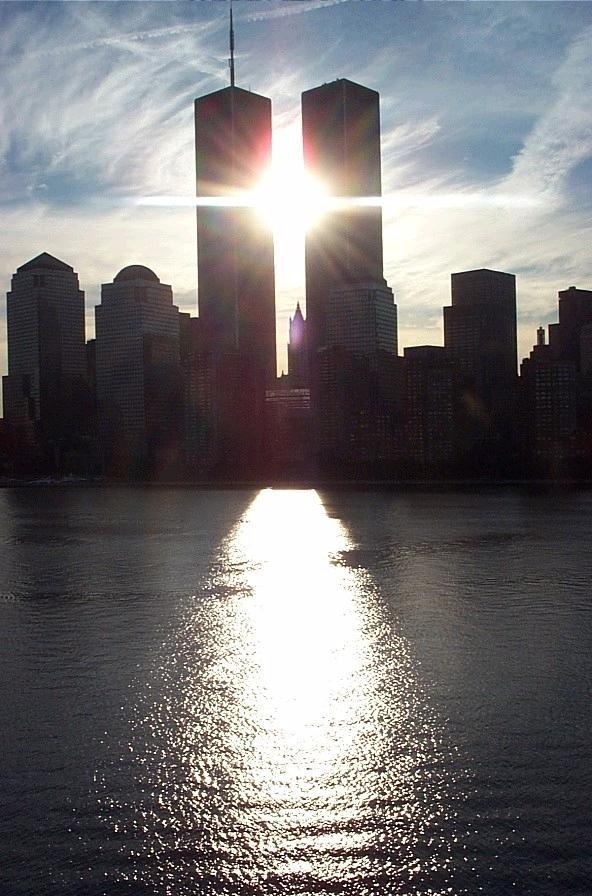
Music of Remembrance and Consolation for the 25th Anniversary of 9/11 on “The Lost Chord”
-
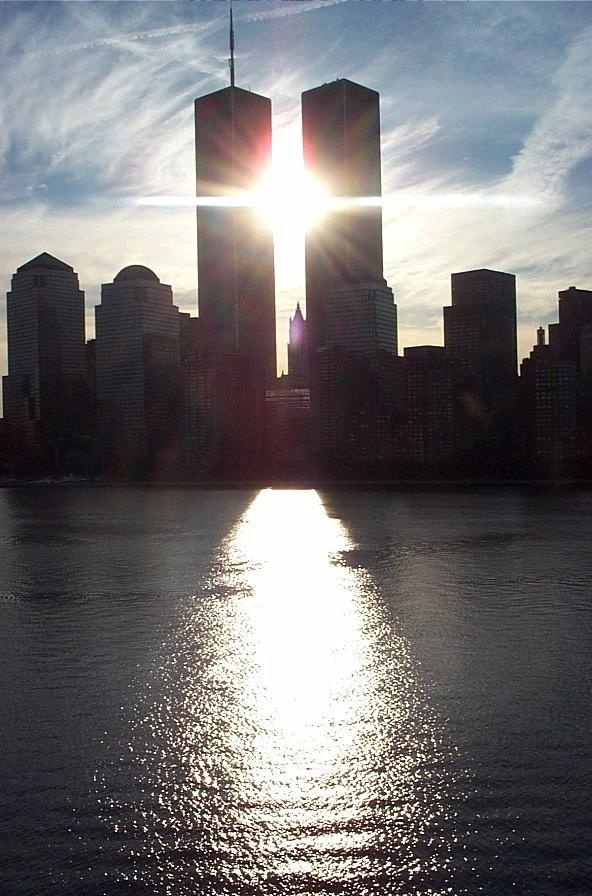
9/11, Art, and a World in Crisis
There was some debate at the time as to whether 2000 or 2001 was the proper start of the new millennium. And in 2000, there was a scramble for generators, as anxiety mounted over whether shortsighted computer programming would cause elevators to plummet and airplanes to drop from the skies for Y2K. Whether or not you felt a touch of annoyance at all the knuckleheads in their New Year’s Eve “2000” novelty glasses who believed they really were welcoming in a new millennium (a year early, in fact), in the end it proved to be as immaterial as a lover’s quarrel. Because the 21st century really began on September 11, 2001.
22 years on, we live in the world 9/11 made, or at any rate embodied. We continue to grapple with uncertainty, and anxiety, and hopelessness, as humankind gives in to its baser instincts and lessons seemingly are never learned. War, terrorism, nuclear weapons, disease, heedless technology, and shady politics had been with us already in the 20th century, of course; but with the destruction of the World Trade Center, and the horror of the attacks, brought to us live, in real time, it really did seem as if everything was running off the rails.
In a society where the arts and education are marginalized and brutishness and nihilism are celebrated and exploited as means to power and economic gain, injustice and aggression are on the rise, and we all pay the price.
This is not to diminish the horror and suffering of those who perished in the attacks or their survivors. Nothing I could write could ever do honor to those who died or convey enough sympathy or solace to their families. But none of us who lived through 9/11 emerged unscathed.
In response to the assassination of John F. Kennedy in 1963, Leonard Bernstein famously declared, “This will be our reply to violence: to make music more intensely, more beautifully, more devotedly than ever before.”
But you know the old philosophical thought experiment: if a tree falls in the woods and no one is around to hear it, does it still make a sound?
If beautiful music is made intensely and devotedly, will it still reach those for whom it might prove transformative in a world where it has been dismissed and even denigrated?
In Bernstein’s day, classical music was still on television. It was on the radio. It was not chopped up and presented as a string of pretty tunes to be promoted as “relaxing.” Beethoven, Mahler, and Shostakovich did not write elevator music. These were soulful outpourings of people with their own struggles. Now, outside the concert hall, lamentably, they are mostly silent.
Would classical music have prevented 9/11? Of course not. But anything that promotes reflection and beauty and solace and empathy can only help. Our artistic monuments are what connect us to one another and reassure us and encourage us in how we relate to our fellow human beings. And you don’t have to be a dead white European male to benefit.
The years pass quickly and it doesn’t take long for people to forget. A generation has already reached adulthood that has no firsthand memory of 9/11. Nor of Leonard Bernstein for that matter.
Horror and human tragedy can always be found in abundance, whether the cause be natural, as in the recent earthquake in Morocco, or the wildfires in Maui, or manmade, as in the misery of the war in Ukraine, or any number of mass shootings in public places. At home, in the United States, there are dangerous undercurrents of social and political unrest.
Classical music is not simply the means to a lofty escape. There is a difference between elitism and elevation. The arts are not all ivory tower, after all; they also have a practical application. With the ever-present threat of injustice, oppression, and violence, they are evidence of our shared humanity at its most transcendent.
Also, I expect they make you feel a hell of a lot better about everything than would an empty diet of soul-crushing noise, vapid flash, and glorified violence.
-

9/11 Remembered A Personal Reflection
Around 9 a.m. A ringing telephone. Me, at work on my computer, somehow oblivious to the news. My friend on the line, informing me that a plane has crashed into the World Trade Center. I’m thinking a piper. I recall the plane that struck the Empire State Building in the 1940s. Terrible, but these things happen. Then she tells me one of the towers “fell over.” That propels me to the TV.
September 11, 2001. Every year, I marvel at the passage of time. 18 years ago this morning, but still so vivid. I can’t even imagine what it was like to be there. I never really want to know.
My parents were actually in the air at the time of the attacks, en route to China. They were traveling west, across Pennsylvania. At 10:03 a.m., United Airlines Flight 93 crashed near Shanksville, southeast of Pittsburgh. The phone lines were jammed. Nobody owned a cell phone. I knew my folks had to be okay, right? It was an uneasy wait until I learned that they had been grounded in Pittsburgh.
Everyone has a 9/11 story. Some are more tragic than others. But the day touched us all and changed us as a people. It changed the world. Welcome to the 21st century.
This afternoon on The Classical Network, I’ll offer a musical memorial, which will include Pulitzer Prize winner Kevin Puts, composer’s moving response to the attacks, as he processes expectancy, uncertainty and hope in his Symphony No. 2.
We’ll also find solace in Philadelphia composer Robert Moran’s sublimely beautiful “Trinity Requiem,” commissioned by Music at Trinity Wall Street, the so-called “Ground Zero Church,” whose St. Paul Chapel was shielded from a falling beam by a sycamore tree.
I’ve been celebrating the contributions of female composers this month to tie in with the Clara Schumann bicentennial on Friday. Today, we’ll hear Composer Alla Pavlova’s “The Old New York Nostalgia,” which features a movement titled “Lullaby for the Twins” – an allusion to the Twin Towers. The recording, by the way, will be conducted by Rossen Milanov, music director of the Princeton Symphony Orchestra.
The horror and surreality of the attacks and their aftermath are perfectly reflected in Gloria Coates’ String Quartet No. 8, with its eerie approximations not only of plane engines but also a kind of emotional instability. I know it gives me a sinking feeling, and that’s pretty much how it was to experience 9/11.
At 6:00 EDT, we’ll have more chamber music – by Clara Schumann and also her husband Robert – on the next “Music from Marlboro.” But from 4 to 6, we’ll remember 9/11. Music keeps us centered when faced with the unfathomable, on WWFM – The Classical Network and wwfm.org.
Tag Cloud
Aaron Copland (94) Beethoven (95) Composer (114) Film Music (151) Film Score (143) Film Scores (255) Halloween (103) John Williams (198) KWAX (233) Leonard Bernstein (105) Marlboro Music Festival (125) Movie Music (166) Mozart (91) Opera (217) Philadelphia Orchestra (91) Picture Perfect (174) Princeton Symphony Orchestra (110) Radio (90) Ross Amico (244) Roy's Tie-Dye Sci-Fi Corner (290) The Classical Network (101) The Lost Chord (269) Vaughan Williams (107) WPRB (397) WWFM (881)