Tag: Xian Zhang

  • NJ Symphony’s “Scheherazade”: A Night of Surprises

    NJ Symphony’s “Scheherazade”: A Night of Surprises

    It’s not every day that a conductor steps on to the podium and is told to wait by a musician calling out from the back of the orchestra. But that’s what happened on Friday night at Princeton University’s Richardson Auditorium, when music director Xian Zhang was just about to raise her baton to prompt the New Jersey Symphony to weave its narrative spell in Nikolai Rimsky-Korsakov’s “Scheherazade.”

    In the moment’s silence between applause and music, one of the trombonists cried out and, with all eyes turned upon him, held up a clearly-snapped pair of glasses. So musicians and audience had no alternative but to sit patiently, as he made his way off stage, with murmuring and chuckling, as the delay stretched awkwardly and Zhang turned to exchange banter with the attendees. At a point, she remarked, “I hope he brought a spare.”

    Bring a spare he did, and when he returned to take his chair with the new specs, he was greeted with disproportionate applause. At last concertmaster Eric Wyrick was cued to commence his musical once-upon-a-time. His violin solos channel the famed storyteller of “One Thousand and One Nights,” an enchanting and alluring “open sesame” that serves as both prologue and narrator to one of the most brilliantly orchestrated showpieces of the Romantic repertoire.

    I know I’ve been a little hard on the New Jersey Symphony recently, last season as a frustrated subscriber who had half my concerts dropped, necessitating a lot of time-consuming online and telephone exchanges. But I wouldn’t fault Sinbad for doing anything he could to keep his ship from foundering, so why should I be angry with the NJS?

    The organization has had to swallow more than its share of bitter pills, which marketing has done its best to sugarcoat. Xian Zhang recently accepted the directorship of the Seattle Symphony, which I expect means she will be out the door in 2028. Then Joshua Bell was named the orchestra’s principal guest conductor, beginning as soon as next season, a move that seems to have received a positive reception from local music lovers, though I confess it doesn’t get me too excited. I admit, there is something to be said for name recognition. But is he being groomed to become the next music director? We’ll see.

    The previous season, the NJS slashed its administrative staff by about 15 percent and siphoned off two thirds of a $9 million endowment. The orchestra’s then-president and CEO, Gabriel van Aalst, also tendered his resignation.

    More recently, it was announced that the NJS will move from its current home in Newark to a newly-constructed, $40 million performing arts facility, Symphony Center, which, through an arrangement with Jersey City, it will occupy for 30 years. Sounds great, but the details set off a few alarms. The hall is projected to seat only 550, for one. (Princeton’s Richardson Auditorium seats 900.) I hope this isn’t a harbinger of the group eventually being reduced to a chamber orchestra. For now, there has been no public announcement that that is in the cards, and the plan is to continue to tour the state with the larger works.

    Also, the orchestra says it will need to raise an additional $12 million in order to furnish the new space and tweak the acoustics. Raising $12 million seems a little steep for an organization that, if I understand correctly, is now operating with a $3 million endowment.

    I hasten to add, this is a Facebook post, NOT a carefully-researched news article. I am simply voicing my concerns, and it is quite possible that the New Jersey Symphony has a sound plan in place.

    All that aside, in common with just about any orchestra these days, the NJS has to call in its share of “substitutes” to play something like “Scheherazade.” It’s simply not feasible anymore for most orchestras to maintain a staff of 100 musicians.

    Despite any of my personal misgivings and all the behind-the-scenes drama, the orchestra played very well on Friday, and I sincerely doubt anyone who attended left the venue disappointed.

    The first half of the program included Mozart’s Piano Concerto No. 17, for which the orchestra was scaled back to about half its size – perhaps 40 players – as a nod to authenticity. The soloist was Inon Barnatan, a familiar face in Princeton, as a fairly frequent guest of both the NJS and the Princeton Symphony Orchestra.

    This is the concerto whose last movement is based on a melody sung by Mozart’s starling. I’m not sure the bird itself possessed the melodic invention to make it as a world-class composer – but the tune is insistently memorably, maddening even – and Mozart works his usual wonders through a series of transformative variations. The NJS winds were standouts in this and also on the second half, in “Scheherazade.” The musicians blended well, playing their parts with refinement and a chamber-like sensitivity.

    Barnatan served up his solos with impeccable taste and technique; but for me where he really shone was when he was called back for an encore and he launched into what I believe was a Scarlatti sonata in G major that held audience and orchestra in his thrall for several magical minutes. More of this, please!

    The program opened with a recent work by Mexican composer Gabriela Ortiz, born in 1964. “Kauyumari” (“Blue Deer,” in the language of Mexico’s Huichol people) was commissioned by the Los Angeles Philharmonic in 2021. Conceived as the world was just beginning to emerge from the Covid-19 pandemic, the work aims for a kind of parallel in being ushered into a new consciousness, in an altered state, under the protection of a spiritual guide.

    Musically, the piece seems like a descendant of Carlos Chávez’s “Sinfonia India,” not only because of its battery of exotic percussion instruments, but also its inspiration in indigenous sources. Copland’s “El Salón México” is perhaps a distant cousin. (By coincidence, the orchestra will perform both the Chávez and Copland works on this weekend’s NJS concerts, this afternoon through Sunday.)

    At seven minutes never wearing out its welcome, with a trance-like repetition of its principal theme (apt, given the nature of the peyote-fueled ritual from which it takes its inspiration), “Kauyumari” certainly makes an effective curtain-raiser. It may have served as something of an appetizer on Friday, in its position at the start of the concert, but its ambitious orchestration also made it an effective bookend to balance “Scheherazade.”

    As for Rimsky-Korsakov’s masterwork, although there wasn’t much feminine allure in Eric Wyrick’s characterization of the title character, undeniably he played his violin solos very well. Again, it was the winds that most consistently embodied the work’s sense of fantasy and even delicacy. That’s not to say the strings were not transporting in romantic passages like those in “The Young Prince and the Young Princess.”

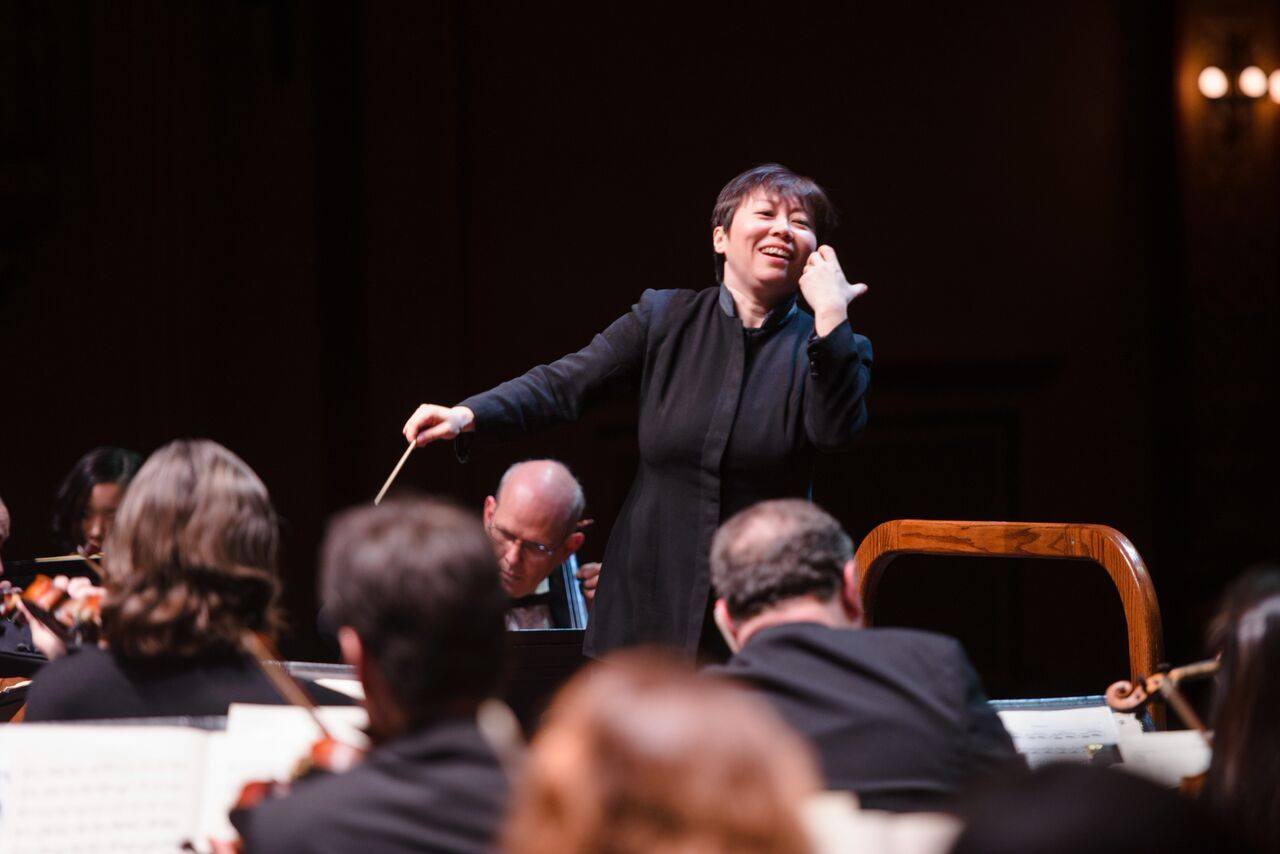
    Zhang’s conducting is always amusing to watch. Her podium presence makes Leonard Bernstein look positively Puritanical by comparison. In fact, one has to think back to Walt Disney’s old “Silly Symphony” shorts from the 1930s to find a conductor of comparable animation. Clearly, Zhang is always living the moment and loving what she’s doing. More power to her.

    For me, the best concerts are those that generate a genuine tingle, and this one did just that, in the orchestra’s expansive statement of the big tune as Sinbad’s ship is dashed to pieces. Such grandeur! There really is nothing like a symphony orchestra giving its all. Bravo, New Jersey Symphony!

    For more information about this weekend’s concerts and what’s in store for the rest of the season, look here:

    https://www.njsymphony.org/concerts-and-events/concert-listing

  • Joshua Bell to NJ Symphony A New Era?

    Joshua Bell to NJ Symphony A New Era?

    I just received a press release announcing that Joshua Bell has been appointed principal guest conductor of the New Jersey Symphony, beginning in the 2025-26 season. Be still, my heart.

    The organization’s music director, Xian Zhang, is due to take over leadership of the Seattle Symphony, also in 2025-26, with a contractual agreement of five years. She is bound to the New Jersey Symphony through 2028, so the Seattle commitment will mean a bicoastal existence. Xian assumed the directorship of the New Jersey Symphony in 2016.

    Bell, of course, has enjoyed a busy career as a violin soloist. He was named music director of the Academy of St. Martin-in-the-Fields in 2011. The famed chamber orchestra, founded by Sir Neville Marriner, is based in London. Bell keeps residences in Manhattan and upstate New York. This year, the ASMF announced the most recent extension of his contract, also through 2028.

    You don’t have to be much of a soothsayer to interpret the new appointment as an extended audition for Bell as the next music director of the New Jersey Symphony.

    Here’s the official notice:

    https://www.njsymphony.org/news/detail/joshua-bell-named-new-jersey-symphony-principal-guest-conductor-beginning-in-202526-season

  • NJ Symphony’s Future: New Home, New Doubts

    NJ Symphony’s Future: New Home, New Doubts

    Between all the birthday observations and the promotion of my radio shows, I’ve been neglecting to share some items of musical news, most of them of local interest, and some of them of wider significance. After all, there are only so many hours in the day, and believe it or not, not all of mine are spent on Facebook – though it may certainly seem that way!

    I usually like to put my own spin on things, but I’ve gotten so backlogged that yesterday I had to simply share a link to Peter Dobrin’s appreciation of Anthony Checchia, founder of the Philadelphia Chamber Music Society and for more than 50 years general manager of the Marlboro Music School and Festival, who died at September 7 at the age of 94.

    Here’s some unfinished business regarding the New Jersey Symphony, which I should have passed along days ago. Like just about everyone else, any number of performing arts organizations were knocked sideways by the pandemic. Over the past year, the NJS has seemed particularly woozy (thankfully not reflected in the quality of its performances), so it was with cautious optimism that I learn the orchestra has found some potential stability in a new home.

    It was announced a couple of weeks ago that the NJS will be settling into a newly-constructed, $40 million performing arts facility, Symphony Center, which, through an arrangement with Jersey City, it will occupy for 30 years. The facility will be part of a luxury housing development erected by Toll Brothers, with permission from the city granted with the stipulation that such a space be included. Jersey City is hoping to raise its profile as a performing arts destination. The orchestra’s move is scheduled to take place in Spring 2026.

    In theory, this is great news. However, the hall is projected to seat 550, making it an especially intimate theater. By way of reference, Princeton’s Richardson Auditorium, about as intimate as I imagine a symphony orchestra can go, has seating for 900. The New Jersey Symphony has long maintained a concert series at the Princeton venue.

    The orchestra, founded in 1922, has led something of a nomadic existence for decades, with concert series not only in Princeton, but also Engelwood, Morristown, New Brunswick, Red Bank, and especially Newark, where the New Jersey Performing Arts Center (NJPAC) has served as its base of operations since 1997. The group is committed to continue the touring relationships. It’s to be assumed that it will continue to perform a series in Newark, but that remains to be seen.

    Also, the orchestra will need to raise an additional $12 million to furnish its new space and tweak the acoustics. Programming is expected to be eclectic, with a mix of chamber music, world music, dance collaborations, and multimedia projects. Don’t expect to hear any Mahler symphonies in Jersey City.

    Which brings us to the elephant in the room: with recent cuts and an impending move to a 550-seat hall, will the orchestra continue to operate at its current size?

    Last season, the organization slashed its administrative staff by about 15 percent and ate into two thirds of a $9 million endowment. A number of concerts were dropped, diminishing its season, after subscribers (including myself) had already purchased tickets. I wouldn’t have subscribed in the first place had I known I wasn’t going to be able to hear those particular programs. I wish the orchestra luck, and I will continue to attend the occasional concert, but I’m sure I’m not alone in being hesitant to commit to a subscription again anytime soon.

    Neither does the fact that, in June, the orchestra’s president and CEO, Gabriel van Aalst, tendered his resignation inspire confidence. It could simply be a matter of unfortunate timing, but it does appear as if Aalst hopped a lifeboat, taking off to become president and CEO of Dayton Live!, the primary host and presenter for performing arts in Miami City, Ohio. Craig Silliman, co-chair of the New Jersey Symphony’s board of trustees, has stepped up to serve as interim president and CEO, on an unpaid basis, until a successor is found.

    Despite these understandable concerns, the orchestra has vowed to continue to play from the larger orchestral repertoire at its other venues throughout the state.

    In a related piece of news, it was announced on Thursday that the orchestra’s dynamic music director Xian Zhang will take over the directorship of the Seattle Symphony, effective with the 2025-26 season. Her initial contract is for five years.

    Zhang, whose star seems very much in the ascendency, as a regular guest conductor of leading orchestras in the United States (including those of Philadelphia, Boston, and the Metropolitan Opera) and abroad (London, Sao Paulo, and Toulouse, among others), is one of the few women to hold the artistic reins of a major American orchestra.

    She assumed the directorship of the New Jersey Symphony in 2016. Her impending commitment to Seattle will mean a bicoastal existence, as she is bound to the New Jersey Symphony through 2028. Her New Jersey successor is yet to be named.

    Congratulations to Xian Zhang, and best wishes to the New Jersey Symphony.


    NJS’ statement on Symphony Space in Jersey City:

    https://www.njsymphony.org/visit/venues/symphony-center-in-jersey-city


    IMAGES: Xian Zhang on the rise, and a mock-up of Jersey City’s new Symphony Center

  • NJ Symphony Celebrates a Century in Princeton

    A venerable orchestra, celebrating 100 years this season, will strike a balance with some-things-old and something new, when the @[100046173663486:2048:New Jersey Symphony] returns to Princeton University’s Richardson Auditorium this Friday at 8 p.m.

    Established classics by Wolfgang Amadeus Mozart and Anton Bruckner will flank a world premiere by Princeton composer Steven Mackey. Vocal soloists and the Princeton University Glee Club will join the orchestra, led by music director Xian Zhang.

    The program will be repeated at the New Jersey Performing Arts Center (NJPAC) in Newark on Saturday at 8 p.m. and at the State Theatre New Brunswick on Sunday at 3:00.

    Find out more about the concerts and a little bit of the orchestra’s colorful history in my article in this week’s @[100063792690234:2048:U.S. 1 Newspaper – PrincetonInfo], in area vending machines and local business, or online now.

  • Xian Zhang Tchaikovsky NJSO Debut

    Xian Zhang Tchaikovsky NJSO Debut

    When certain composers or pieces have become ensconced in the repertoire, it’s very easy to take them for granted. But, as the New Jersey Symphony Orchestra’s new music director, Xian Zhang, reveals, it’s often hard work to make the familiar sound effortless.

    “People know Tchaikovsky, in a way – you know, the most popular works – but if you look deeper, it’s not that easy to make it sound good,” she says. “The Fifth is one of the most popular symphonies. We have to actually work very hard to make it sound as good as people expect.”

    It’s certainly worth noting, as the orchestra prepares three favorites by one of classical music’s most beloved composers. Simon Trpčeski will be the soloist in Tchaikovsky’s Piano Concerto No. 1. In addition, Zhang will conduct the Polonaise from his opera “Eugene Onegin” and the Symphony No. 5.

    The program will mark Zhang’s debut as the orchestra’s music director, with appearances at four different venues across the state. Remaining performances will take place at Richardson Auditorium in Princeton (tonight at 8), the State Theatre New Jersey in New Brunswick (tomorrow night at 8), and the Mayo Performing Arts Center – MPAC in Morristown (Sunday at 3).

    Find out more in my article in today’s Trenton Times:

    http://www.nj.com/times-entertainment/index.ssf/2016/10/classical_music_njso_performin_2.html

Tag Cloud

Aaron Copland (92) Beethoven (95) Composer (114) Film Music (120) Film Score (143) Film Scores (255) Halloween (94) John Williams (185) KWAX (229) Leonard Bernstein (100) Marlboro Music Festival (125) Movie Music (135) Opera (198) Philadelphia Orchestra (88) Picture Perfect (174) Princeton Symphony Orchestra (106) Radio (87) Ralph Vaughan Williams (85) Ross Amico (244) Roy's Tie-Dye Sci-Fi Corner (290) The Classical Network (101) The Lost Chord (268) Vaughan Williams (103) WPRB (396) WWFM (881)

DON’T MISS A BEAT

Receive a weekly digest every Sunday at noon by signing up here


RECENT POSTS