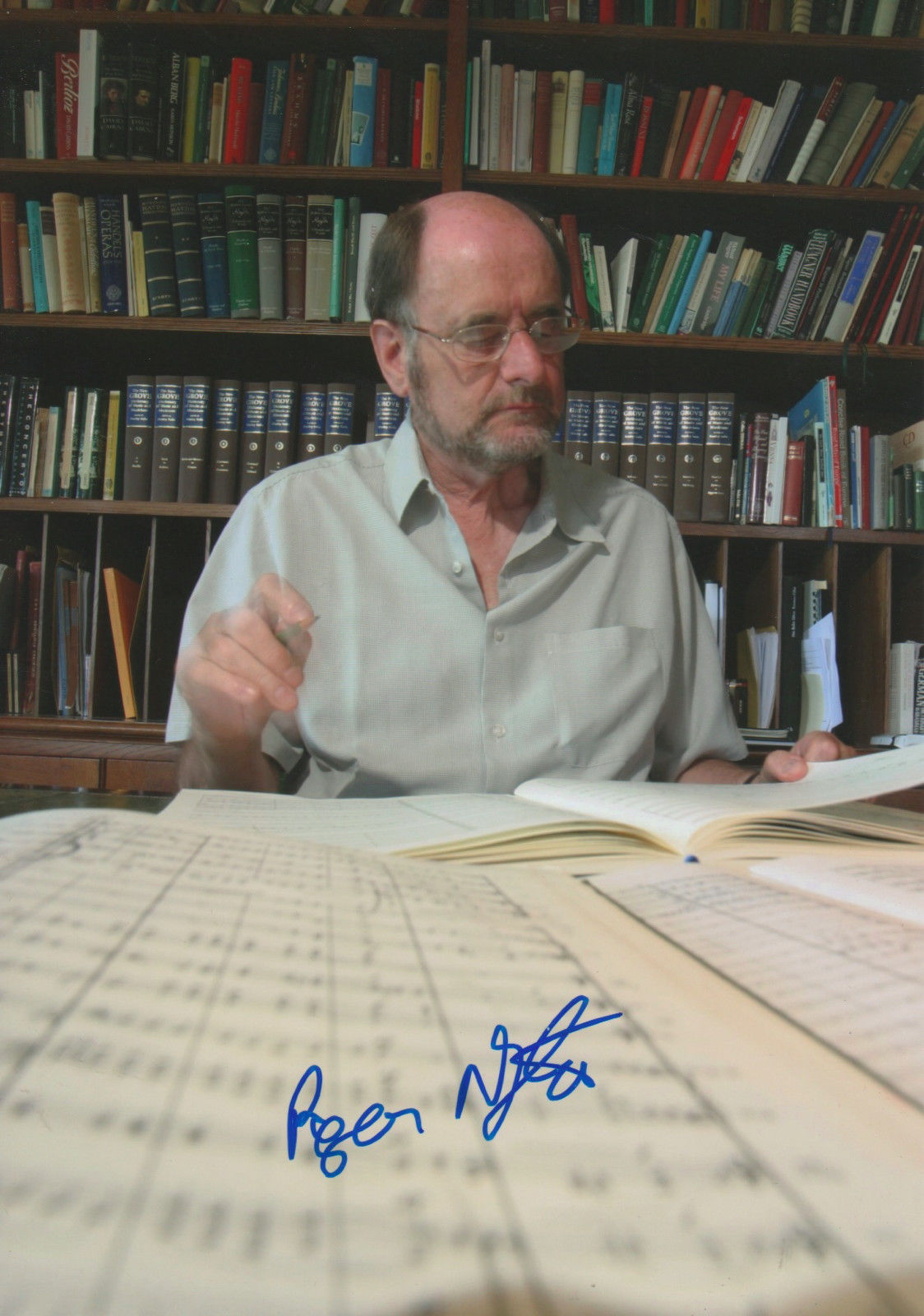
As the interest in period instrument recordings was just beginning to crest in the 1980s, I remember being put off by what I perceived as a kind of “metallic” sound – something of a paradox, since historic instruments flaunted gut strings, made from organic matter (sheep or cattle intestines). Yet the sound impressed me as alien. Clinical. Inhuman. There was just something about many of those CD recordings of Baroque and Classical music of the time that for me lacked warmth. They left me cold.
Roger Norrington was one of the influences that helped expand my consciousness, so that gradually I realized that sometimes the fault, dear Brutus, is not in a performance, but in ourselves. Or to borrow a somewhat folksier insight from George Ives, Charles Ives’ bandmaster father, sometimes our ears can use a good stretching. It’s healthy for music, and healthy for ourselves.
Norrington allowed me to perceive the advantage of regarding the classics from different perspectives, with, of all things, one of his Robert Schumann recordings for EMI. (He later rerecorded the symphonies for Hänssler Classic.) Schumann, a Romantic composer if ever there was one, is quite beyond the jurisdiction of “early music,” or so one would suppose. But that doesn’t mean performance of his works cannot benefit from a contextual lesson from history, or at any rate historical theory. In Schumann, Norrington’s brisk tempi and understatement struck me as novel in music that often benefits from the opposite approach. I hasten to add that this is NOT Schumann for every day, but it is interesting.
Norrington applied his lexicon of “period” practices, compiled through his experiments with Baroque and Classical music, to the works of later masters, viewing their scores not retrospectively, as most conductors were in the habit of doing, but rather chronologically, as extensions of what had come before.
That’s not to say a Norrington performance, regardless of how it was sold, was not, in its way, any less subjective than that of any other conductor. Norrington was frequently pelted with accusations of misguided dogma, but he would have been the first to admit that, at the end of the day, bringing a piece of music to life requires making interpretive choices.
It was Norrington’s Beethoven that really seemed to tickle people’s ears. His performances were characterized by sparse vibrato, fleet tempi, strange sonorities, and shifting seating charts. Controversially, he adhered “strictly” to Beethoven’s metronome markings (though not always). Most conductors have deemed these to be far too fast to properly allow what Beethoven presumably was trying to express in his music.
Norrington was already in his 50s by the time he was propelled to international fame with the launch of his first, ear-catching Beethoven cycle. In retrospect, was it really the lessons of history that made listeners sit up and take notice, or was it the novelty of an interpreter going all in with something new? Does it matter? When packaged as “the one, true way,” I suppose it does. But when viewed as ANOTHER way, well, why not? How is Norrington any different, in his fashion, than Celibidache? Aside from the philosophical underpinnings, I mean?
There’s a lot of guess-work involved in “historically-informed performance.” To a large extent, we don’t know what the music sounded like before the invention of recordings. But the more reputable of its practitioners used sound scholarship to back-up their artistic decisions. Norrington came under fire in some circles for just sort of making things up. It could be especially awkward when ignoring testimonial evidence of conductors who lived from the time of Brahms and Mahler into the stereo era (Bruno Walter, Otto Klemperer, Pierre Monteux), all of whom actually knew how this stuff was performed back in the day.
But hey, if it doesn’t distort the composer’s intentions too badly and allows us to hear the music with fresh ears, why not? Norrington was merely the other side of the coin from the Romantic indulgence we experienced with some conductors earlier in the century.
In the end, he might not have expressed it as such, but he could be as much a sensualist as anyone else. Norrington was not some self-abnegating high priest of classical music. Just the opposite. For him, music was not to be approached as a holy relic, but rather as a vehicle for having fun. He promoted a relaxed atmosphere in his concerts, encouraging applause between movements, if the audience was so moved, citing the fact that concerts in the 18th century would have been far from the staid affairs they later became.
His survey of Beethoven piano concertos for EMI, with Melvyn Tan the soloist, performing on a replica of a period keyboard instrument, was another ear-opener. Again, the tinkly, underpowered nature of the fortepiano triggered plenty of aversion at first, but I’ll be damned if it didn’t present the “Choral Fantasy” in a whole new, convincing way.
His second cycle of Beethoven symphonies (for Hänssler), in some respects improves on the first. By then he had moved on from the London Classical Players, the period instrument ensemble he founded in 1978, which often struggled mightily with its anemic, historically-informed instruments, to the Stuttgart Radio Symphony Orchestra, a modern band, well-versed in the repertoire. When Norrington formed lasting relationships with “modern” groups, such as Stuttgart, the Zurich Chamber Orchestra, or the Orchestra of St. Luke’s, the weird sonorities (mercurial, undernourished strings and unruly brass) were exchanged for a more moderate, middle ground.
Gradually, cumulatively, the world’s major orchestras all came around to the idea that maybe not all music from all periods should be played using the same techniques. Thanks to the efforts of Norrington and his peers (Christopher Hogwood, Trevor Pinnock, John Eliot Gardiner), early music revisionism became normalized, so that now it is rare to hear truly “big band” Mozart and Haydn, for instance, and certainly not Bach. Is the medium subservient to the message? There are plenty of recordings of “old school” Bach, Haydn, Mozart, and Beethoven to suggest that there are things to relish in either camp.
Norrington, the most hubristic of the period performance practitioners, perhaps overplayed his hand, as he continued to push into the later Romantic era to tackle symphonies by Bruckner and Mahler. Experimentation admits the possibility of disaster. On the other hand, though I was as skeptical as the next guy when he entered the modern era, he managed a satisfying recording of Gustav Holst’s “The Planets,” of all things. (His Elgar was not so fortunate.)
He was also a surprisingly effective advocate of contemporary music. He conducted over 50 first performances and won a Grammy in 2001 for his recording of Nicholas Maw’s Violin Concerto, with Joshua Bell the soloist.
Norrington was no slouch. He studied conducting with Sir Adrian Boult at the Royal Academy of Music, but also composition and music history. He was a violinist and a professional singer, and he played percussion in the conservatory orchestra. Based on his success, he also had a genius for self-promotion and showmanship.
Around his 60th birthday, he experienced some major health scares, when he was diagnosed with melanoma and a brain tumor. At a point, he was given only months to live. Miraculously, he beat it. The illness may have taken the edge off his earlier dynamism, but he retained his mental vigor and sense of joy through his retirement in 2021.
Norrington was knighted for his services to music in 1997. He died on Friday at the age of 91.
R.I.P. Sir Roger.
Norrington introduces and conducts Beethoven’s 8th
Beethoven insights, courtesy of the Orchestra of the Age of Enlightenment
Worthwhile interview with Bruce Duffie
Leave a Reply