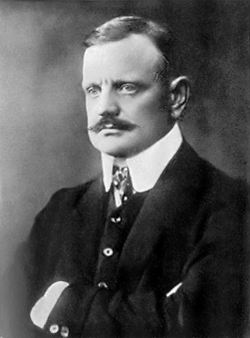
I don’t know what’s going on with me. First of all, it doesn’t feel like Christmas. I could blame it on the early start for Advent or the weather being too warm. The grass keeps greening here, and there’s still new growth. And now, suddenly, it’s the birthday of Jean Sibelius. So much for “8 Days of Sibelius,” as I have been known in past years to celebrate the composer in a series of daily posts starting at the beginning of the month. Whatever it is that has gotten into me, I seem to have become unstuck in time. And not like Vonnegut’s Billy Pilgrim, mind you.
Be that as it may, so much of the wonder of music, especially long-form music, is how it plays with our perception of time. Symphonies are often narratives, even if there is no story. The internal logic of a piece creates the illusion of movement, a sense of connections being made, and even varying degrees of momentum.
Sibelius was a master at manipulating time in works like his Symphony No. 5. The piece begins with a musical sunrise, the merest suggestion of the grandeur to come, with perhaps a meditation of the natural world stirring to life; and then somehow, before we know it, the ground is shifting seismically beneath our feet, and we’re in the middle of a scherzo. The effect is thrilling, yet, when executed properly (always a challenge for conductors), seems totally organic.
And that ending! There is no other symphony like it in the repertoire. It’s as if the composer has mastered time itself, and brought everything to an abrupt halt, over six staggered, monolithic chords, leaving the listener suspended at the very peak of sublimity,.
Sibelius worked hard to achieve his effects. The Symphony No. 5 was given its world premiere on his 50th birthday, December 8, 1915. A second version, which only partly survives, was unveiled the next year. The final version, the version we all know and love, was given its performance on November 24, 1919. To contemplate the level of objectivity he managed to attain in reshaping the raw material of his first thoughts is staggering. Like Beethoven, Sibelius worked very hard to realize his genius.
Perhaps whenever I get to feeling unstuck, a healthy attitude would be to imagine myself, like someone listening to Sibelius’ Symphony No. 5, suspended between moments of sublimity.
Happy birthday, Jean Sibelius.
Symphony No. 5 (final version, 1919)
Original version (1915, with some very notable differences)
Leave a Reply