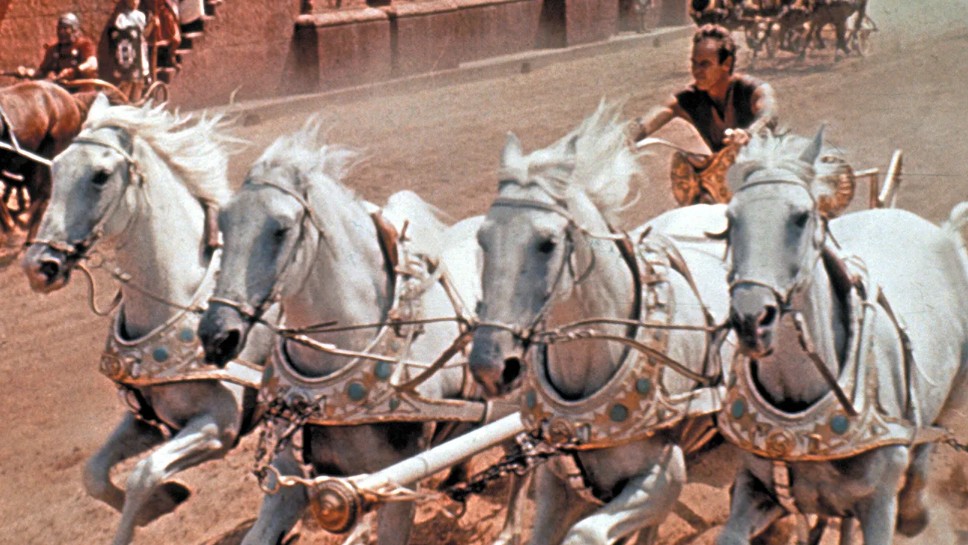
I devoted one of my posts the other day to news of a limited-time revival of “Ben-Hur,” back on the big screen, courtesy of Fathom Entertainment. The film has been showing at select theaters across the country over the past four days, with today being the last. If you’re at all interested in seeing it in its new 4K restoration, search for theaters in your area by clicking on “get tickets” at https://www.fathomentertainment.com/releases/ben-hur-2026/. Screenings tonight will likely begin sometime between 6:00 and 7:00.
And let me tell you, the film looks great. Also, I don’t know that it’s ever sounded better. Miklós Rózsa’s fanfares and choruses soar, the clatter, thundering horse hoofs, and roar of the crowd during the chariot race thrill, and the earthquake following Jesus’ crucifixion terrifies.
Granted, the film is four hours long (presented with a brief intermission), but it is an absorbing story told on a grand scale. Why, then, was I the ONLY PERSON IN THE THEATER when I saw it last night? I mean, this was the most-decorated film of all-time, with a record-breaking 11 Academy Awards. It was also the highest grossing picture since “Gone with the Wind.” Everything about it is immaculately rendered (no pun intended).
Were people put off because it’s an old movie? By the length? By the religion? Because it was a work night? Here, the film was over by 9:50.
Most likely, they stayed away because it doesn’t have Ryan Gosling in a spaceship. Also, it’s less demanding to stay home and stream “content” as background to scrolling on the phone and texting friends.
If any of these is the case, I feel sorry for those people. But I am also concerned for the future of everything I hold dear. A large segment of the population, it seems, possibly a majority, lacks the curiosity and the attention spans of our parents and grandparents, who might have considered this a deeply satisfying, even transformative night out.
Concerning the religion, “Ben-Hur” is a peculiar movie. On the surface, it has a Christian outlook (Lew Wallace’s book bears the subtitle “A Tale of the Christ”), but the hero, blue-eyed Charlton Heston as the Judean prince Judah Ben-Hur, is proudly Jewish. Of course, the conflict in the film is more political than religious. Ethnic distinctions are drawn mainly along the lines of those in occupied lands who bristle under their Roman conquerors. There’s one scene wherein the Romans make a sneering remark about a proposed chariot race with Judah. “A Jew?” one remarks, incredulously (sponsored by an Arab, no less). But the Romans, in general, are a proud, supercilious lot.
The other day, I mentioned an alleged gay subtext (according to Gore Vidal) in the establishing scene between Judah and his childhood friend, Messala (played by Stephen Boyd), which does exude a certain, unusually ardent quality, though things very quickly go south as the men’s allegiances drive a wedge between them. However, given that Judah’s later relationship with the Roman general Arrius (played by Jack Hawkins) deepens into an equally unguarded affection, it would be easy to chalk it up to simple phileō. This was, after all, the ancient world.
That said, if there’s a more homoerotic mainstream American movie, I can’t think of it. There are half-naked, well-oiled men everywhere. They stop just short of snapping each other with their towels. And if it’s an historical or Biblical epic, you can bet Heston will be standing around in a loin cloth for at least some of it. It must have been in his contract.
The film is adapted from a bestselling novel by Civil War general Lew Wallace, the most-read American novel in the period between “Uncle Tom’s Cabin” and “Gone with the Wind.” Wallace claimed not to be particularly religious at the time he took up his pen, but on completion of the manuscript, he found he had become a believer.
The story is really a mash-up of “The Count of Monte Cristo” and a Jesus movie. Jesus pops in every once in a while, always viewed from the back of the head, as Rózsa’s score strikes a mystic tone. But the film is not really about Jesus, or rather it isn’t JUST about Jesus, as much as it is about getting in touch with your own humanity and embracing your better angels. Yes, the ideals advocated by Jesus point the way, but Judah himself, as a good and thoughtful person, grapples with the complexity and corrupting nature of the impulse to revenge. Heston delivers a nuanced performance, a career best, that conveys much of his character’s conflict and evolution through his thoughts, facial expressions, and physical bearing, as much of it is not explicit in the dialogue, though certainly supported by the compassionate exchanges in Judah’s encounters with Jesus.
Interestingly, Judah recognizes the extraordinary in these silent encounters, but he remains a Jew to the end (as opposed to converting to Christianity). Throughout the film he touches his mezuzah reverently, even tenderly, when entering his house. When his family’s fortunes plummet, still he adjusts the scroll and carefully tends to this symbol of his identity and faith. At a point, he covers his head and prays for forgiveness for his desire to seek vengeance. Whether or not he embraces Christianity beyond the action of the movie is unclear, but I think not. Nevertheless, he is transformed.
In a way, Jesus is an external symbol of Judah’s inner goodness. Or perhaps, putting it another way, Jesus becomes a catalyst for Judah’s self-awareness. A Roman early in the film remarks that Jesus teaches that God exists inside every one of us. (“It’s quite profound, actually,” he adds, with a far-away look.) Whether or not you are a “religious” person, whether you are Jewish or Christian, the film should still work for you. It’s interesting that, for such an earnest, at times histrionic presentation, it manages to satisfy when viewed from multiple perspectives.
Judah’s journey leads him through physical trials and into the emotional abyss. But he does believe in a higher power. He makes it clear several times throughout the film, most especially when he tells Arrius he cannot believe that God would keep him alive in the galleys for three years only to have him drowned at the bottom of the sea.
It’s an inspiring movie, not least of all for all the craftsmanship that went into it. The starfield in the film’s prologue, as the Three Magi travel to Bethlehem to pay homage at the manger, is magical. The kings, captured in profile, are like a Rembrandt brought to life. The stable scene is touchingly reverent, but the chance cavorting of a rambunctious calf saves it from stiffening into sanctimonious kitsch. And then the credits! My god, Miklós Rózsa’s music!
There were no computers back then, remember, so everything you see was made by hand. The sets, the expert matte paintings, the costumes on the cast of thousands. Those nine chariots racing around the arena with their teams of frothing horses are real. Stuntmen risked life and limb, and Heston and Boyd can be seen in some of the shots actually maneuvering their rigs. I know it’s a hackneyed phrase, but they really don’t make ‘em like this anymore!
I should add, the film is not for ironists. It is absolutely in earnest from beginning to end, but as I suggest, it’s open to a range of interpretations. It is the visual equivalent of reading a book. It feels like a literary experience. Whether or not it reflects Wallace’s original in that regard, I cannot say. I have yet to read it, but I’ll get around to it one of these days. For now, and as has been the case for decades, I hold the movie very close.
Heston, Boyd, Hawkins, Finlay Currie (as the king Balthasar), and Frank Thring (who plays Pilate as a consummate politician) have never been better. William Wyler (who was Jewish) was one of the most skilled Hollywood directors of all time. Google him and just look at his credits. He directed all kinds of pictures, from “Wuthering Heights” and “The Heiress” to “Roman Holiday” and “Funny Girl,” with very few of them being less than wholly satisfying. Several of them, including “The Best Years of Our Lives” and “The Big Country,” are among my all-time favorites.
You have one more chance to catch “Ben-Hur” on the big screen in its 4K restoration. I don’t care how good your system is at home. Watching it on your couch with distractions of the phone, the refrigerator, and easy access to a bathroom is not the same experience. Go, and prepare to be overwhelmed.
Category: Film Reviews
-
Is There Still an Audience for “Ben-Hur”?
-
Raising a Pint to Barry Fitzgerald for St. Patrick’s Day
I try to watch “The Quiet Man” every year on St. Patrick’s Day, whether I need it or not. If, already a quarter of the way into the 21st century, this confirms that I am hopelessly out of touch, so be it. Someday, someone will pry this twee, politically-incorrect Irish fable from my cold dead hand.
I’m working my way through the recent John Williams biography by Tim Greiving, and although I am having some major issues with it (the book, published by Oxford University Press, reads like a first draft, to put it kindly), it is obviously written with love and chock full of valuable information. I know Williams always speaks fondly of Victor Young, but it was interesting to learn that Young’s music for “The Quiet Man,” which Williams saw in the theater in 1953, was one of the first film scores that really made him sit up and take notice and made him consider the possibility of writing for the movies.
I guess this makes sense, especially with having everything laid out chronologically in a biography. Progressions become clearer, and from the start Williams was always a gifted arranger. I mean, his first Academy Award was for his arrangements for Norman Jewison’s film of “Fiddler on the Roof,” and it was far from his first musical. Even apart from the movies, Williams was arranging for and accompanying Frank Sinatra, Vic Damone, Frankie Laine, and so many others. So he would have had a connoisseur’s appreciation of what Young achieved in his score for “The Quiet Man,” which positively overflows with inspiring arrangements of folk and popular song and sentimental ballads.
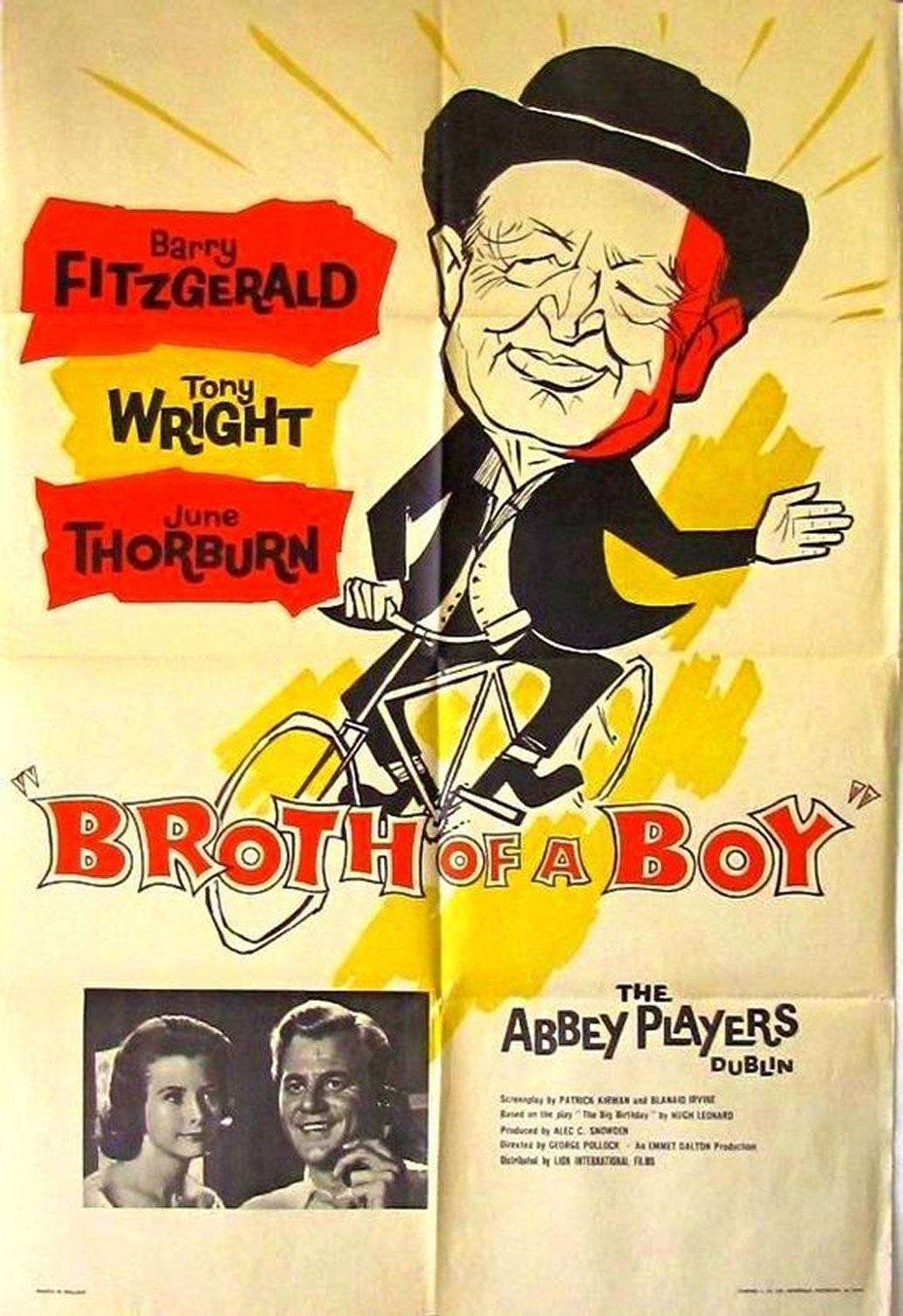
On a related note, for a long time, after having run across some clips, probably on YouTube, I’ve wanted to see a film called “Broth of a Boy.” It stars Barry Fitzgerald (who plays the “Quiet Man’s” insatiably thirsty Michaeleen Oge Flynn) as the oldest man in the world. With that premise, how could it miss? Unfortunately, the film is seemingly unavailable in the United States – only intensifying my desire to see it – and the reviews I’ve read ranged from mildly charmed to middling. So I certainly knew not to expect a classic.
Every year, around St. Patrick’s Day, I search for it, and what do you know, last night I found it on YouTube! The transfer is barely adequate, but you know how old movies are from the United Kingdom. Even the Alastair Sim version of “A Christmas Carol” (released in the U.K. as “Scrooge” in 1951 – a year before “The Quiet Man!”) looks like it was made in the 1930s. I don’t blame the technology; I blame post-war austerity.
Anyway, “Broth of a Boy” looks older than its years, as for that matter, does Barry Fitzgerald. His character is supposedly 110. Fitzgerald died in 1961 at the age of 72. But here, in 1959, he looks tired. Or maybe he was just hammered the whole time.
Be that as it may, if you’re a “Quiet Man” fan, I think you will find much to enjoy. The humor and characterizations are of the same cloth, and both films employ actors from Dublin’s Abbey Players – the National Theatre of Ireland – although, as far as I can tell, Fitzgerald is the only common denominator between the two.
Alas, the screenplay isn’t as consistent or sharp, and the scenes are not always the most imaginatively captured. I sure do miss John Ford’s direction and Technicolor. The score, by Stanley Black, will never be mistaken for Victor Young. The film feels longer than its 77 minutes, but if you are a “Quiet Man” die-hard, you might want to give it a shot. Or have a few yourself, if you know what’s good for you. -
“The Choral” Misses Its High Notes
The trailer for Ralph Fiennes’ new film, “The Choral,” which I’ve been seeing over the past month or so, whenever I go to the movies, has proved to be a bit of a bait and switch. An English period piece set during World War I, it appeared, from the marketing, it would be an inspirational story about the power of music.
Yeah, the war was a bad time, lives were destroyed, and the flower of England’s youth mowed down at the Somme. But the trailer features just enough humor to make it seem like something it’s not. I caution you not to go into it expecting a charming story of idiosyncratic British resourcefulness in the tradition of “The Full Monty,” “Kinky Boots,” or “Calendar Girls.” I’d have been happy had it been “Chariots of Fire” meets “Brassed Off.” (The latter is about England’s colliery brass bands; “The Choral” is about its amateur choral societies.)
Primarily, I got the impression that the film was going to explore musical performance as a kind of therapy for damaged soldiers returning from the front, but it really does nothing of the sort, beyond the suggestion being made in one scene, and then it’s never revisited.
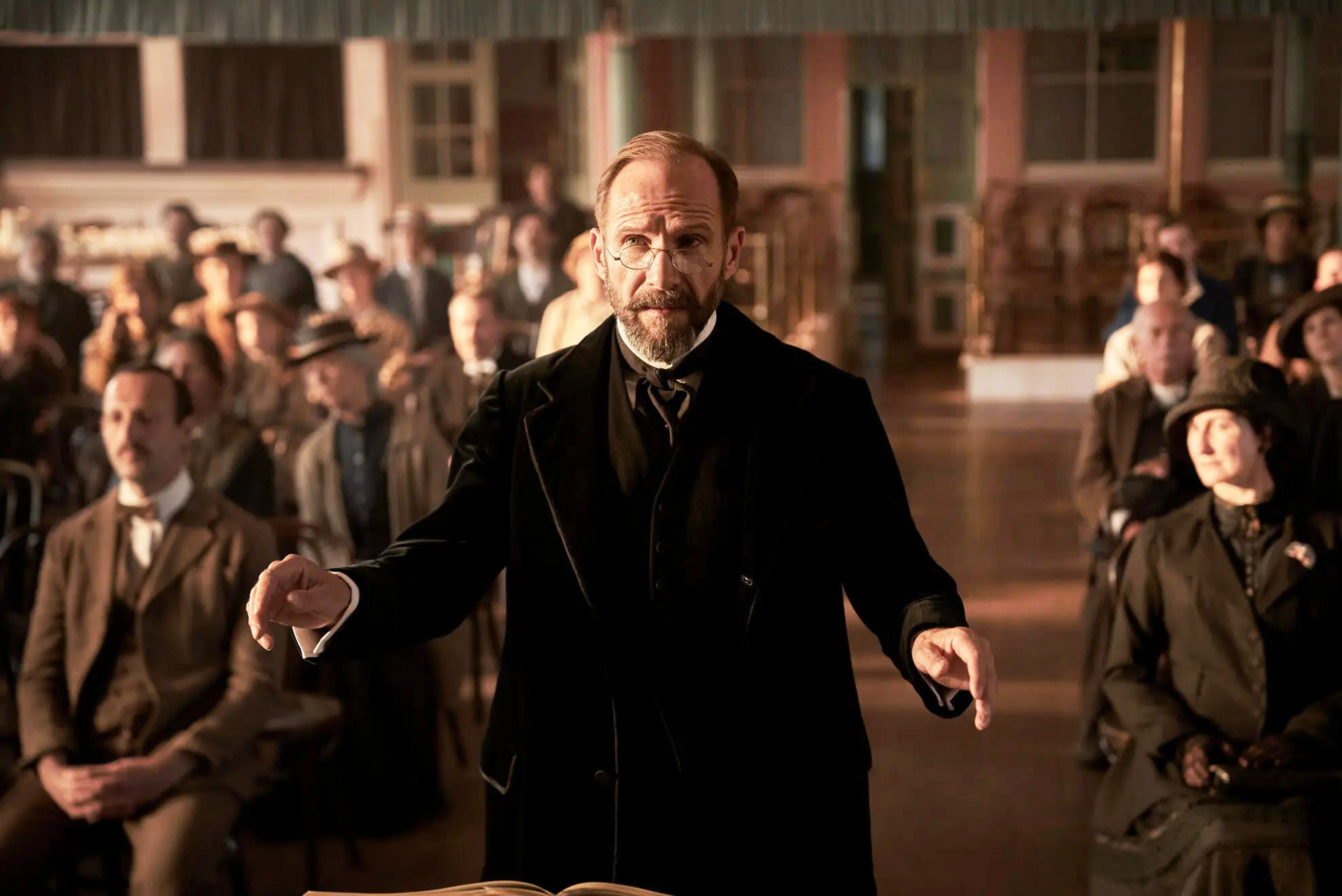
Fiennes is excellent as always, as the displaced, disgraced choral director forced back to England from a satisfying career in Germany, on account of the war. His scrupulous German allusions and quotations from passages of Goethe and the “St Matthew Passion” (which the English of course sing in English) do nothing to endear him to the locals, who view his foreign connections with suspicion. After a rock comes crashing through a window during a rehearsal, it is suggested perhaps the choir should sing something else. It is to the choristers’ collective dismay that they realize that every composer they offer happens to be German – even honorary Londoner George Frideric Handel.
This is when “The Choral” pulls its rabbit out of the hat, and we discover that the rest of the film will center on an amateur performance of Elgar’s “The Dream of Gerontius.” What a very happy surprise!
Alas, the happiness is short-lived. Naturally because of the war, budgetary constraints, and not least the varied ability of the singers, concessions have to be made. The result is a “bold” reimagining of the oratorio that seems about as edgy as something out of “Dead Poets Society.”
Inevitably, Elgar shows up, and both his character and the casting (he’s played by the estimable Simon Russell Beale) are totally wrong. Nothing I have ever seen or read about Elgar leads me to believe he was squat, portly, and petty. Couldn’t the filmmakers even have given him a decent push broom mustache?
Perhaps it won’t bother viewers who aren’t so close to the subject, but for me it kills the movie. My guess is that the marketers kept the “Gerontius”/Elgar angle out of the trailer, because there are about five people in the U.S. who would have any idea who or what they are, much less want to see a movie about them.
More broadly, the screenplay by playwright Alan Bennett (“The Madness of George III,” “The History Boys”) is a mess, with few of the many dramatic ideas introduced in the first act (war trauma, suspicion of espionage, wounded vanity and squabbles among the singers, betrayal in love, an interracial romance that never raises an eyebrow, the plight of the homosexual and the conscientious objector in 1916) are ever satisfactorily resolved.
Like real life, then? I think it was just weak. Still, hats off to Bennett for writing another screenplay at the age of 90!
Bennett is clearly interested in English music. He wrote a play, “The Habit of Art,” about the relationship between W.H. Auden and Benjamin Britten. Ursula Vaughan Williams (Ralph’s widow) was a personal friend and appears as a character in “Lady in the Van.” So I am especially sorry that this late attempt to dramatize the import of Elgar and his music is a swing and a miss. Perhaps with a different actor. If only C. Aubrey Smith were still with us!
“The Choral” is not a bad movie. As a classical music lover, I would desperately like a film of this sort to succeed. However, if like Fiennes’ choral director I’m to be brutally honesty, I must acknowledge that it fails to hit any of the high notes.
——–
View the trailer here: -
Bergman’s Enchanting “The Magic Flute”
From time to time, I guess even Ingmar Bergman needed a break from existential dread. How else to explain his delightful adaptation of “The Magic Flute?” Originally intended for television, Bergman’s playful and inventive 1975 film of Mozart’s 1791 singspiel had a lot to do with setting me on the path to become an opera lover.
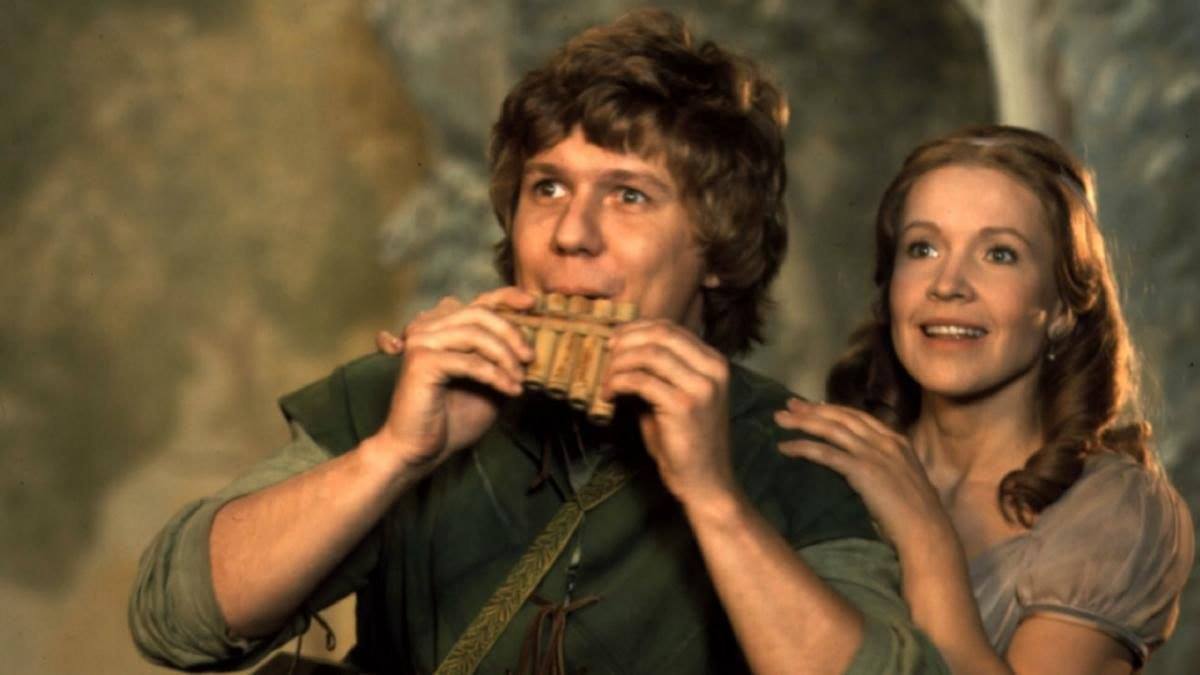
The conceit, to set the action as a live performance in the historic Drottningholm Palace Theater (a reproduction, since there were concerns about the actual theater safely accommodating a film crew), is disarming and inspired. All the stagecraft is laid bare. The scenery is evidently painted plywood, the animals are all people in suits, and the characters pause from time to time to hold up little signs with moralistic aphorisms on them as they sing their arias.
Bergman’s film begins outside the actual theater and then enters the hall during the overture to register the facial expressions of a audience members as they anticipate the curtain rising. Most especially the camera lingers on the eager face of an impressionable young girl. It’s evident that the director would like us to experience it all from her perspective, through a lens of innocence.
By contrast, we’re also taken backstage, to glimpse Papageno, fallen asleep and nearly missing a cue, Sarastro between acts studying the score to “Parsifal,” and one of Monostatos’ minions reading a Donald Duck comic book.
Sure, there are moments of despair even here, as a couple of the characters contemplate suicide (we also get a memorable vision of hellfire), but it’s all dispelled in a decisive victory of good over evil, an endorsement of universal brotherhood, and a resolution of unalloyed joy.
It was Mozart’s librettist, Emanuel Schikaneder, who suggested during rehearsals that Papageno stammer in excitement at the recognition of his desired Papagena, in their famous duet. Here’s what Bergman does with it.On Mozart’s birthday anniversary, I think it’s time to revisit this film.
Behold! Here it is on YouTube.
-
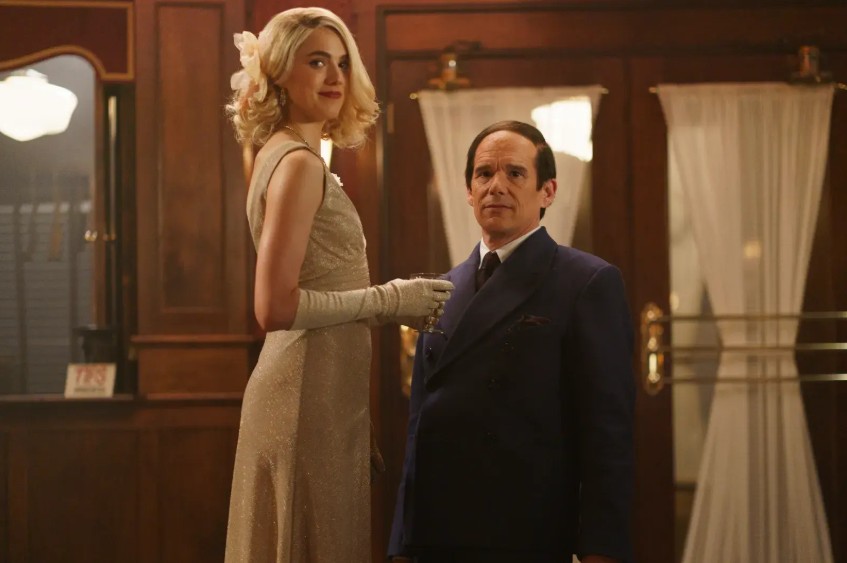
“Blue Moon” Sings
It’s got to be Oscar season. It’s rare for me to see two movies I liked – I mean, really enjoyed – in one week. (Read my impressions of Guillermo del Toro’s “Frankenstein” from November 6.) I mean, I don’t generally make the trek to a theater to see anything I know is going to be trash anymore – unless it’s “Indiana Jones and the Dial of Destiny” (ouch!) or “Megalopolis.” “Blue Moon” is on a more intimate scale, but quietly thrilling in a way neither of those enormously-budgeted films were.
Local hero Ethan Hawke, who grew up in West Windsor, NJ, and hung out in Princeton – where he attended the Hun School and gained early acting experience at McCarter Theatre – plays the acerbic, needy, soulful, brilliant lyricist Lorenz Hart, smarting from the fledgling success of his longtime creative partner, composer Richard Rodgers, on the opening night of “Oklahoma!” – Rodgers’ inaugural effort with Oscar Hammerstein II. Hart, the wound of rejection oozing like sour grapes through all the malbec and bourbon, delivers rapid-fire, barbed arias and elevated panegyrics to ineffable beauty – unsurprisingly, given his vocation, always lighting on the “mot juste.” He observes that any show that ends in an exclamation point isn’t worth seeing. He’s hard on “Oklahoma!’s” middlebrow success (and I can’t say that I disagree). He thirsts for art that’s more inventive, more challenging, one that takes creative chances. He bristles at facile lyrics such as corn that’s “as high as an elephant’s eye,” as all good folk should. Except, of course, the beauty of what Rodgers & Hammerstein achieved at their best also defies logic.
Hart was no slouch either, if exasperatingly difficult to pin down. It’s made abundantly clear that he had to be a nightmare to work with, especially for someone as disciplined as Rodgers, with his regular work habits. By contrast, Hart enjoys the pleasures of distraction and dissipation, staying out after-hours and sleeping until noon. You couldn’t find a better example of clashing personalities sharing an inexplicable chemistry, although of course such bonds are abundant in the history of the creative arts. We’re reminded from the start that the Rodgers & Hart partnership yielded a thousand songs, including “Bewitched, Bothered and Bewildered,” “My Funny Valentine,” “Isn’t It Romantic,” “The Lady is a Tramp,” and the titular “Blue Moon.” The soundtrack is a juke box for admirers of the golden age of the American Songbook, with the soundtrack pretty much wall-to-wall Richard Rodgers, Irving Berlin, Jerome Kern, and George Gershwin.
There are running gags about “Casablanca,” as Hart banters with Eddie the bartender (Bobby Cannavale), an earthy but sympathetic foil, and in-jokes about Stephen Sondheim and “Stuart Little.” E.B. White (Patrick Kennedy) happens to be sitting in a corner booth. There’s also a plum role for Magaret Qualley, as the self-described “ambisexual” Hart’s statuesque, 20-year-old muse. There’s an extended conversation in a cloakroom that allows both actors to really shine.
Hawke, who in life is 5’ 10” with a full head of hair, disappears into the character, made to appear physically diminutive, sporting a combover and double-breasted suit, and for much of the movie, swilling booze and chomping on a monstrous cigar. (In the old days, Hart could have been played by Lionel Stander.) The illusion is broken only in a couple of shots, when he’s shown wearing a hat in profile, which obscures the make-up, and we can’t help but notice that it is indeed Ethan Hawke. Otherwise, the magic is sustained for 100 mesmerizing minutes.
The film is directed by Richard Linklater, who’s written and/or directed mostly modest yet persistently memorable movies, including “Slacker,” “Dazed and Confused,” and “School of Rock.” I’m not by any means a rocker, but I do have a soft spot for the Jack Black opus, which I still find myself quoting often. (I too have lived the legend of the rent.) Also, the trilogy of films starring Hawke and Judy Delpy that began with “Before Sunrise.” And the even more ambitious “Boyhood,” shot in installments over 12 years, so that the actors (including Hawke, but especially the young Ellar Coltrane, who plays his son) could age in real time.
Despite taking place largely in one location (the legendary theatrical hangout, Sardi’s), “Blue Moon” is more rapid-fire, with enough dialogue for four or five movies, and I wouldn’t be the least bit surprised if it takes on a second life as a play. The screenplay is by Robert Kaplow, whose book, “Me and Orson Welles,” Linklater shepherded to the screen in 2008. The dialogue is very good – smart, often acrobatic, but always believable – and the actors stick every line.
There’s a moment when Hart holds Rodgers (Andrew Scott, no less excellent) back from an upstairs reception and the two men – Rodgers now at the peak of his career and Hart sensing he is at the end of his – stand on a landing together, cycling through a gamut of emotions that color their complex personal relationship, with its shades of friction, annoyance, exasperation, and underlying affection. It is some finely tuned and nuanced work, those emotions flitting across their faces and reflected in their body language as subtly as wisps of cloud on a sunny day. Anyone who’s lived long enough has surely experienced similar moments with a complicated friend or family member. The movie is full of such touches, which stand in absorbing contrast to Hart’s alcohol-propelled bluster.
I’ve been meaning to get around to seeing this, which I had been anticipating ever since I saw the trailer weeks ago, but I missed it in Princeton, where it had a very short run. But I was able to catch it up Route 206 at Montgomery Cinemas (where, by the way, “Frankenstein,” is also still playing). My stepfather saw it a week or two ago, and he brought it up during our most recent telephone conversation, knowing what a music guy I am. We always talk movies. We’ve done so our entire lives, and I know he gets a kick out of it, probably in large part because I still know who people like Lionel Stander are. He said he’d tell me what he thought of it once I had a chance to see it. He didn’t want to color my impressions of it, he said. To me, that suggests he was lukewarm on it. One of his most-hated experiences in a theater was viewing “My Dinner with André” (which I also really like), which is basically André Gregory and Wallace Shawn conversing at a table in a restaurant for two hours. I could see how, for him, this movie might have a touch of that, but I would think also that there are just so many period references – he’ll recognize Sardi’s and “Casablanca” and the American Songbook, even if he might not pick-up on E.B. White and Sondheim – he would at least got some enjoyment from it. I guess I’ll find out.
Anyway, I wouldn’t be surprised if there are Academy Award nominations for Hawke, who’s come a long way from “Dead Poets Society,” and screenwriter Robert Kaplow.
It’s the rare movie about music that I actually like. I feel like “Blue Moon” actually gets it right, largely because it avoids the Scylla and Charybdis of, on the one hand, attempting to portray the mystifying act of creation (a mostly internal, undramatic process), and on the other, attempting to define the ineffable (a word Hart really likes) essence of music.
“Blue Moon” works as a character portrait of a fictionalized Hart, with just enough supporting players and good performances to make this pocket-dramedy sing.
Tag Cloud
Aaron Copland (92) Beethoven (94) Composer (114) Film Music (116) Film Score (143) Film Scores (255) Halloween (94) John Williams (185) KWAX (228) Leonard Bernstein (99) Marlboro Music Festival (125) Movie Music (131) Opera (197) Philadelphia Orchestra (86) Picture Perfect (174) Princeton Symphony Orchestra (106) Radio (86) Ralph Vaughan Williams (85) Ross Amico (244) Roy's Tie-Dye Sci-Fi Corner (290) The Classical Network (101) The Lost Chord (268) Vaughan Williams (99) WPRB (396) WWFM (881)