Category: Sweetness and Light

  • Sherbet for Schubert on “Sweetness and Light”

    Sherbet for Schubert on “Sweetness and Light”

    Franz Schubert’s birthday. A day to vacillate between smiles and tears. Is there any other composer whose music so perfectly reflects the delicacy and transience of feelings? It is the language of poetry and yearning.

    Personally, I prefer my Schubert bittersweet. Nevertheless, this week on “Sweetness and Light,” most of the music will be of an extroverted, even buoyant character. Okay, maybe it’s impossible for me get through the hour without a touch of emotional ambiguity. I’ll sneak in one of my favorite lieder around the midpoint. Otherwise, it’s a potpourri of ballet music, transcriptions, and some high-spirited marches for piano four-hands.

    It’s sherbet for Schubert on “Sweetness and Light,” this Saturday morning at 11:00 EST/8:00 PST, exclusively on KWAX Classical Oregon!

    Stream it, wherever you are, at the link:

    https://kwax.uoregon.edu/

    ———-

    IMAGE: Always refreshing: orange Schubert
  • Let It Snow on “Sweetness and Light”

    Let It Snow on “Sweetness and Light”


    It’s funny, when you’re a kid, there’s nothing more exciting than snow. You stay up half the night, waiting for the first flake, and then in the morning you’re out the door making snowballs and building forts until your mom calls you back for lunch (grilled cheese sandwiches and tomato soup), and your gloves are wet and your fingers are frozen and you’re half-blind as you knock the snow out of the wales of your corduroys, and Mom tells you to take off your boots and not get snow on the carpet.

    When you’re an adult, you put away childish things, and freak out.

    This week on “Sweetness and Light,” we’ll keep calm and carry on, with a program designed to boost your serotonin and minimize your chionophobia (snow anxiety). We’ll welcome what comes with a playlist of snow-inspired works by Ronald Binge, Frederick Delius, Georgy Sviridov, Sergei Prokofiev, Angela Morley, Edward Elgar, Nikolai Rimsky-Korsakov, and Adam Saunders.

    Tune in and drop out – in front of the fireplace with a hot beverage of your choice. There’s no music like snow music, on “Sweetness and Light,” this Saturday morning at 11:00 EST/8:00 PST, exclusively on KWAX Classical Oregon!

    Stream it, wherever you are, at the link:

    https://kwax.uoregon.edu/

    ———

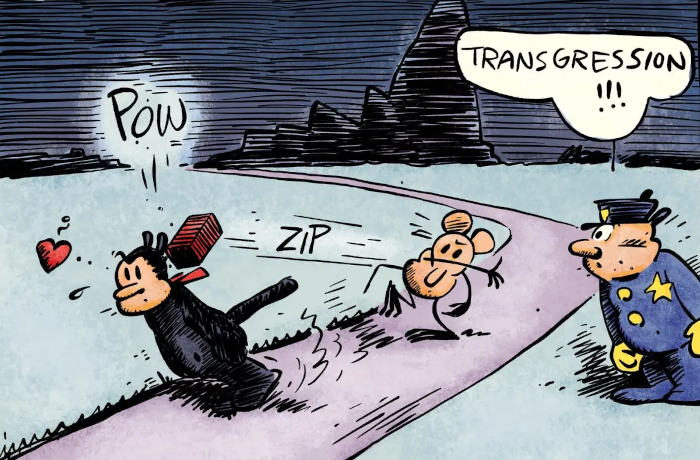
    IMAGE: Princeton’s own Patrick McDonnell tells it like it is

  • Fantastic Adventures in the 18th Century on “Sweetness and Light”

    Fantastic Adventures in the 18th Century on “Sweetness and Light”

    The Enlightenment isn’t exactly remembered for its flights of fancy. If the odd novel embraced a fantastic tone, it was frequently in the service of satire, an entertaining means to send-up contemporary mores and pursuits or to mock authority figures and good old reliable human frailty. This week on “Picture Perfect,” we’ll explore a few of these fantastic adventures of the 18th century.

    “The Surprising Adventures of Baron Munchausen” (1785) pokes fun at one Hieronymus Karl Friedrich, Freiherr von Münchhausen, a German nobleman and veteran of the Russo-Turkish War, whose reputation for telling outrageous tall tales is lampooned by Rudolf Erich Raspe. Raspe, looking to avoid a libel suit, published the work anonymously, with the result that it was commonly believed that the Baron actually dictated the tales himself. Naturally, the real-life Munchausen was upset by the unwanted attention. Thanks to Raspe, his very name came to be associated with feigned illness and pathological lying.

    The book has been adapted to film several times, beginning with a silent version by Georges Méliès, all the way back in 1911. We’ll be listening to music from two subsequent adaptations. The first, “Münchhausen” (1943), is undeniably entertaining and exceptionally well-made. However, undermining one’s enjoyment is a sense of unease in the knowledge that the film was a pet project of Joseph Goebbels, who wanted to celebrate the 25th anniversary of the UFA film studio by producing a lavish spectacle worthy to stand toe-to-toe with foreign efforts like “The Wizard of Oz” and “The Thief of Bagdad.”

    Considering the source, one would have to look awfully hard to come up with anything resembling Nazi propaganda. The entire exercise comes across as a pastoral escape from the horrors of totalitarianism, total war, and the Final Solution. The elegant music, by Georg Haentzschel, would not be out of place in the concert hall. Haentzschel is regarded as perhaps the last representative of a generation of Middle European light music composers.

    More than 40 years later, director Terry Gilliam undertook another production design-driven adaptation that resembles nothing if not a series of Doré illustrations brought to life. Contrary to received wisdom, “The Adventures of Baron Munchausen” (1988) managed to pull in a respectable amount of per-screen capital. The film was a casualty of a management turnover at Columbia Pictures, with the new regime eager to bury the projects of the old. Hence, it was never seen theatrically beyond a very limited release. The score, by Michael Kamen, while in a romantic heroic style, wittily contains abundant allusions to music of the 18th century.

    “The Manuscript Found in Saragossa” (1805) is a transitional work, with its ecstatically lurid opening chapter – replete with gypsy storytellers, highwaymen, dueling skeletons, lesbian vampires, and a couple of corpses dangling in a gibbet – dragging the Enlightenment kicking and screaming into the Romantic age. It starts out as a masterpiece of surrealism, by way of Gothic convention, but the spell is eventually broken, sadly, by a large, cold bucket of Enlightenment water, in the form of a perfectly rational explanation at the end. But until then, the author, Jan Potocki, gets an A for effort. The interlocking structure, with stories inside stories inside stories looks ahead to postmodern experiments by writers like Italo Calvino and John Barth, to say nothing of Jorge Luis Borges.

    The book was made into an acclaimed Polish film, “The Saragossa Manuscript,” in 1965. Its cult status led to a restoration financed by Jerry Garcia, Martin Scorsese, and Francis Ford Coppola that was released on VHS and DVD in 2001.

    Who else could provide the perfect soundtrack to such a hallucinogenic experience but Krzysztof Penderecki? Penderecki intersperses spooky passages with neo-classical and baroque interludes.

    Finally, we’ll hear music from one of the many adaptations of Jonathan Swift’s “Gulliver’s Travels” (1726). “The Three Worlds of Gulliver” (1960) simplifies the book’s narrative and dispenses with a great deal of the misanthropic humor in favor of children’s fantasy. You won’t catch Gulliver extinguishing a fire in the Lilliputian Emperor’s palace with his urine in this version. What you will find is a good deal of technical wizardry and a delightful score by Bernard Herrmann.

    What, you doubt my veracity? Then surely the music must speak for itself. Join me for fantastic adventures in the 18th century, now in syndication on KWAX Classical Oregon!

    ——–

    Clip and save the start times for all three of my recorded shows:

    PICTURE PERFECT, the movie music show – Friday at 8:00 PM EST/5:00 PM PST

    SWEETNESS AND LIGHT, the light music program – Saturday at 11:00 AM EST/8:00 AM PST

    THE LOST CHORD, unusual and neglected rep – Saturday at 7:00 PM EST/4:00 PM PST

    Stream them, wherever you are, at the link!

    https://kwax.uoregon.edu

    ——–

    PHOTO: A fancy flight with Baron Munchausen
  • Technicolor Moira Shearer, for Her Centenary, on “Sweetness and Light”

    Technicolor Moira Shearer, for Her Centenary, on “Sweetness and Light”

    Dancer and movie star Moira Shearer was born on this date 100 years ago. The striking Scottish ballerina with fiery red hair first earned recognition through her work with the Sadler’s Wells Ballet, but soon achieved world fame through her appearances, in Technicolor, in indelible Powell-Pressburger classics such as “The Tales of Hoffmann” and “The Red Shoes.”

    Once seen, who can forget the surreal sequence in which her life-like mechanized doll, Olympia, is dismembered and dismantled before our very eyes, mostly through the magic of practical effects? Zombie maestro George A. Romero, director of “Night of the Living Dead,” cited “The Tales of Hoffmann” as his favorite film of all time, and the one that set him on a career of making movies.

    And then of course, there’s “The Red Shoes,” choreographed by Robert Helpmann, who seemed to devote his cinematic career to refining nightmare fuel, up to and including his appearance as the Child Catcher in “Chitty Chitty Bang Bang.” Robert Helpmann and Hans Christian Anderson – what could possibly go wrong?

    Join me for music from “The Tales of Hoffmann” and “The Red Shoes,” as well as selections from two of Shearer’s ballet triumphs at the Sadler’s Wells, “The Sleeping Beauty” and “Coppélia” (the latter based on the same E.T.A. Hoffmann short story that inspired the doll sequence in the Powell-Pressburger adaptation of Offenbach’s opera).

    Strap on your demonic dancing shoes. It’s an hour of music for Moira Shearer on “Sweetness and Light,” this Saturday morning at 11:00 EST/8:00 PST, exclusively on KWAX Classical Oregon!

    Stream it, wherever you are, at the link:

    https://kwax.uoregon.edu/

  • Northern Exposure on “Sweetness and Light”

    Northern Exposure on “Sweetness and Light”

    This week on “Sweetness and Light,” it’s a program of lighter music from the northern countries.

    We’ll give poor overworked Edvard Grieg a break, with Norway represented by Johan Halvorsen and the now lesser-known pianist-composer Agathe Backer Grøndahl, a pupil of Franz Liszt.

    From Sweden, we’ll enjoy two versions of Hugo Alfvén’s evergreen “Swedish Rhapsody No. 1” – first, Mantovani’s popular hit from 1953, then with the composer himself conducting, from the very next year, in the first stereo recording ever made in Sweden.

    Speaking of popular hits, we’ll also hear Arthur Fiedler’s bestselling recording of “Jalousie,” by Danish composer Jacob Gade (no relation to Niels Wilhelm Gade), from 1935. Fiedler remade it in stereo, but it’s my show, so I’m keeping it hardcore.

    Also from Denmark, we’ll have a folk-music suite by Percy Grainger. Ah! But Grainger was not from the north, you say. He was born in Australia. Quite true. However, as an energetic pianist and composer of insatiable curiosity, he traveled seemingly everywhere, with a particular fondness for the Scandinavian countries. (His wife was Swedish.)

    But if authentic Danish composers are more your thing, not to worry, we’ll round out the hour with a galop by Hans Christian Lumbye.

    All eyes and ears face north this week on “Sweetness and Light.” I hope you’ll join me for this hour of northern “lights,” this Saturday morning at 11:00 EST/8:00 PST, exclusively on KWAX Classical Oregon!

    Stream it wherever you are at the link:

    https://kwax.uoregon.edu/

Tag Cloud

Aaron Copland (92) Beethoven (94) Composer (114) Conductor (84) Film Music (106) Film Score (143) Film Scores (255) Halloween (94) John Williams (179) KWAX (227) Leonard Bernstein (98) Marlboro Music Festival (125) Movie Music (121) Mozart (84) Opera (194) Picture Perfect (174) Princeton Symphony Orchestra (102) Radio (86) Ross Amico (244) Roy's Tie-Dye Sci-Fi Corner (290) The Classical Network (101) The Lost Chord (268) Vaughan Williams (97) WPRB (396) WWFM (881)

DON’T MISS A BEAT

Receive a weekly digest every Sunday at noon by signing up here


RECENT POSTS