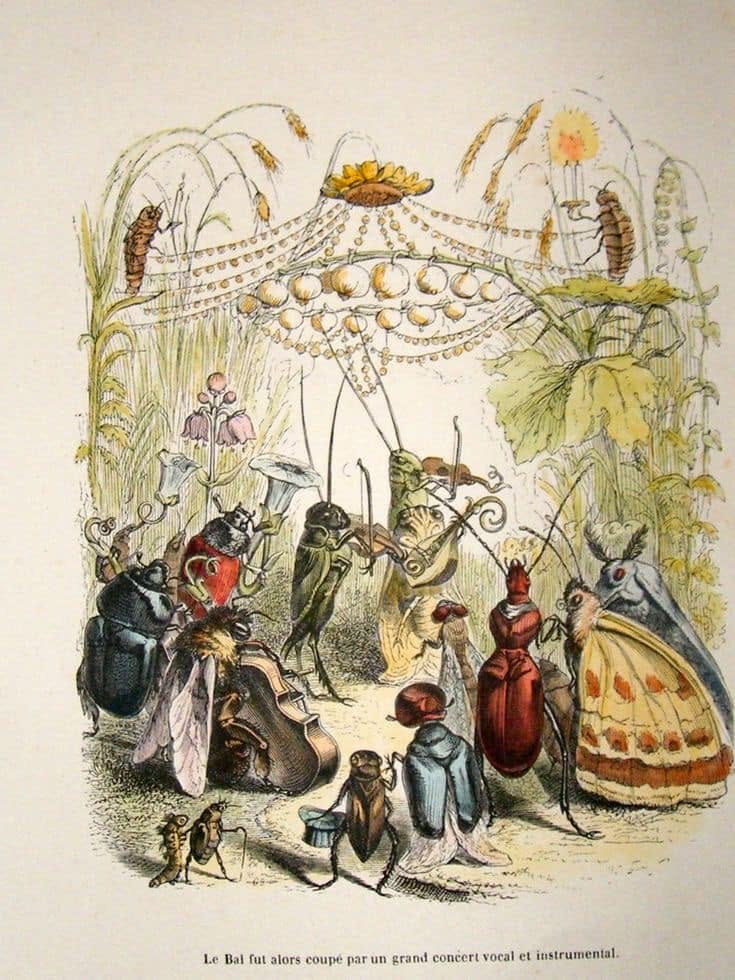
This week on “Sweetness and Light,” celebrate the season of the cricket and the katydid! Put your legs together for an hour of insect “song.”
We’ll enjoy works by Ralph Vaughan Williams, Paul Lincke, Ernest Bucalossi, Dmitri Shostakovich, Nikolai Rimsky-Korsakov, Frank Loesser, Billy Mayerl, Frederic Cowen, and Fred L. Moreland.
Tune in for a wasps’ overture, a glow worm’s idyll, a grasshopper’s dance, a gadfly’s romance, a bumble-bee’s flight, an inchworm’s measure, some insect oddities, a butterfly’s ball, and a doodle-bugs’ parade.
We’ll be buzzing from the start on “Sweetness and Light,” this Saturday morning at 11:00 EDT/8:00 PDT, exclusively on KWAX Classical Oregon!
Stream it, wherever you are, at the link:
https://kwax.uoregon.edu/
———–
ILLUSTRATION: From “Scènes de la vie privée et publique des animaux,” by J.J. Grandville (1842)
Category: Sweetness and Light
-
Frolicking with Light Music Master Richard Wagner on “Sweetness and Light”
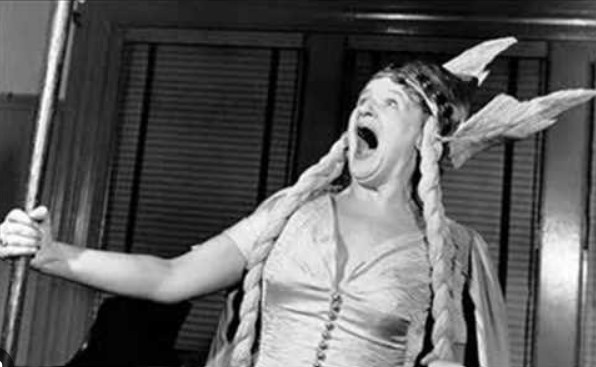
The four installments of Wagner’s Ring Cycle were performed together for the first time in the brand-spanking-new Festspielhaus at the inaugural Bayreuth Festival on August 13-17, 1876. This week on “Sweetness and Light,” to mark the 150th anniversary of Wagner’s magnum opus, we’ll have music tying in, in one way or another, with opera’s most successful “miniseries.” An unlikelier source for a light music program would be more difficult to imagine!
I may lack the muscle to hoist Donner’s hammer, but I will employ the cunning of Loge to dissipate the Wagnerian gloom with virtuosic piano transcriptions of “Ride of the Valkyries” (by Carl Tausig) and “Magic Fire Music” (by Louis Brassin), Wagner’s “Siegfried Idyll” (arguably the sweetest thing he ever wrote), humorist Anna Russell’s classic routine “The Ring of the Nibelungs (An Analysis),” and a cheeky work for piano four-hands by Gabriel Fauré & André Messager, in which they render somber motifs from the “Ring” as a quadrille!
They say it can’t be done! You’ll be left agog at the evidence of your own ears when you join me for an hour of Wagnerian “light” music, in celebration of 150 years of the “Ring,” on “Sweetness and Light,” this Saturday morning at 8:00 EDT/11:00 PDT, exclusively on KWAX Classical Oregon!
Stream it, wherever you are, at the link:
https://kwax.uoregon.edu/ -
Wagner Out the Wazoo on “Picture Perfect,” “Sweetness and Light,” and “The Lost Chord”
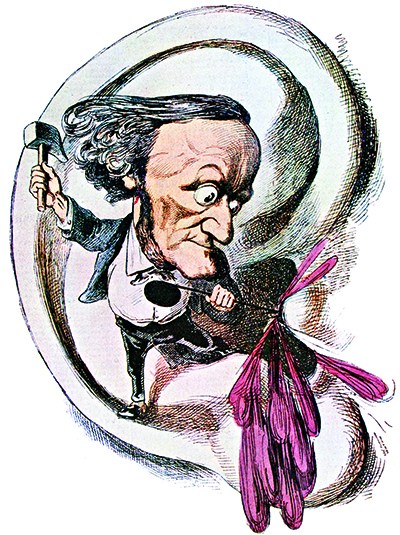
In 1876, the four operas – or music dramas (the composer’s preferred term) – of Wagner’s “Ring Cycle” were performed together for the first time, from August 13 through August 17, at the inaugural Bayreuth Festival, in the Festspielhaus (a theater of the composer’s design) in Bayreuth, Germany. The Bayreuth Festival has continued as a mecca for Wagnerites down to the present day.
To mark the 150th anniversary of the “Ring,” all three of my radio shows this weekend will tie in, in one way or another, with this most grandiose and influential undertaking.
First, today on “Picture Perfect,” we’ll have music from four films in which Erich Wolfgang Korngold served as ghostwriter for onscreen composers, providing a ballet for Errol Flynn’s in “Escape Me Never” (1946), a tone poem for Charles Boyer in “The Constant Nymph” (1943), and a cello concerto for Claude Rains in “Deception” (1946). More to the point, Korngold actually appears onscreen – hastily made-up when the actor hired for the purpose didn’t show – to play conductor Hans Richter in the Wagner biopic “Magic Fire,” for which he adapted selections from, yes, the Ring Cycle.
Then tomorrow morning, on “Sweetness and Light,” it will be the unlikeliest “light music” program, as we listen to piano transcriptions by Carl Tausig and Louis Brassin, the “Siegfried Idyll” (probably the sweetest thing Wagner ever wrote), humorist Anna Russell’s classic routine “The Ring of the Nibelungs (An Analysis),” and a cheeky work for piano four-hands by Gabriel Fauré & André Messager, in which they distill somber motifs from the cycle into a frivolous ballroom dance.
Finally, tomorrow afternoon/evening (depending on where you are), it will be an hour of historic recordings of “Die Walküre” – the second of the “Ring” operas (er, music dramas) – by Lawrence Tibbett, with Leopold Stokowski and the Philadelphia Orchestra, in 1934, and Lotte Lehmann and Lauritz Melchior, with Bruno Walter and the Vienna Philharmonic, in 1935. Also, we’ll hear Karl Muck conducting selections from Wagner’s “Parsifal” at the actual Festspielhaus, in 1927. The recording will feature actual bells of Wagner’s design, which were later melted down for munitions by the Nazis.
Hojotoho! Get out your party hats (helmets with horns and wings, of course), as we celebrate the 150th anniversary of the “Ring” this weekend, on KWAX Classical Oregon!
Stream the shows, wherever you are, at the times below:
PICTURE PERFECT, the movie music show – Friday at 8:00 PM EDT/5:00 PM PDT
SWEETNESS AND LIGHT, the light music program – Saturday at 11:00 AM EDT/8:00 AM PDT
THE LOST CHORD, unusual and neglected rep – Saturday at 7:00 PM EDT/4:00 PM PDT
Here’s the link!
https://kwax.uoregon.edu -
Keep Cool and Carry on with Refreshing Fountain Music on “Sweetness and Light”
In writing this, I am wondering if it’s more accurate to state that fountains burble or gurgle? This is the kind of heavy-lifting I do behind the scenes to make my light music shows seem so buoyant and effortless.
This week on “Sweetness and Light,” as I weigh the finer points, peering through the magnifying glass into my O.E.D., I hope to lessen your own burdens with a refreshing and restorative playlist for the hazy, lazy days of summer. Join me for an hour of “fountain” music by Robert Farnon, Franz Liszt, Maurice Ravel, Charles Tomlinson Griffes, Hans Christian Lumbye, Arthur Meulemans, and Carl Bohm. For anyone flabbergasted by the omission of Respighi’s “Fountains of Rome,” fear not, the opulence of Meuleman’s “Pliny’s Fountain” will give old Ottorino a run for his money!
I may be a fount of indecision, but you can be certain of plenty of burbling or gurgling music on “Sweetness and Light,” this Saturday morning at 11:00 EDT/8:00 PDT, exclusively on KWAX Classical Oregon!
Stream it wherever you are at the link:
https://kwax.uoregon.edu/
________________________________________
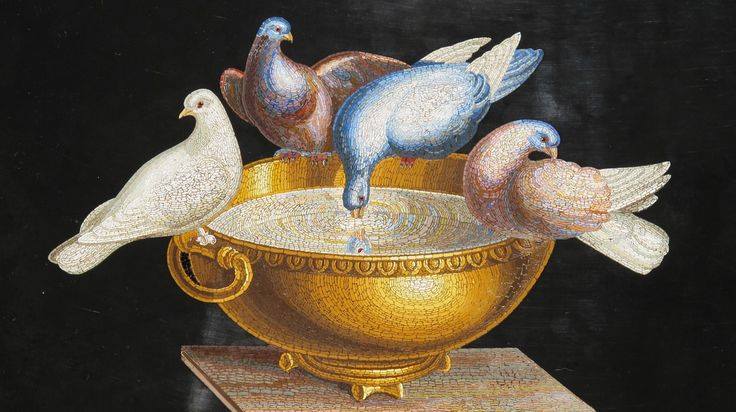
IMAGE: “Doves of Pliny” from Hadrian’s Villa in Tivoli, after second century BCE mosaic by Sosus of Pergamon (reproduced many times)
FUN FACT! IMPRESS YOUR FRIENDS! Tivoli was also the location of the villa that inspired Liszt’s “Les jeux d’eaux à la Villa d’Este” (“The Fountains of the Villa d’Este”), also to be heard in this hour. -
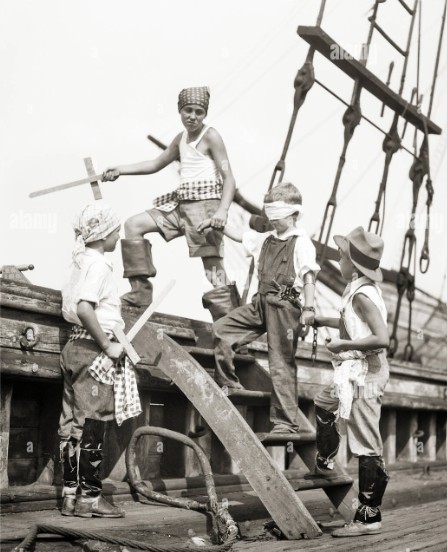
Endless Summer of Childhood on “Sweetness and Light”
At midlife, the seasons fly by so quickly, they scarcely seem to register. This week on “Sweetness and Light,” we defy the gravitational pull of back-to-school advertisements and premature Halloween displays to indulge in some nostalgic recollections of the carefree and seemingly endless summers of youth.
Join me for alternately boisterous and languid works by Eugène Bozza, Sergei Prokofiev, Déodat de Severac, and William Walton.
It’s music reflective of riding bikes, tramping through woods and meadows, building forts, laughing with friends, and getting up to no good. When you’re a kid, there’s always plenty of adventure to be had, with the guaranteed security of a homecooked meal and a roof over your head. At least if you’re as fortunate as I was.
I don’t know, perhaps this kind of off-the-leash freedom and hedonistic enjoyment is a thing of the past, in a society where dreams are strangled by subdivisions and superwarehouses, surveillance cameras and militarized police, helicopter parents and cell phones, psychopaths and existential dread. But even with a hemmed-in, over-scheduled existence crammed with organized activities and soul-crushing electronics, I think the illusion of time stretching on forever must surely still be one of the enchantments of youth?
I don’t want to think about it. In a world wreathed by barbed wire, I will hang onto my illusion that childhood is the last frontier. Listen for me rafting down the Delaware, crowing like Peter Pan, on “Sweetness and Light,” this Saturday morning at 11:00 EDT/8:00 EDT, exclusively on KWAX Classical Oregon!
Stream it wherever you are at the link:
https://kwax.uoregon.edu/
Tag Cloud
Aaron Copland (94) Beethoven (95) Composer (114) Film Music (148) Film Score (143) Film Scores (255) Halloween (97) John Williams (196) KWAX (232) Leonard Bernstein (105) Marlboro Music Festival (125) Movie Music (163) Mozart (91) Opera (215) Philadelphia Orchestra (90) Picture Perfect (174) Princeton Symphony Orchestra (110) Radio (90) Ross Amico (244) Roy's Tie-Dye Sci-Fi Corner (290) The Classical Network (101) The Lost Chord (269) Vaughan Williams (107) WPRB (397) WWFM (881)