No more stuffing phone booths or goldfish swallowing contests or taking the dean’s car apart and reassembling it in his living room. In the words of the poet: All good things must come to an end.
This morning on “Sweetness and Light,” for graduation season, it’s a hazy recollection of the world of higher education, as we salute another successful batch of cogs about to enter the work force.
Join me for a program of processionals and scenes from campus life – including a shocking number of works based on student drinking songs. Composers represented will include Jean Sibelius, Johannes Brahms, Franz Liszt, Johann Strauss II, Sigmund Romberg, Nikolai Rimsky-Korsakov, and of course Sir Edward “Pomp and Circumstance” Elgar.
Hide the empties from the folks and join me in cap and gown. We’ll be churning out responsible citizens as they reel to the platform to claim their parchment on the next “Sweetness and Light,” this Saturday morning at 11:00 EDT/8:00 PDT, exclusively on KWAX Classical Oregon!
Stream it, wherever you are, at the link:
https://kwax.uoregon.edu/
Category: Sweetness and Light
-

It’s Graduation Season on “Sweetness and Light”
-

Say I Do to June Weddings on “Sweetness and Light”
This week on “Sweetness and Light,” hie thee to the church on time. it’s an hour of June weddings!
We’ll have a comedy overture, “The Tinker’s Wedding,” by English composer Havergal Brian. Brian attained notoriety for his “Gothic Symphony,” a work so grand it entered the Guinness Book, when it was acknowledged as the world’s largest symphony. He composed 32 symphonies in all, 20 of them after the age of 80!
We’ll also hear a wedding march by Alexander Glazunov, composed to mark his parents’ silver anniversary and a processional by Philadelphia composer Robert Moran, written as a wedding gift for his friend, organist Robert Ridgell (then of Trinity Wall Street).
Camille Saint-Saëns wrote his confectionery, the “Wedding Cake,” a work for piano and orchestra, as a matrimonial offering to former Liszt pupil Caroline de Serres Wieczffinski (née Montigny-Rémaury). Imagine trying to fit that name on an invitation.
Speaking of the piano, anyone who took lessons surely bears the scars of Carl Czerny. But Czerny composed more than just exercises and etudes. We’ll hear his “Fantaisie brillante” on themes from Mozart’s “The Marriage of Figaro.”
We’ll also hear a work by Wolfie’s father, Leopold Mozart, a raucous, descriptive symphony called “The Peasant Wedding.” And a rowdy wedding it is!
Once experienced, there’s no turning back, so we’ll wrap things up with violinist Lara St. John’s polka band, Polkastra, and the “Shotgun Wedding March,” from their album, “I Do.” And I think you’ll agree, Spike Jones would be proud.
Look for me in my squirting boutonniere. Say “I do” to “Sweetness and Light,” this Saturday morning at 11:00 EDT/8:00 PDT, exclusively on KWAX Classical Oregon!
Stream it, wherever you are, at the link:
https://kwax.uoregon.edu/ -
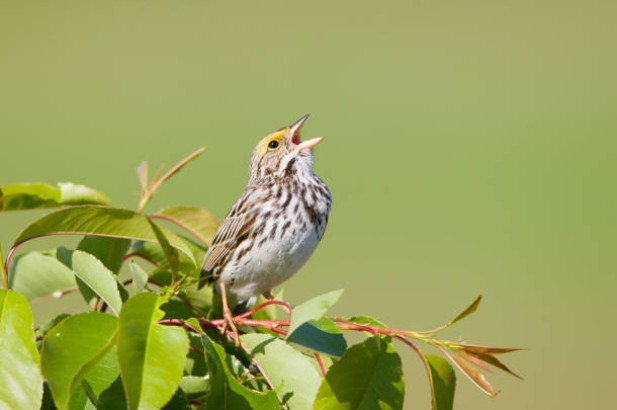
Hope Is the Thing with Feathers on “Sweetness and Light”
This week on “Sweetness and Light,” I’ve assembled a playlist of avian music for the month of May.
Yes, yes, I’ve programmed Ottorino Respighi’s “The Birds,” his evergreen suite for small orchestra based on musical bird portraits of the 17th and 18th centuries, and Handel’s Organ Concerto in F major, “The Cuckoo and the Nightingale.”
But I’ve also included a lesser-heard selection by Hubert Parry, from his incidental music for Aristophanes’ “The Birds,” a bridal march revived for the weddings of both Princess Elizabeth (soon to be Elizabeth II) and Prince William; a piece of light music kitsch juxtaposing bird song and chanting monks by Albert Ketèlbey; and a galop by Danish composer Hans Christian Lumbye, the Johann Strauss of the North, celebrating the exotic birds of the Tivoli Volière.
Finally, it’s very much my pleasure to have dusted off some vintage recordings of Elisabeth Schumann (whose hobby it was to engage in bird-whistling) and John McCormack, who will sing works by Carl Zeller and Eric Coates, respectively.
Better start lining the cage with newspaper. It’s “For the Birds” this week on “Sweetness and Light,” this Saturday morning at 11:00 EDT/8:00 PDT, exclusively on KWAX, the radio station of the University of Oregon!
Stream it wherever you are at the link:
https://kwax.uoregon.edu/ -

Memorial Day Picnic on “Sweetness and Light”
For many, Memorial Day marks the unofficial start of summer, as people take advantage of the three-day weekend, and the hopefully mild weather, to celebrate.
Of course, Memorial Day itself is a rather solemn holiday, as we’re meant to honor the sacrifice of those who laid down their lives in defense of our country.
That said, this morning on “Sweetness and Light,” since there’s little “sweet” or “light” about war, I figured rather we’d take the hour to enjoy a little Memorial Day picnic, if you will.
I hope you’ll join me for an outdoor overture, a barbecue divertimento, a carousel waltz, some gazebo dances, a pickle-and-pepper rag, a teddy bear’s picnic, and, yes, even a musical moment of reflection for the fallen.
The first of the summer’s patriotic holidays is upon us. Wrap yourself in the flag and everything else in bacon, this morning on “Sweetness and Light.” The three-legged races and pie-eating contests commence at 11:00 EDT/8:00 EDT, exclusively on KWAX Classical Oregon!
Stream it, wherever you are, at the link:
https://kwax.uoregon.edu/ -
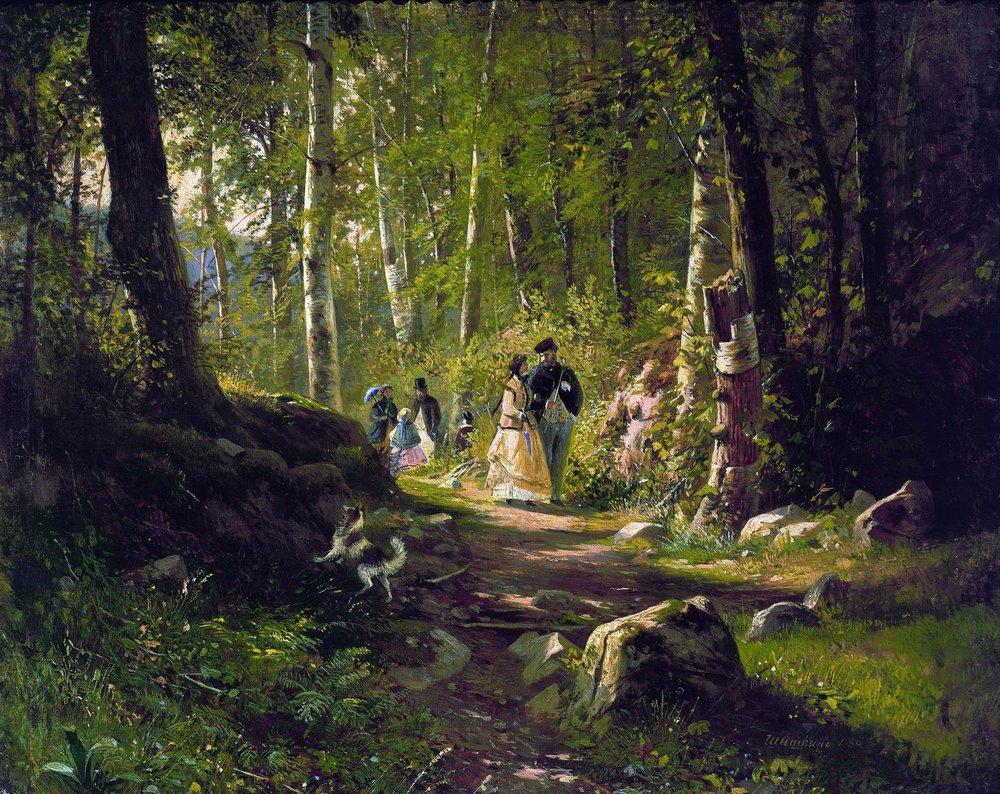
Woodland Walks on “Sweetness and Light”
It’s well into May, the birds are singing, and the trees are vibrant and cheering (at least from where I type, in the Northern Hemisphere). All in all, the conditions are perfect for a musical walk in the woods this morning on “Sweetness and Light.”
We’ll visit the forests of Sherwood and Arden, respectively, courtesy of Frederic Curzon’s “Robin Hood Suite” and William Walton’s music for a 1936 film version of “As You Like It.” In between, we’ll enjoy a trip to the Vienna woods with Johann Strauss II and explore the lush forests of Lithuania with Mikalojus Čiurlionis. We’ll even partake in a woodland revel courtesy of George Melachrino, oh my!
No need to put on a hat or tuck your pants into heavy socks. The ticks and snakes will be most amicable on “Sweetness and Light,” this Saturday morning at 11:00 EDT/8:00 EDT, exclusively on KWAX Classical Oregon!
Stream it, wherever you are, at the link:
https://kwax.uoregon.edu/——-
PAINTING: “A Walk in the Forest” (1869) by Ivan Shiskin
Tag Cloud
Aaron Copland (94) Beethoven (95) Composer (114) Film Music (148) Film Score (143) Film Scores (255) Halloween (97) John Williams (196) KWAX (232) Leonard Bernstein (105) Marlboro Music Festival (125) Movie Music (163) Mozart (91) Opera (215) Philadelphia Orchestra (90) Picture Perfect (174) Princeton Symphony Orchestra (110) Radio (90) Ross Amico (244) Roy's Tie-Dye Sci-Fi Corner (290) The Classical Network (101) The Lost Chord (269) Vaughan Williams (107) WPRB (397) WWFM (881)