Tag: 19th Century Music

  • Mendelssohn: Underrated Genius and Musical Revolutionary

    Mendelssohn: Underrated Genius and Musical Revolutionary

    I am starting to get just a little bit tired of hearing that if Felix Mendelssohn had never lived, music history would not have turned out any differently. He’s second-rate, he’s sentimental, he’s an academician, blah blah blah. When are these pompous idiots going to open their ears and acknowledge the fact that he was only one of the most influential composers of the 19th century? Especially in Germany, England and America, did any serious musician escape his sway?

    Mendelssohn was essentially adopted as England’s national composer. Figures from William Sterndale Bennett through Sir Arthur Sullivan gleefully played in his shadow. In fact, Mendelssohn was the hottest composer in England since Handel. Such a stranglehold did Handel and Mendelssohn have on English concertgoers’ affections that, in Germany, England was mocked as “Das Land ohne Musik” – The Land without Music. The best English composers were all German.

    But if the Germans were to be at all honest with themselves, they would have realized that all the best German composers were also followers of Mendelssohn. What about Wagner, you say, surely one of the most progressive composers who ever lived? There’s plenty of Mendelssohn in early Wagner. Ditto for Richard Strauss. As for the “second rank,” the more conservative school, just about everyone emulated Mendelssohn.

    Of himself, of course, Mendelssohn was one of the most astonishing of musical prodigies. He composed two of the most enduring masterpieces in the repertoire, the overture to a “Midsummer Night’s Dream” and the Octet for Strings, at 16 and 17 respectively. In terms of maturity and polish, these were certainly on a par with anything written by the teenaged Mozart.

    Yes, Mendelssohn was a traditionalist. He structured his music on foundations laid in the past. Even so, he cautiously ventured into the mists of Romanticism. Occasionally, he even subverted expectations, in works like his famous Violin Concerto. Furthermore, he was respectful, if not kind, to everyone, even those of whose music he disapproved.

    As a conductor, there’s no question he was one of the most influential musicians in Europe, if not the world. For twelve years, he led the Leipzig Gewandhaus Orchestra, an ensemble full of players who went on to distinction in their own right. He was admired for the precision of his performances. He was also the one who essentially drew up the blueprint for modern orchestras in developing a musical “canon.” He gave important premieres of music by his contemporaries, while also reviving works of Bach, Mozart, and Beethoven.

    In particular, he is credited with resuscitating the reputation of Johann Sebastian Bach, not only through his resurrection of the “St. Matthew Passion,” but in overseeing an edition of Bach’s organ works, along with an edition of Handel’s oratorios, both of which were published in England.

    So music history would have been quite different if not for Mendelssohn, thank you very much. He may not have been the most seismic of innovators, but there’s something to be said for being a master of one’s craft.

    Mendelssohn died in Leipzig, after a series of strokes, at the age of 38. Did he live up to his potential? Who among us is really qualified to judge? How much is one man expected to accomplish, anyway?

    No radio station in the world is going to devote a full day to Mendelssohn’s music. Since the death of Victoria, I don’t think Mendelssohn has ever really been fashionable, except perhaps at weddings. But who doesn’t love the overture to “A Midsummer Night’s Dream,” the Octet for Strings, the “Hebrides Overture,” the “Italian” Symphony, or the Violin Concerto in E minor?

    Morton Feldman once said, “The people you think are radicals might really be conservative. The people who you think are conservative might really be radical.”

    I don’t know that I would ever go so far as to label Mendelssohn a radical, but he most certainly did change the world, and those of us who love music would have been a lot poorer without him.

    Happy birthday, Felix Mendelssohn!


    IMAGE: Another view of Mendelssohn
  • Ureli Corelli Hill Musician’s Hard Life

    Ureli Corelli Hill Musician’s Hard Life

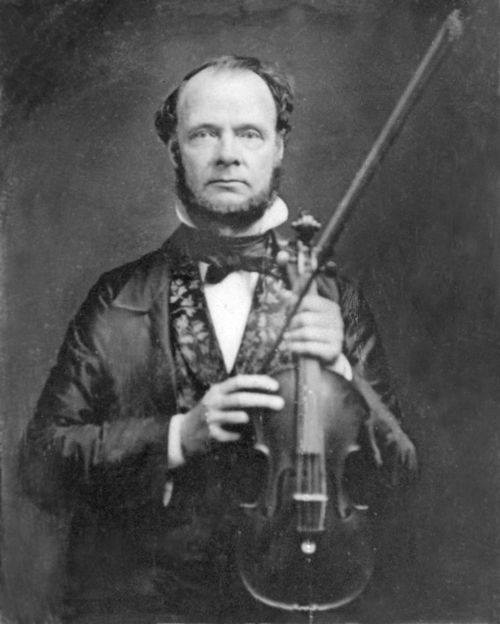
    Historically speaking, most musicians have never had it easy. Consider the case of Ureli Corelli Hill.

    Hill was born into an artistically-inclined family in Hartford, CT, in 1802. His father was a music teacher and composer (an 1810 New York newspaper ad trumpeted him as the “first performer on violin in America”), and his brother, George Handel Hill, a contemporary and colleague of John Wilkes Booth, achieved renown for his portrayal of a stereotypical rustic New Englander, which earned him the nickname “Yankee.”

    One source states that Yankee Hill made his first appearance in character at the Arch Street Theatre in Philadelphia, around 1832. Others claim George had already assumed his persona a few years earlier, as he strode the boards in New York. (He had run away to Manhattan to get his start as an actor in 1826.) Unfortunately, Hill was not a temperate man. Wine, women, and precarious health led to his untimely demise in 1849, less than two weeks before his 40th birthday.

    The other Hill, Ureli, also entered the theater, but on the other side of the footlights. At 19, he played violin in the pit. He was also in the orchestra for the first performances of Italian opera in New York City in 1825.

    In 1831, he led the first complete American performance of Handel’s “Messiah” at New York’s St. Paul’s Chapel. He also introduced to the U.S. Mendelssohn’s oratorio “St. Paul.”

    Hill studied in Germany with Louis Spohr and participated in a performance of Beethoven’s Ninth Symphony under the baton of Felix Mendelssohn, “an affable man,” who also spoke perfect English. Later, as first president of the New York Philharmonic Society, Hill would invite Spohr and Mendelssohn to conduct. Both politely declined, unable to make the trans-Atlantic journey. However, both responded with warm letters of thanks.

    On the Philharmonic’s first concert in 1842 – a varied menu, mixing orchestral, chamber, and vocal selections – Hill conducted Beethoven’s Fifth Symphony and participated as a violinist in Johann Nepomuk Hummel’s Piano Quintet in D minor. Also on the program were orchestral works by Carl Maria von Weber and Johann Wenzel Kalliwoda, and some Italian operatic arias.

    Hill arranged for the first American performance, with the Philharmonic, of Beethoven’s Ninth, in 1846. The symphony was conducted on that occasion by George Loder, Jr. Hill continued to conduct the Philharmonic, in alternation with six others, until he became embroiled in controversy for his advocacy of American composers of the era, including George Bristow and William Henry Fry.

    Hill moved to Cincinnati, where he allowed things to cool down for three years. Then in 1850, he returned to New York and resumed his membership as a violinist in the orchestra. He was really hoping to make his fortune with a piano he invented that used tuning forks in place of strings. Instead, he lost his shirt, since, as fate would have it, Steinway & Sons was only just taking off.

    By 1873, Hill was 71 years-old and unable to play at a standard worthy of the orchestra. In retirement, he moved to Paterson, NJ. There, he had difficulty finding students. Unable to support his family, he died of his own hand, of an opium overdose, on this date in 1875. Hill left a note, in which he stated, “Why should or how can a man exist and be powerless to earn means for his family?”

    It is possible for an artist to achieve much in this life but still have nothing.

  • Beethoven’s Dedication Disaster

    Beethoven’s Dedication Disaster

    How to spoil your shot at a dedication!

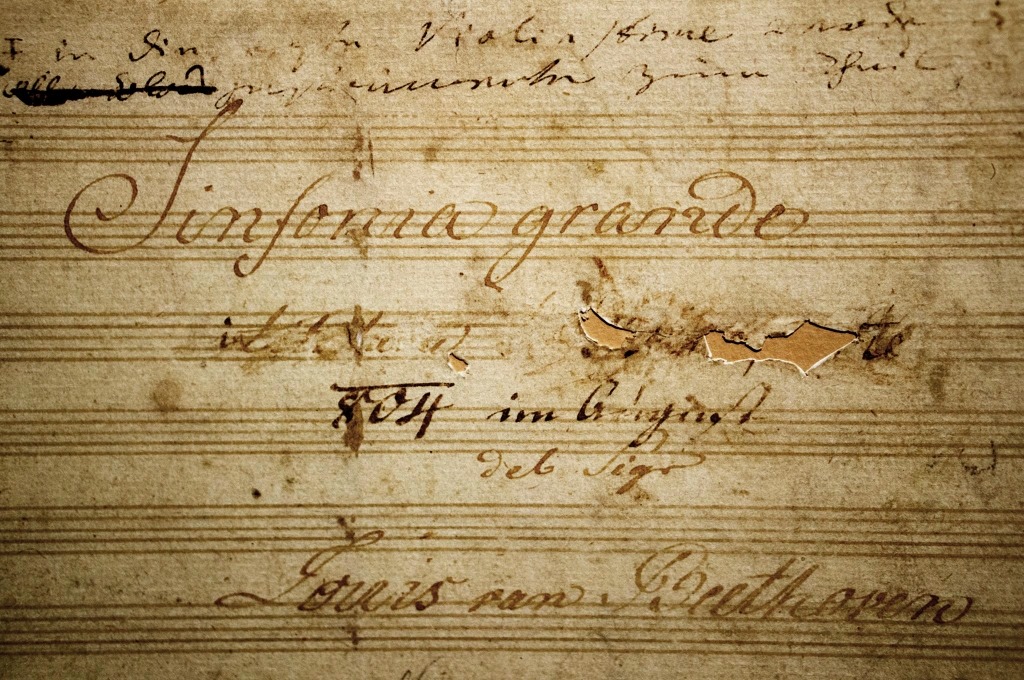
    Ludwig van Beethoven had recently completed his Symphony No. 3 under the giddy influence of an idealized Napoleon Bonaparte. As a statesman and military leader who was well on his way to conquering (or as Beethoven may have seen it, liberating) most of Europe, Napoleon was deemed by the composer to be on equal footing with the greatest consuls of Ancient Rome.

    The egalitarian-minded Beethoven may have been blinded by his revolutionary fervor, but once he learned that Napoleon had been proclaimed Emperor on this date in 1804, the scales dropped from his eyes and his affection curdled. He is alleged to have said, “So he is no more than a common mortal! Now, too, he will tread under foot all the rights of Man, indulge only his ambition; now he will think himself superior to all men, become a tyrant!” In a fury, he scratched out the symphony’s original dedication.

    Later, once he had cooled, Beethoven confided to his publisher that the proper title of the symphony should be “Bonaparte.” Instead, it was released under the name “Sinfonia Eroica” – “Heroic Symphony.” The revised dedication reads, “Composed to celebrate the memory of a great man.”

    Beethoven’s “Eroica” Symphony is regarded as one of the most significant works of the early 19th century. With its structural breadth and emotional scope, the work exploded the boundaries of symphonic form as it was recognized at the time. In his way, Beethoven managed to win as much new ground as Napoleon. Unlike Napoleon, however, he was able to keep it. And he holds it still.

  • Franz Liszt Superstar Sinner Saint

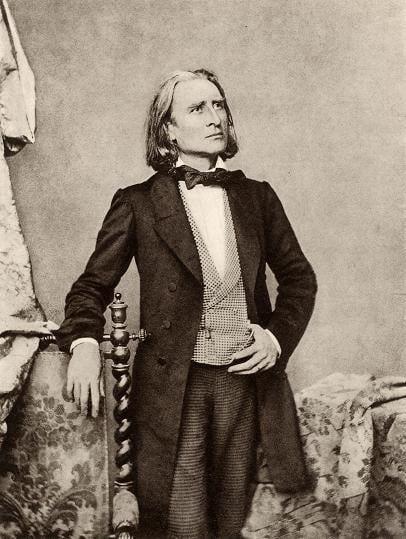
    Franz Liszt Superstar Sinner Saint

    Charlatan. Visionary. Sinner. Saint. Showman. Superstar.

    Franz Liszt’s prowess at the keyboard is still spoken of in tones of awe. This inventor of the modern piano recital lent spectacle and showmanship to Orphean musicality and transcendental technique. He tore through pianos as if they were made out of paper and reduced the ladies of Europe to skirmishes over his cigar butts or the calculated neglect of a glove.

    He loved the attention. He loved the applause. He loved the women.

    Then all at once he stopped. Liszt retired from the concert stage at the age of 35, returning thereafter only for charitable causes – for the relief of victims of fire and flood, in support of political refugees, and to raise money for a Beethoven monument in Bonn.

    He may have been a man who savored all the privileges of his celebrity, but he was also an intellectual and an artist of the spirit. He was devoutly religious for his entire life – even taking minor orders and living in a cell in Rome for a few years at middle age – and he was unfailingly generous to others. He never took payment from any of his pupils, and selflessly promoted the work of Grieg, Smetana, Debussy, Saint-Saëns, Fauré, Borodin and many more.

    Throughout his career, he was lambasted by critics for pandering to the mob. He was ridiculed as a charlatan and a hypocrite. He was shunned for his long-term relationships with two women who fled troubled marriages, and intrigued against by jealous rivals at the Weimar court for championing the works of Berlioz and Wagner.

    He helped the latter, a political fugitive for his role in the 1849 Dresden uprising, to flee the country, and even endorsed Wagner’s marriage to Liszt’s (already married) daughter. Wagner’s “Tristan chord” would send shockwaves throughout Europe, changing music forever, but in actuality it was only one of the many innovations he borrowed from his father-in-law. Wagner may have been the greater composer, but Liszt was the idea man. He was the soil that allowed Wagner’s genius to flower.

    Liszt was one of the most original musical thinkers of the 19th century. His influence rippled down the generations to color the thinking also of Ravel, Scriabin, and Schoenberg. “My sole ambition as composer,” he once pronounced, “is to hurl my lance into the infinite space of the future.”

    The future is now, as we celebrate this wildly influential, yet still sorely underrated composer on his birthday with an afternoon of his music, including the epic and seasonally appropriate “A Faust Symphony.”

    First, on today’s Noontime Concert, Mimi Stillman and Charles Abramovic will enchant in a program presented as part of Penn State Flute Day (January 13, 2019). They’ll share works by Philippe Gaubert, Daniel Dorff, Heidi Jacob (a world premiere), Francis Poulenc, Antonin Dvorak, and Vittorio Monti. Monti’s “Czardas” will act as a bridge to an afternoon of music by one of Hungary’s greatest masters.

    We’ll provide an assist for Liszt, prefaced by a recital by stylish Stillman. Join me for music both notable and noble, from 12 to 4 p.m. EDT, on WWFM – The Classical Network and wwfm.org.


    Learn more about Stillman and Abramovic’s upcoming concert of Bach masterworks, with the Dolce Suono Ensemble, at Philadelphia’s Old Pine Street Presbyterian Church, this Sunday at 3 p.m.:

    DSE Presents: Bach Masterworks

  • William Henry Fry Birthday Fry Day?

    William Henry Fry Birthday Fry Day?

    When is Saturday “Fry Day?” Why, when it’s the birthday of William Henry Fry, of course!

    Fry was born in Philadelphia in 1813. A pioneering figure in American music, he was the first native-born composer to write on a large scale. He composed orchestral works and the first opera by an American to be performed publicly in his lifetime (“Leonora,” in 1845). He was an outspoken advocate of American music – that is, music composed by Americans – at a time when German imports ruled the roost. It would be decades before American music would gain a toehold in the concert halls, which makes Fry an even more remarkable figure.

    He studied music with a former bandleader in Napoleon Bonaparte’s army, who went on to become the head of Philadelphia’s Musical Fund Society. Fry himself would become the society’s secretary.

    Fry was also a journalist, a writer on music, and the first music critic to write for a major American newspaper. He was a foreign correspondent for the Philadelphia Public Ledger and acted as music critic for the New York Herald Tribune.

    He composed seven symphonies, all of them of a descriptive nature. His “Santa Claus Symphony,” after Clement Moore, is more of a Straussian tone poem. My personal favorite is the “Niagara Symphony,” written for P.T. Barnum, conceived for enormous forces augmented by a mindblowing eleven timpani.

    Fry died of tuberculosis, “accelerated by exhaustion,” in Santa Cruz (Saint Croix) in the Virgin Islands in 1864, at the age of 51.

    There is some discrepancy regarding the date of his birth, with some sources giving August 10, and others August 19. So maybe it’s not Fry Day, after all.

    Happy birthday (perhaps belatedly), William Henry Fry.

    The “Niagara Symphony” (it begins quietly):

Tag Cloud

Aaron Copland (92) Beethoven (94) Composer (114) Film Music (117) Film Score (143) Film Scores (255) Halloween (94) John Williams (185) KWAX (228) Leonard Bernstein (99) Marlboro Music Festival (125) Movie Music (132) Opera (197) Philadelphia Orchestra (86) Picture Perfect (174) Princeton Symphony Orchestra (106) Radio (86) Ralph Vaughan Williams (85) Ross Amico (244) Roy's Tie-Dye Sci-Fi Corner (290) The Classical Network (101) The Lost Chord (268) Vaughan Williams (101) WPRB (396) WWFM (881)

DON’T MISS A BEAT

Receive a weekly digest every Sunday at noon by signing up here


RECENT POSTS