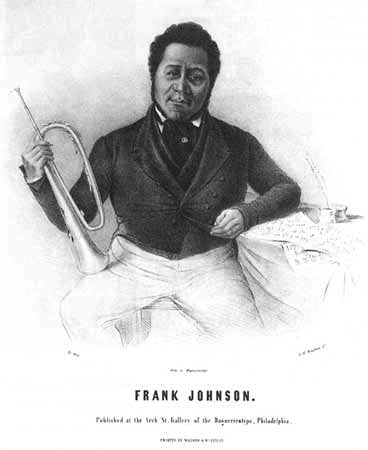
A blue and gold marker erected before his home, at 65 South 4th Street in Philadelphia, describes him as “America’s first native-born master of music.” He was a prolific composer, “trumpeter of 1st Troop, City Cavalry, and Bandmaster, 128th Regiment, Pennsylvania Volunteer Infantry.” He was also the leader of America’s most popular band for more than twenty years. Over a century before Dorothy Maynor and Little Richard, Francis Johnson, born on this date in 1792, was presenting racially-integrated concerts.
Johnson was the first African-American to have his works published as sheet music. He led the first American ensemble, an all-black brass band, in performance abroad. In 1837, he sailed to England to take part in the celebrations surrounding the coronation of Queen Victoria. In gratitude, the Queen presented him with a silver bugle. While there, he was exposed to the promenade concert – a style of informal, outdoor garden entertainment – which he brought back with him to the United States. He returned to Philadelphia in 1838, the year Pennsylvania Hall was burned to ground by an angry mob for hosting a convention of abolitionists.
Indeed, it’s remarkable, in a climate of mounting racial tension and violence, with the Civil War still decades in the future, just how beautifully Johnson’s career flourished. In 1824, he was invited to perform for General Lafayette during Lafayette’s return to the United States. He also taught wealthy European-American students at a studio much-remarked upon for its extensive music library. Over the years, he also amassed an impressive array of instruments. His works were published in compilations alongside those of Beethoven, Brahms, Bellini, Donizetti, Weber, and Czerny.
At the same time, he performed in Philadelphia’s black churches. His style of playing included rhythmic variations that deviated considerably from his written scores. In the 20th century, this might have been described as “jazzing,” but Johnson’s improvisions would have been worlds away from what we now recognize as jazz.
He was also known to have delighted his audiences with certain extended techniques and programmatic elements. His “Bird Waltz” featured a chirrupy flute obbligato, his “New Railroad Gallop” emulated a train, and his “Philadelphia Fireman’s Quadrille” was punctuated by cries of “Fire! Fire!”
Unfortunately, a lot of this music was not fully written-out, with prompts often indicated in his scores. When they were published, it was commonly in arrangements and as piano transcriptions made by other hands. Scholars have reconstructed his performance style to the best of their ability from surviving evidence, including newspaper accounts and other documents describing the effects heard on Johnson’s concerts. The music itself is fairly simple, often a framework to be adorned by improvisation and development.
Johnson died in 1844 at the age of 51. At his funeral, Queen Victoria’s bugle lay atop his casket.
Happy birthday, Francis Johnson.
General Lafayette’s Grand March
Philadelphia Firemen’s Cotillion
Princeton Gallopade
Dirge (played at Johnson’s funeral)