Can it really be 50 years since the first moonwalk? Could it ever have happened had it been today? We seem to be worlds away from the spirit of teamwork and optimism that harnessed good old-fashioned American know-how to the kind of integrity, cooperation, and sacrifice – the sense of something greater than oneself – necessary to point the way forward for mankind.
Be that as it may, this week on “Picture Perfect,” we’ll celebrate Neil Armstrong’s historic “giant leap” with an hour of music from movies about space exploration and the moon.
We’ll begin with a sop for the conspiracy theorists. “Capricorn One” (1978) runs with the idea – originally formulated with the televised moon landing – that the first manned mission to Mars is a fabrication, filmed on a soundstage. When the actual, unmanned capsule burns up upon re-entry into the earth’s atmosphere, the government attempts a cover-up, and the astronauts are sent scrambling for their lives. This is the film in which O.J. Simpson eats a rattlesnake. The cast also includes Elliot Gould, James Brolin, Sam Waterston, Hal Holbrook, and Karen Black. The music is by Jerry Goldsmith.
If the moon landing were indeed a hoax, who better to execute it than Stanley Kubrick? (This is an actual theory!) After all, Kubrick had directed “2001: A Space Odyssey” (1968), which was released a little over a year before the flight of Apollo 11.
For “2001,” under pressure from the studio, Kubrick again engaged his “Spartacus” collaborator, composer Alex North, to provide the music. North did his best to adhere as closely as possible to the temp tracks Kubrick had selected for some scenes, yet deviated enough from Richard and Johann Strauss to maintain his own distinctive musical identity.
In the end, despite the obvious sensitivity and craftsmanship with which North undertook the project, Kubrick tossed out his entire contribution and stuck with his original choices by classical music masters. Unfortunately, he never bothered to mention it to the composer, who only found out at the film’s premiere. North’s original score remained unpublished until its first commercial release (conducted by Goldsmith) in 1993.
Princeton’s own Demian Chezelle tackled Neil Armstrong – his personal struggles, and his triumph on the moon – in “First Man” (2018). Ryan Gosling plays Armstrong. The music is by Chezelle’s former Harvard classmate and frequent collaborator, Justin Hurwitz, two-time Academy Award winner for “La La Land.”
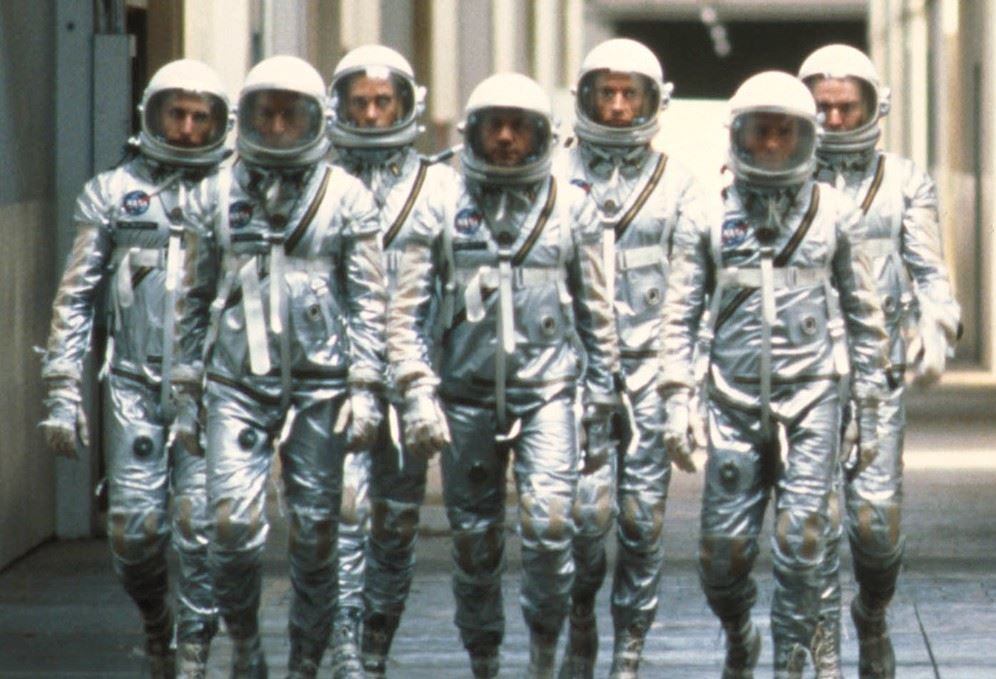
Finally, Philip Kaufman’s panegyric to the heroic military pilots who helped propel America’s space program, both higher and faster, resulted in one of the best films of the 1980s. “The Right Stuff” (1983) provides an epic, three-hour ride, with a spot-on cast, including Ed Harris, Scott Glenn, Fred Ward, Dennis Quaid, and Sam Shepherd as Chuck Yeager. Though a darling of the critics, somehow the film didn’t quite catch on with audiences, perhaps intimidated by its imposing running time. The music is by Bill Conti, probably best known for his work on “Rocky.”
Aim high this week, as we look to the moon and beyond, on “Picture Perfect,” music for the movies. This Friday evening at 6:00 EDT, on WWFM – The Classical Network and wwfm.org.
