Tag: 20th Century Composers

  • Daniel Gregory Mason Rediscovered

    Daniel Gregory Mason Rediscovered

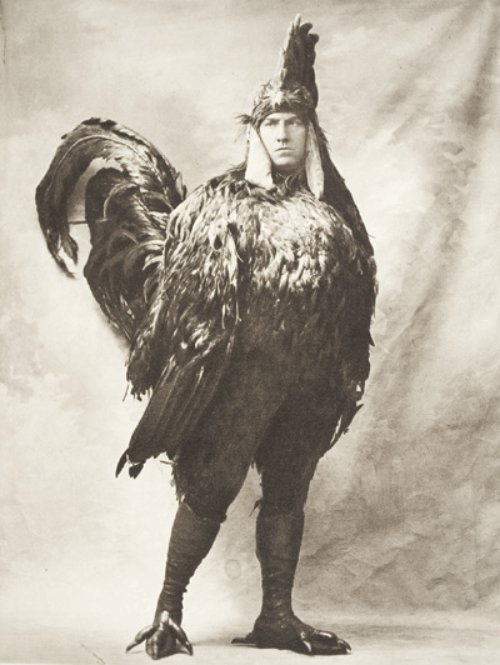
    “I do not propose to write an ode to dejection, but to brag as lustily as Chanticleer in the morning, standing on his roost, if only to wake my neighbors up.” So wrote Henry David Thoreau in his preface to “Walden” (now on my bedstand, just in time for the season of consumerism run amuck).

    The quote serves as a superscription for Daniel Gregory Mason’s “Chanticleer Festival Overture.” Mason was born in Brookline, MA, on this date 150 years ago. His father was Henry Mason, cofounder of the Mason & Hamlin piano company, and his grandfather was Lowell Mason, composer of some 1600 hymn tunes, including “Nearer, My God, to Thee.”

    Daniel studied theory and composition at Harvard under John Knowles Paine, continuing his lessons with George Whitefield Chadwick and others. He became a writer on music and a lecturer at Columbia University. After 1907, his compositional output increased. He acquired further polish in Paris, studying with Vincent d’Indy, in 1913.

    Of course, 1913 was the year that Stravinsky’s “The Rite of Spring” shook the musical world, but Mason remained resistant to its charms. Instead, he continued to create cocooned in a Romantic sensibility, and a rather conservative one.

    In his way, he sought to increase respect for American music, incorporating indigenous and popular themes into a number of his works, urging native composers to stop imitating European models (though he himself evidently admired the Austro-German canon), and criticizing European conductors working in the U.S. for not including American works on their programs. On the other hand, he wasn’t overly happy with George Gershwin or Aaron Copland, nor was he thrilled by jazz or the influence of Stravinsky.

    In common with many of his time, Mason held some complicated views. He publicly condemned anti-Semitism and embraced what were then described as Negro spirituals. However, he was pretty firm in his belief that American culture should be “Anglo-Saxon,” and went a little overboard in expressing his xenophobia, to the extent that he felt compelled to write an apology in the New York Times in 1933, stating that he had been misinterpreted and clarifying that he was opposed to “jingoism and Hitlerian nationalism.”

    Mason was a man of contradictions, to be sure. Among his writings are 18 books on music, so there is certainly plenty to sift through. One can only imagine what he made of American music at the time of his death in 1953.

    Mason’s “Chanticleer Festival Overture” dates from 1926. Gershwin’s “Rhapsody in Blue” was composed in 1924, and Copland’s jazz-inflected “Music for the Theater” appeared in 1925.

    “All climates agree with brave Chanticleer. He is more indigenous even than the natives. His health is ever good, his lungs are sound, his spirits never flag.”

    Mason’s own music is now virtually forgotten. But it is not without its charms. His Thoreau-derived rooster portrait is still something to crow about. A tip of the cockscomb to Daniel Gregory Mason on his sesquicentennial.

    Symphony No. 3 “Lincoln,” conducted by Sir John Barbirolli

    String Quartet in G minor on Negro Themes

    “Variations on Yankee Doodle in the Styles of Various Composers”
  • Hindemith Beyond Gebrauchsmusik

    Hindemith Beyond Gebrauchsmusik

    I always suspected there was more to Paul Hindemith than meets the ear. No question, he was one of the 20th century’s most influential composers, especially in the United States, where he offered a respectable alternative for young composers to the Schoenberg school of twelve-tone composition. But he sure could blanch the color out of tonality. You can have your tonal music, but don’t let it get too voluptuous!

    Of course, it wasn’t always that way. There was an iconoclastic edge to a lot of his earlier works. At least they made one sit up and take notice – including the Nazis, who booted him out of Germany. Occasionally, he’d come up with something like “Mathis der Maler,” which manages to be both sober and spiritual. But seldom does he rollick, as he does in his popular “Symphonic Metamorphosis of Themes by Carl Maria von Weber.” I suppose letting down your hair doesn’t necessarily come naturally to one who doesn’t have any.

    Blame it on Hindemith’s philosophical adherence to “gebrauchsmusik” – in English, “utility music” – functional music written on demand, whether the Muse happens to be “in” or not. Hindemith penned reams of it. But it’s not all like being trapped in the back seat of your parents’ car on a long trip with nothing but a gray crayon.

    Clearly the man did have a sense of humor, and liked to share inside jokes with his wife, Gertrud, whom he married in 1924. There is, for example, the Concerto for Woodwinds, Harp and Orchestra, with its third-movement allusions to Mendelssohn’s “Wedding March.” The work was premiered on May 15, 1949 – the couple’s silver wedding anniversary.

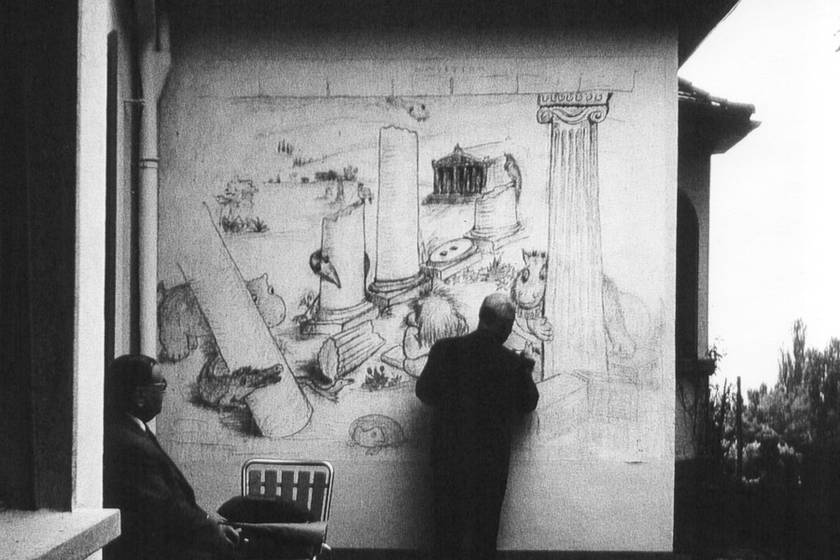
    Hindemith was also a talented draughtsman, whether doodling in his manuscripts or sketching a mural on an outside wall of their Swiss villa. He was especially fond of designing his own Christmas cards. Sometimes the drawings were Thurberesque, with perhaps just a touch of Gerard Hoffnung’s whimsy when approaching musical subjects. Sometimes they were executed with a little more care.

    He frequently included lions in his drawings. This was not a reference to St. Jerome, but rather to Hindemith’s wife, who happened to be a Leo. I find that touching, and rather human. A good deal more so than some of his music.

    Happy birthday, Paul Hindemith!


    A sample of Hindemith’s drawings

    https://www.hindemith.info/en/life-work/drawings/

    More about his relationship with Gertrud

    http://www.hindemith.info/en/life-work/biography/1918-1927/life/marriage/

    Concerto for Woodwinds, Harp and Orchestra (with Mendelssohn allusions beginning around 10:49)

    Classic recording of “Mathis der Maler” Symphony, conducted by William Steinberg

    Hindemith in a rare swashbuckling mood, from the “Symphonic Metamorphosis”

    Hindemith the iconoclast (punctuated by a siren)

    One of my most hated Hindemith works – get out the gray crayons!

    And one of the most touching, written in a mere six hours the day after the death of King George V, as a last-minute replacement for Hindemith’s viola concerto “Der Schwanendreher,” and played by the composer himself on a live radio broadcast over the BBC not long after completing it at 5 p.m.

  • Boulez & Composers A Rare 1977 Photo

    Whoaaaaaa! Check out this incredible photo.

    Pierre Boulez (front right), with all the living composers whose works he programmed during his tenure with the New York Philharmonic. The photo was taken in 1977.

    First row (left to right): Milton Babbitt, Lucia Dlugoszewski, Ulysses Kay, George Rochberg, and Mario Davidovsky.

    Second Row: David Gilbert, Stephen Jablonsky, Jacob Druckman, Roger Sessions, William Schuman, and Aaron Copland.

    Third Row: Donald Martino, Donald Harris, Daniel Plante, Morton Gould, Vincent Persichetti, and Roy Harris.

    Fourth Row: Charles Wuorinen, Carmen Moore, Sydney Hodkinson, David Del Tredici, Earle Brown, Harley Gaber, Stanley Silverman, John Cage, and Elliott Carter.

  • Kreisler & Schoenberg: Vienna’s Odd Couple

    Kreisler & Schoenberg: Vienna’s Odd Couple

    Fritz Kreisler, the sweet-toned confectioner and purveyor of violin bonbons, and Arnold Schoenberg, the dour high priest of twelve tone music. Vienna’s fin-de-siècle odd couple reunite on this week’s “Music from Marlboro.”

    Both artists were born in Vienna, only five months apart – Schoenberg on September 13, 1874, and Kreisler on February 2, 1875. Kreisler’s father was a doctor. Schoenberg’s sold shoes.

    Both had Jewish parents. Kreisler, whose mother was Catholic, was baptized into the faith at the age of 12. Schoenberg converted to Lutheranism at 24. However, just when it would have been most dangerous to do so, he roared back to Judaism and – with the rise of Hitler in 1933 – defiantly embraced his heritage.

    In general, Kreisler seems to have enjoyed the easier life. He had a more comfortable start and a happier disposition. As a musician, he was content to entertain.

    Schoenberg was a revolutionary and probably a bit of a hard-nosed contrarian. He had a turbulent marriage, seldom smiled for photos, and indulged in expressionist painting. Also, he was superstitious. He especially suffered from triskaidekaphobia, fear of the number 13.

    On the other hand, he did orchestrate his share of Viennese operettas, arranged Strauss waltzes for performance with his friends, played tennis with George Gershwin, and was a fan of Hopalong Cassidy.

    Both men came to be regarded in some circles as mountebanks. Kreisler ruffled a few feathers when he let slip that many of the 18th century “rediscoveries” he had used to charm audiences, critics and musicologists were not in fact rediscoveries at all. Nor did they date from the 18th century. When the professionals complained, Kreisler made like Vinnie Barbarino. Wha-? Schoenberg triggered kneejerk reviews and outright hostility with his dismantling of tonality.

    Nevertheless, both also acquired some serious musical credentials. Kreisler gave the world premiere of the Elgar Violin Concerto and became a favorite recital partner of Sergei Rachmaninoff. Schoenberg blossomed into one the most influential composers of the 20th century.

    In 1941, Kreisler was hit by a milk truck, which fractured his skull and put him into a coma. Like something out of an early Woody Allen comedy, when he awoke he could only communicate in Latin and Greek. Thankfully, the effect was only temporary.

    It is Kreisler’s music that continues to communicate most effectively. We’ll hear his String Quartet in A minor, from 1922, performed at the 2013 Marlboro Music Festival by violinists Danbi Um and Nikki Chopi, violist Sally Chisolm, and cellist Lionel Cottet.

    That will be followed by Schoenberg’s Chamber Symphony No. 1 of 1906, a pre-serial work that nevertheless pushes harmony to the brink. It was presented at Marlboro in 1982 by an ensemble of fifteen players directed by Leon Kirchner.

    Was the glass half empty or the milk truck half full? Kreisler lived a good long life. He died in 1962 at the age of 86. Schoenberg died on his 76th birthday, Friday the 13th, 1951. Earlier in the day, he had been informed by his astrologer that 7 plus 6 equals 13.

    No matter how you tally, the performances will be top-notch on the next “Music from Marlboro,” this Wednesday evening at 6:00 EDT, on WWFM – The Classical Network and wwfm.org.

    Marlboro School of Music and Festival: Official Page


    PHOTO: Fritz Kreisler (second from left) and Arnold Schoenberg (cello) in 1900

  • Stravinsky Genius or PR Machine?

    Stravinsky Genius or PR Machine?

    Was Igor Stravinsky the greatest composer of the 20th century? Sure, he was in the right place(s) at the right time, but he wouldn’t have gotten very far without his own unique blend of talent, curiosity and drive. His was an incredible journey that spanned from the Russian nationalism of his teacher, Rimsky-Korsakov, to post-Schoenberg serial experimentation. Also, he had one hell of a PR machine. Happy birthday, Igor Stravinsky.

Tag Cloud

Aaron Copland (92) Beethoven (94) Composer (114) Film Music (117) Film Score (143) Film Scores (255) Halloween (94) John Williams (185) KWAX (228) Leonard Bernstein (99) Marlboro Music Festival (125) Movie Music (132) Opera (197) Philadelphia Orchestra (86) Picture Perfect (174) Princeton Symphony Orchestra (106) Radio (86) Ralph Vaughan Williams (85) Ross Amico (244) Roy's Tie-Dye Sci-Fi Corner (290) The Classical Network (101) The Lost Chord (268) Vaughan Williams (101) WPRB (396) WWFM (881)

DON’T MISS A BEAT

Receive a weekly digest every Sunday at noon by signing up here


RECENT POSTS