Tag: 20th Century Music

  • Rediscovering Copland American Music Icon

    Rediscovering Copland American Music Icon

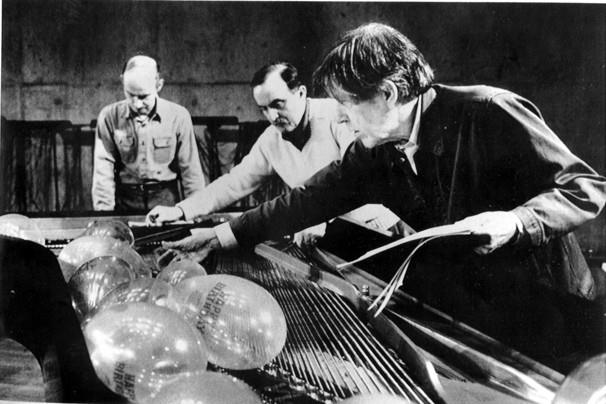
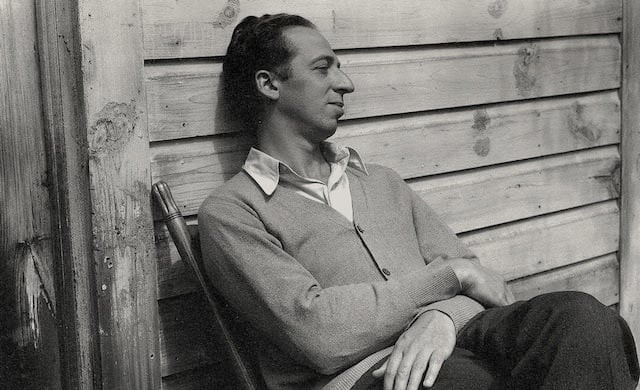
    I am so happy to rediscover this 30-minute documentary on Aaron Copland. I remember watching it years ago. What an exciting time for American music – and for America – to say nothing of the arts in general. Not that American music does not remain vital. But Copland seems to be the last man standing, in terms of the active repertoire, of that great generation. To catch a Roy Harris or a William Schuman symphony in concert is very rare indeed.

    It is the fate of even the greatest composers to be remembered through but a handful of pieces, usually from a particular phase of his or her career. In Copland’s case, it’s pretty much the cowboy music. Some people love it; some are put off by it. Cowboys aren’t exactly “in” right now, and when someone hears “I Ride an Old Paint,” they may not trouble themselves to look beyond the trappings.

    But nearly everything Copland wrote is worth hearing – and I’ve heard most of it – even the misfires. Once you get to know him, his sound is immediately identifiable in anything he touched. He had vision, he had craft, and he had integrity.

    I love this man, and I love his music, and I love what he did for music. Would that we had someone of his caliber today. Happy birthday, Aaron Copland.

  • George Crumb American Original at 90

    George Crumb American Original at 90

    George Crumb is an American original, the reigning Grand Old Man of American Music. Crumb, who makes his home in Swarthmore, PA, produces works with an economy and elegance that seem to contradict – and yet, somehow, paradoxically, to reinforce – an Ivesian tendency to suggest greater vistas beyond their seemingly modest means.

    On a more visceral level, sometimes they can be downright scary. Which is especially amusing since, by all accounts – and supported by my own experience, having met him perhaps five or six times – he has been unfailingly approachable, modest and even cheerful.

    It’s fortuitous indeed that his birthday falls so close to Hallowe’en. It’s not for nothing that his work for electric string quartet, “Black Angels,” was used in “The Exorcist.”

    Crumb has enjoyed a remarkable Indian summer, drawing on the hymns and folk songs of his West Virginia boyhood and lending them a unique resonance through his imaginative and colorful use of percussion. These are collected into seven cycles for voice titled “American Songbook” – remarkably effective and affecting works, especially when heard live in concert, where the breadth and subtlety of the instrumentation can be fully appreciated.

    Just because you’ve been pigeonholed as an avant-gardist doesn’t mean your music can’t be fun. “Mundus Canis” (“A Dog’s World”) is a musical portrait gallery for guitar and percussion inspired by the Crumbs’ family pets. Five of them are enshrined in the suite: Tammy, Fritzi, Heidel, Emma-Jean and Yoda. Apparently Yoda, a fluffy white mixed-breed, adopted from a New York City pound, was especially disobedient.

    “Mundis Canis”

    Many happy returns to George Crumb on his 90th birthday!


    “Black Angels” (wait until after breakfast)


    From his “American Songbook:”

    “All the Pretty Horses”

    “Poor Wayfaring Stranger”

    “One More River to Cross”

    “Give Me That Old Time Religion”


    PHOTO: George Crumb with “bad dog” Yoda

  • John Cage Freedom Maverick of Sound

    John Cage Freedom Maverick of Sound

    It’s ironic that a man named Cage would be all about freedom.

    A pioneer of aleatory or chance-controlled music, electroacoustic music, nonstandard use of musical instruments (like the prepared piano), making music with found objects, and finding the music in everyday sounds, John Cage was a titan of 20th century music.

    It’s possible to not know a single work he ever “wrote,” or at any rate conceived, and still be exposed to his influence constantly. Cage taught us new ways to think about sound and the nature of music, opening our ears to an infinite variety of new worlds for exploration. His genius lay in recognizing that which had always been invisible before our eyes and silent to our ears.

    To honor him on his birthday, I might insert objects between the caps lock and shift key of my laptop, or roll dice to determine which letters or combinations of letters to hit, or allow my cat to walk across the keyboard or spill a cup of coffee across the keys.

    Or I could write nothing at all and allow the peripheral impressions you receive from your own environment determine how you experience my blank post.

    You don’t have to like Cage any more than you like the hum of the refrigerator, or a creaking chair, or a tree falling in the woods. If you’re there to hear it, once in a while you should be made to do so. Me, I’ll have 4’ 33” on infinite repeat all day.

    Happy birthday, John Cage (1912-1992). There are plenty who would scoff at the Emperor’s New Clothes, but you were one hell of a tailor.


    “I can’t understand why people are frightened of new ideas. I’m frightened of the old ones.” – John Cage

    “Discovery consists of seeing what everybody else has seen and thinking what nobody has thought.” – Albert Szent-Györgyi

    Cage’s most notorious piece, 4’ 33”:

    Cage performs “Water Walk” on national television:

    complete appearance

    composition only, in better quality

    Cage for people who don’t like Cage:

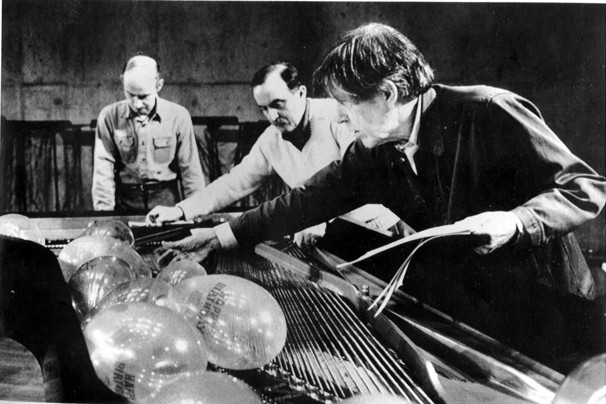
    PHOTO: What’s a birthday without balloons?

  • Jón Leifs Icelandic Heroism in Music

    Jón Leifs Icelandic Heroism in Music

    Jón Leifs’ music can be austere to the Nth degree, its severity reflective of the unforgiving yet sublime Icelandic landscape and the stoicism of the heroes of the Icelandic sagas. His is a wholly unique voice in 20th century music, which deserves to be much better known.

    Leifs, who studied at the Leipzig Conservatory, was caught in Nazi Germany through much of World War II. On the surface, his celebration of Norse heroism should have been just the thing to endear him to the National Socialists. However two things worked against him: the modernistic language of his music, and the fact that his wife and children were Jewish.

    Performances of Leifs’ music were derided or discouraged. This, apparently, he took in his stride, delighting in re-reading the Icelandic Sagas and living vicariously through the exploits of their heroes. Because of his family’s precarious safety, Leifs tried not to draw a lot of attention to himself. He was still useful for propaganda purposes in Germany’s relations with Scandinavia.

    For the record: despite their shared interest in Nordic themes, Leifs found Wagner’s “Ring Cycle” repellent, feeling that Wagner had completely misunderstood the essence and artistic tradition of the North. In fact, he went so far as to state that much of his output was written as a specific protest against Wagner.

    Leifs finally managed to obtain permission to leave Germany in 1944. His family temporarily settled in Sweden. He and his wife divorced, and Leifs returned to Iceland, where he found himself regarded with suspicion for his “Nazi assocations.”

    It didn’t help that much of his music was conceived on such a gargantuan scale – and scored for such outlandish instruments – there was no way it could be practically performed. A lot of it simply went unheard in his lifetime.

    His works are notable for their sparsity, their passages of stasis, and for their unconventional use of wooden hammers, tree stumps, chains, anvils, shields and Viking long horns.

    Leifs had a tendency to write on a scale worthy of his subject matter: the heroism of the Norse sagas and the grandeur of the Icelandic landscape, with its geysers, waterfalls and volcanoes. His orchestral work “Hekla,” about a volcanic eruption, has the reputation of being the loudest piece of orchestral music ever written. Here it is:

    Happy birthday, Jon Leifs (1899-1968).

  • John Cage Freedom & Experimental Music

    John Cage Freedom & Experimental Music

    It’s ironic that a man named Cage would be all about freedom.

    A pioneer of aleotory or chance-controlled music, electroacoustic music, nonstandard use of musical instruments (such as the prepared piano), making music with found objects, and finding the music in everyday sounds, John Cage was a giant of 20th century music.

    It’s possible to not know a single work he ever “wrote,” or at any rate conceived, and still be exposed to his influence constantly. Cage taught us new ways to think about sound and the nature of music, literally opening up new worlds for exploration. His genius lay in recognizing what had always been invisible before our eyes and silent to our ears.

    To honor him on his birthday, I might insert objects between the caps lock and shift key of my laptop, or roll dice to determine which letters or combinations of letters to hit, or allow my cat to walk across the keyboard or spill a cup of coffee across the keys.

    Or I could write nothing at all and allow the peripheral impressions you receive from your own environment determine how you experience my blank post.

    Happy birthday, John Cage (1912-1992). There are plenty who would scoff at the Emperor’s New Clothes, but you were one hell of a tailor.


    “I can’t understand why people are frightened of new ideas. I’m frightened of the old ones.” – John Cage

    “Discovery consists of seeing what everybody else has seen and thinking what nobody has thought.” – Albert Szent-Györgyi

    Cage performs “Water Walk” on national television:
    https://www.youtube.com/watch?v=Yybn6iKmYdQ

    Cage for people who don’t like Cage:

    PHOTO: What’s a birthday without balloons?

Tag Cloud

Aaron Copland (93) Beethoven (95) Composer (114) Film Music (126) Film Score (143) Film Scores (255) Halloween (94) John Williams (189) KWAX (229) Leonard Bernstein (101) Marlboro Music Festival (125) Movie Music (141) Mozart (87) Opera (203) Philadelphia Orchestra (89) Picture Perfect (174) Princeton Symphony Orchestra (107) Radio (87) Ross Amico (244) Roy's Tie-Dye Sci-Fi Corner (290) The Classical Network (101) The Lost Chord (268) Vaughan Williams (103) WPRB (396) WWFM (881)

DON’T MISS A BEAT

Receive a weekly digest every Sunday at noon by signing up here


RECENT POSTS