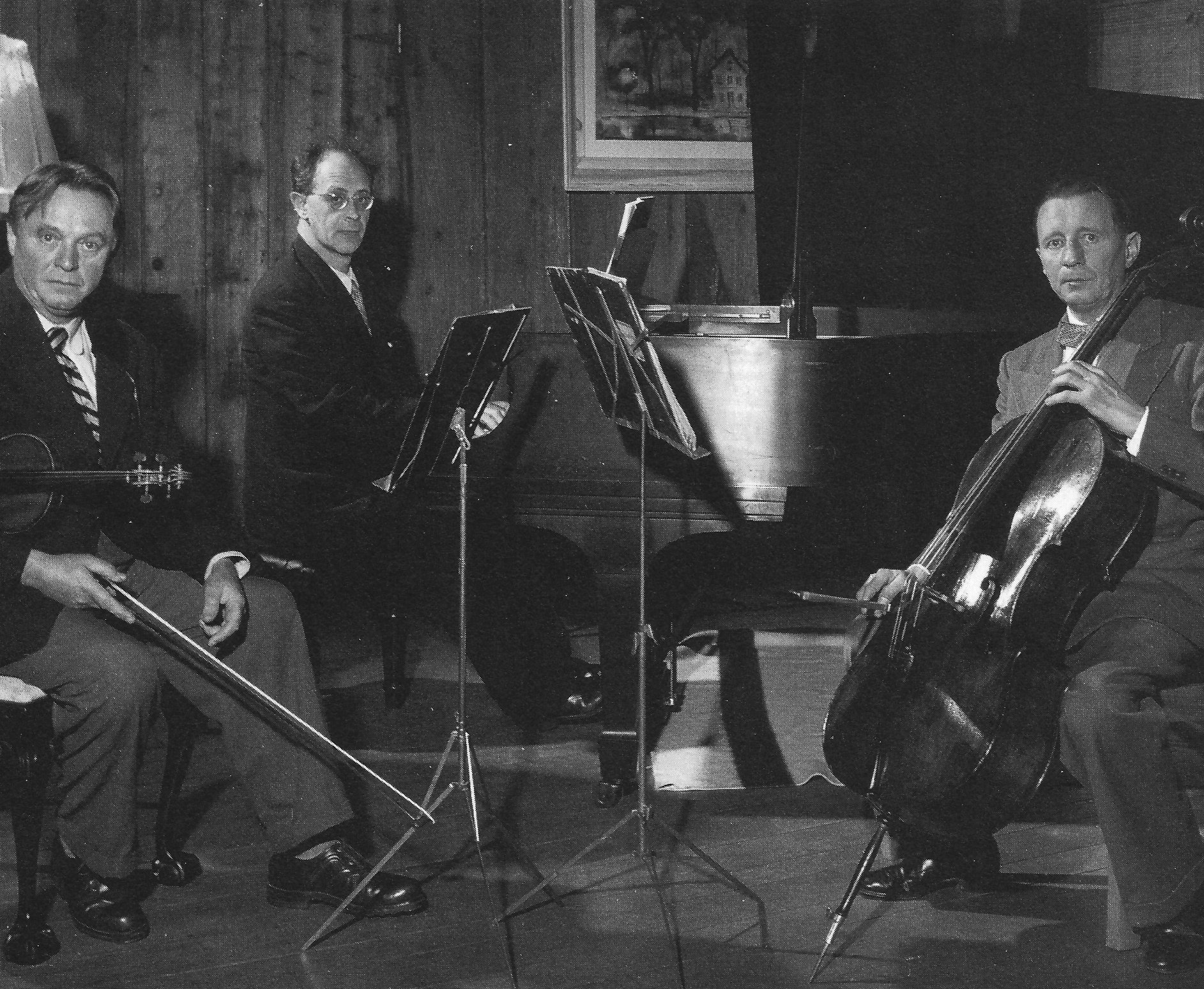
Tag: Adolf Busch

  • Schubert’s Bittersweet Farewell at Marlboro

    Schubert’s Bittersweet Farewell at Marlboro

    Blissful days, you are eternally past!

    On this week’s “Music from Marlboro,” as this year’s Marlboro Music Festival approaches its final weekend, we’ll partake of an hour of bittersweet musings, courtesy of Franz Schubert. Even at the best of times, Schubert’s emotional equilibrium could be extraordinarily sensitive to change. But the works of his final year seem especially intimate – confessional, even.

    Is the melancholy traveler borne out to sea in “Auf dem Strom” (“On the River”) actually parting from life? The narrator is cut off from all human contact. He is unable to hear songs from the distant shore. His memory of his beloved is intense, even as she grows increasingly distant. The text, by Ludwig Rellstab, was originally intended for Beethoven, but Beethoven died before he could set to work on it.

    We’ll hear a performance of this remarkable art song from the 1960 Marlboro Music Festival, featuring soprano Benita Valente, hornist Myron Bloom, and pianist Rudolf Serkin.

    Faced with his own mortality, Schubert reacted as only Schubert could, by churning out masterpiece after masterpiece: two piano trios, three piano sonatas, the String Quintet in C, the song cycle “Schwanengesang,” and “The Shepherd on the Rock,” alongside assorted smaller works, all within the span of only six months. It’s an extraordinary act of defiance, or perhaps acceptance, of the inevitable.

    The haunting second movement of his Piano Trio No. 2 in E-flat major was written just as he received the news that his illness was beyond cure and that the end was near. The music holds the tragic and the romantic in devastating balance.

    The entire trio will be heard in a recording made in Brattleboro, VT, all the way back at the beginning, on October of 1951, featuring Marlboro cofounders, pianist Rudolf Serkin, violinist Adolf Busch, and cellist Herman Busch.

    By coincidence, tomorrow, August 8, is Adolf Busch’s birthday. What better way to celebrate than to remember him making music with those he loved?

    Both of these works, by the way, were presented on the only public concert devoted exclusively to Schubert’s music during the composer’s lifetime. The concert was held on the first anniversary of Beethoven’s death, March 26, 1828. Schubert himself would be dead only eight months later, at the age of 31.

    For more information on the concluding weekend of this summer’s Marlboro Music Festival, and its three valedictory concerts, visit marlboromusic.org.

    All good things must come to an end, on the next “Music from Marlboro,” this Wednesday evening at 6:00 EDT, on WWFM – The Classical Network and wwfm.org.

    Marlboro School of Music and Festival: Official Page


    PHOTO: Rudi and the Busches

  • Strauss, Busch & Marlboro’s Divergent Paths

    Strauss, Busch & Marlboro’s Divergent Paths

    On the next “Music from Marlboro,” we’ll have works by two German composers who traveled widely divergent paths.

    As the aging elder statesman of Romantic opulence, Richard Strauss was in his late 60s when the Nazis seized control of Germany in 1933. He was 75 at the outbreak of World War II. Controversially, he remained at home, hoping to preserve and promote German music (including his own) and to shield his Jewish daughter-in-law and grandchildren. While comprehending Strauss’ importance as a propaganda tool, Goebels wasn’t actually fond of his music, referring to him privately as a “decadent neurotic.”

    All that was still decades in the future at the time Strauss wrote his Piano Quartet in C minor, in 1883-84, at the tender age of 20. Interestingly, for a composer who became celebrated for the apotheosis of the lavish tone poem, Strauss here channels his admiration for Johannes Brahms, and in a genre not generally associated with a follower of the post-Wagnerian “New Music School.” Brahms was at the height of his fame while the young Strauss was living in Berlin. In fact, Strauss attended the premiere of Brahms’ Fourth Symphony, following his appointment as music director in Meiningen at 21.

    We’ll hear Strauss’ quartet, performed at the 1972 Marlboro Music Festival, with Walter Klien at the keyboard, in his early 40s and at the peak of his pianistic powers. The string players will include violinist Edith Peinemann, violist Philipp Naegele, and cellist Miklós Perènyi.

    Violinist Adolf Busch lived with his family – and friend, future son-in-law Rudolf Serkin – in Berlin in the 1920s, as Serkin established himself as one of Europe’s outstanding young pianists. The musicians remained in Germany until 1927. The much-respected Busch, who was not Jewish, vehemently opposed the National Socialists. He was one of the first prominent non-Jews to do so. With the rise of Hitler, Serkin and the Busches relocated to Switzerland. Busch repudiated Germany entirely in 1933.

    He and Serkin arrived in the United States, with the rest of Busch’s family, in 1938, with Europe on the brink of war. They settled in Vermont in the 1940s. There, alongside flutist Marcel Moyse, they founded the Marlboro Music School and Festival in 1951, having successfully eluded the horrors that had claimed so many others to create something of lasting beauty – a chamber music retreat in what must have seemed like a bucolic paradise.

    In addition to being one of the great violinists, Busch was also a talented composer. We’ll hear his “Divertimento for 13 Solo Instruments,” from 1925, in a 1982 recording featuring Marlboro musicians: Isidore Cohen and Irene Serkin, violins; Caroline Levine, viola; Robie Brown Dan, cello; Carolyn Davis, double bass; Odile Renault, flute; Rudolph Vrbsky, oboe; Cheryl Hill, clarinet; Stefanie Przybylska, bassoon; Robin Graham and Stewart Rose, French Horns; Henry Nowak, trumpet; and Neil Grover, timpani, all under the direction of Sol Schoenbach.

    The path of least resistance leads to misery, on the next “Music from Marlboro,” this Wednesday evening at 6:00 EDT, on WWFM – The Classical Network and wwfm.org.

    Marlboro School of Music and Festival: Official Page


    More about Strauss’ complicated relationship with the Third Reich here:

    http://holocaustmusic.ort.org/politics-and-propaganda/third-reich/reichskulturkammer/strauss-richard/


    PHOTO: Adolf Busch and Rudolf Serkin in 1928

Tag Cloud

Aaron Copland (92) Beethoven (95) Composer (114) Film Music (119) Film Score (143) Film Scores (255) Halloween (94) John Williams (185) KWAX (229) Leonard Bernstein (99) Marlboro Music Festival (125) Movie Music (134) Opera (198) Philadelphia Orchestra (86) Picture Perfect (174) Princeton Symphony Orchestra (106) Radio (87) Ralph Vaughan Williams (85) Ross Amico (244) Roy's Tie-Dye Sci-Fi Corner (290) The Classical Network (101) The Lost Chord (268) Vaughan Williams (102) WPRB (396) WWFM (881)

DON’T MISS A BEAT

Receive a weekly digest every Sunday at noon by signing up here


RECENT POSTS