It was quite a birthday present for Florence Price when one of her arrangements was heard by what was likely the largest audience she would ever enjoy in her lifetime.
On Easter Sunday, on this date in 1939, Marian Anderson, barred from performing at Constitution Hall by the Daughters of the American Revolution, because of her race, sang instead from the steps of the Lincoln Memorial, to a diverse crowd of 75,000 people on the mall and a national radio audience estimated in the millions.
The program concluded with Price’s arrangement of the spiritual “My Soul’s Been Anchored in the Lord.” By coincidence, it also happened to be Price’s birthday.
Price, born in Little Rock, Arkansas, in 1887, had become the first African-American woman to be recognized as a symphonic composer, when her Symphony in E minor was performed by the Chicago Symphony in 1933. Needless to say, in an era when White American males struggled to find acceptance on Eurocentric classical music programs, Price, as a Black American woman, faced even greater challenges.
The playing field has shifted in recent years, and interest in Price’s music has been on the rise. It’s hard to believe, for a composer of her accomplishments, that dozens of her manuscripts were rescued from her dilapidated summer home, on the outskirts of St. Anne, Illinois, only as recently as 2009.
Price died in 1953.
Who knows what other musical riches are out there, undervalued in their time, awaiting rediscovery?
Anderson sings “My Soul’s Been Anchored in the Lord”
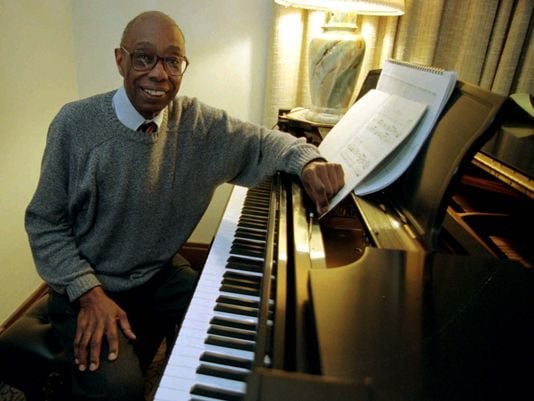
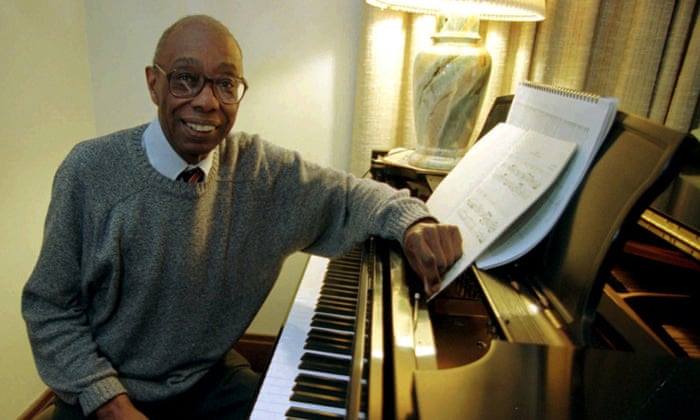
It’s crazy that the first time an African-American composer would receive the Pulitzer Prize for Music was only in 1996. I remember when it happened. It was a pretty big deal. A special award had been made to Scott Joplin in 1976 – 59 years after Joplin’s death – and there have been some special citations and a number of Black honorees since. But it was George Walker who broke the glass ceiling.
It was not the first time he was a “first.” Walker was the first Black pianist to present a solo recital at New York’s Town Hall (in 1945); he was the first Black performer to appear as soloist with the Philadelphia Orchestra (performing Rachmaninoff’s Piano Concerto No. 3); and he was the first Black musician to graduate from the Curtis Institute of Music (where he studied with Rudolf Serkin and Rosario Scalero).
Walker was born in Washington, D.C., on this date in 1922. His father emigrated from Kingston, Jamaica, to study at Temple University School of Medicine. Walker’s mother supervised his first piano lessons. He was accepted into the Oberlin School of Music at the age of 14. He was then admitted to the Curtis Institute in Philadelphia. Later, he attended the Eastman School. For two years, in common with so many 20th century composer of merit, especially Americans, he studied in Paris with the famed pedagogue Nadia Boulanger.
Walker’s own academic career included posts with Dillard University in New Orleans, the Dalcroze School of Music, the New School for Social Research, Smith College, the University of Colorado Boulder, Rutgers University (where he served as chairman of the music department), the Peabody Institute of John Hopkins University, and the University of Delaware.
“Lilacs for Voice and Orchestra” was introduced by soprano Faye Robinson on February 1, 1996, with the Boston Symphony Orchestra conducted by Seiji Ozawa. The 15-minute work is a setting of texts from Walt Whitman’s 1865 Lincoln elegy “When Lilacs Last in the Dooryard Bloom’d.” “Lilacs” was described by the Pulitzer committee as a “passionate, and very American, musical composition with a beautiful and evocative lyrical quality.”
“Lyric” is a descriptor that followed Walker his entire life, or at least since his music became more widely known. His most popular work is his “Lyric for Strings,” a touching piece for string orchestra. Like the ubiquitous “Adagio” by Samuel Barber (who also attended Curtis), “Lyric” was arranged from the slow movement of a string quartet, in Walker’s case written while he was still a student. Originally, he had titled the piece “Lament.” But comparisons with Barber’s “Adagio” end there. Walker’s work doesn’t strive for profundity or wrench the soul as Barber’s does. But it is moving, all the same, for being so evidently personal, confessional even.
Walker wrote the piece in 1946, following the death of his grandmother. For anyone who learned about slavery in America from a history textbook, it’s sobering to discover that Melvina King actually lived it. Walker went on to a career studded with impeccably crafted works that brought him many honors and much critical praise. But “Lyric” has the distinction of going straight to the heart.
A longtime resident of Montclair, NJ, George Walker died in 2018 at the age of 96. I often wonder if he ever got tired of hearing about his resume of firsts. In relation to his skin color, I mean. It was always the first thing you ever read or heard about him (and, alas, this post is no different).
In an interview given in 2012, Walker commented, “I’ve always thought in universal terms, not just what is Black or what is American, but simply what has quality.”
Hearing “Lyric for Strings” was once a rare treat. Now, in the past few years, everyone has taken it up. I have no doubt that the work will hold a lasting place in the standard repertoire.
“Lilacs for Voice and Orchestra”
Walker plays his Piano Sonata No. 1
Brief 2012 documentary on Walker, in which he is interviewed, for the occasion of his 90th birthday:
A fascinating interview conducted by Frank J. Oteri. Also includes some great photos!
Walker was the first African-American recipient of the Pulitzer Prize for Music – as recently as 1996 – for “Lilacs for Voice and Orchestra.” He was the first black pianist to present a solo recital at New York’s Town Hall (in 1945). He was the first black performer to appear as soloist with the Philadelphia Orchestra (performing Rachmaninoff’s Piano Concerto No. 3). He was the first black musician to graduate from the Curtis Institute of Music (where he studied with Rudolf Serkin and Rosario Scalero).
Walker died on August 23, 2018, at the age of 96. This Sunday night on “The Lost Chord,” we’ll celebrate this trailblazing artist with a program of four of his original works, including his Piano Sonata No. 2 (with the composer himself at the keyboard), the award-winning “Lilacs” (after poetry of Walt Whitman), “Address for Orchestra” (his first major orchestral work), and “Lyric for Strings” (his most famous music, in its original version for string quartet).
Born in Washington, D.C., Walker was a longtime resident of Montclair, NJ. His father emigrated from Kingston, Jamaica, to study at Temple University School of Medicine; Walker’s mother supervised his first piano lessons. He was admitted to the Oberlin School of Music at the age of 14. He was then admitted to the Curtis Institute in Philadelphia, and later attended the Eastman School. For two years, he studied in Paris with famed pedagogue Nadia Boulanger.
Walker’s own academic career included posts with Dillard University in New Orleans, the Dalcroze School of Music, the New School for Social Research, Smith College, the University of Colorado Boulder, Rutgers University (where he served as chairman of the music department), the Peabody Institute of John Hopkins University, and the University of Delaware.
He was the father of two sons, violinist and composer Gregory T.S. Walker and playwright Ian Walker. His sister was the pianist Frances Walker-Slocum.
By his own assessment, Walker was a composer more interested in building “elegant structures” than in “creating beauty.” Depending on one’s sensibility, it could be argued that he achieved both.
I hope you’ll join me in “Perambulating with Walker,” this Sunday night at 10:00 EDT, on WWFM – The Classical Network and wwfm.org.
A fascinating interview with Walker by Frank J. Oteri, which, among other things, lends an added dimension to Walker’s most frequently performed music (the “Lyric”) and offers insights into his life and musical philosophy. Also, some great photos!
Do you enjoy exploring unusual and neglected repertoire like that offered on “The Lost Chord?” Whatever it is you appreciate about WWFM The Classical Network, we hope you will help support it with your contribution today. Make a donation through Wednesday, June 30 (the end of our fiscal year), and help balance our budget, at wwfm.org.
We couldn’t do it without enthusiastic and committed listeners like you. Thank you for all that you do to keep classical music on the radio!
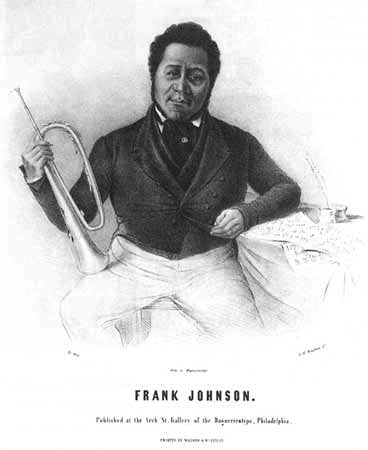
A blue and gold marker erected before his home, at 65 South 4th Street in Philadelphia, describes him as “America’s first native-born master of music.” He was a prolific composer, “trumpeter of 1st Troop, City Cavalry, and Bandmaster, 128th Regiment, Pennsylvania Volunteer Infantry.” He was also the leader of America’s most popular band for more than twenty years. Over a century before Dorothy Maynor and Little Richard, Francis Johnson, born on this date in 1792, was presenting racially-integrated concerts.
Johnson was the first African-American to have his works published as sheet music. He led the first American ensemble, an all-black brass band, in performance abroad. In 1837, he sailed to England to take part in the celebrations surrounding the coronation of Queen Victoria. In gratitude, the Queen presented him with a silver bugle. While there, he was exposed to the promenade concert – a style of informal, outdoor garden entertainment – which he brought back with him to the United States. He returned to Philadelphia in 1838, the year Pennsylvania Hall was burned to ground by an angry mob for hosting a convention of abolitionists.
Indeed, it’s remarkable, in a climate of mounting racial tension and violence, with the Civil War still decades in the future, just how beautifully Johnson’s career flourished. In 1824, he was invited to perform for General Lafayette during Lafayette’s return to the United States. He also taught wealthy European-American students at a studio much-remarked upon for its extensive music library. Over the years, he also amassed an impressive array of instruments. His works were published in compilations alongside those of Beethoven, Brahms, Bellini, Donizetti, Weber, and Czerny.
At the same time, he performed in Philadelphia’s black churches. His style of playing included rhythmic variations that deviated considerably from his written scores. In the 20th century, this might have been described as “jazzing,” but Johnson’s improvisions would have been worlds away from what we now recognize as jazz.
He was also known to have delighted his audiences with certain extended techniques and programmatic elements. His “Bird Waltz” featured a chirrupy flute obbligato, his “New Railroad Gallop” emulated a train, and his “Philadelphia Fireman’s Quadrille” was punctuated by cries of “Fire! Fire!”
Unfortunately, a lot of this music was not fully written-out, with prompts often indicated in his scores. When they were published, it was commonly in arrangements and as piano transcriptions made by other hands. Scholars have reconstructed his performance style to the best of their ability from surviving evidence, including newspaper accounts and other documents describing the effects heard on Johnson’s concerts. The music itself is fairly simple, often a framework to be adorned by improvisation and development.
Johnson died in 1844 at the age of 51. At his funeral, Queen Victoria’s bugle lay atop his casket.
George Walker was the first African-American recipient of the Pulitzer Prize for Music – as recently as 1996 – for his work, “Lilacs for Voice and Orchestra.” He was the first black pianist to present a solo recital at New York’s Town Hall (in 1945). He was the first black performer to appear as soloist with the Philadelphia Orchestra (performing Rachmaninoff’s Piano Concerto No. 3). He was the first black musician to graduate from the Curtis Institute of Music (where he studied with Rudolf Serkin and Rosario Scalero).
Walker died on August 23, 2018, at the age of 96. This Sunday night on “The Lost Chord,” we’ll honor this trailblazing artist with a program of four of his original works, including his Piano Sonata No. 2 (with the composer himself at the keyboard), the award-winning “Lilacs” (after poetry of Walt Whitman), “Address for Orchestra,” and “Lyric for Strings,” his most famous music, in its original version for string quartet.
Born in Washington, D.C., Walker was a longtime resident of Montclair, NJ. His father emigrated from Kingston, Jamaica, to study at Temple University School of Medicine; Walker’s mother supervised his first piano lessons. He was admitted to the Oberlin School of Music at the age of 14. He was then admitted to the Curtis Institute in Philadelphia, and later attended the Eastman School. For two years, he studied in Paris with the famed pedagogue Nadia Boulanger.
Walker’s own academic career included posts with Dillard University in New Orleans, the Dalcroze School of Music, the New School for Social Research, Smith College, the University of Colorado Boulder, Rutgers University (where he served as chairman of the music department), the Peabody Institute of John Hopkins University, and the University of Delaware.
He was the father of two sons, violinist and composer Gregory T.S. Walker and playwright Ian Walker. His sister, the pianist, Frances Walker-Slocum, died on June 9 at the age of 94.
The New Jersey Symphony Orchestra, which has played a number of the composer’s pieces over the years, has announced that it will be adding “Lyric for Strings” to its opening concerts, October 5th through October 7th, to be performed in Newark and New Brunswick. Also on the program will be the U.S. premiere of Kate Whitley’s “Speak Out” and Beethoven’s Symphony No. 9. Find out more at njsymphony.org.
Then join me for “Perambulations with Walker,” this Sunday night at 10:00 EDT, on WWFM – The Classical Network and wwfm.org.