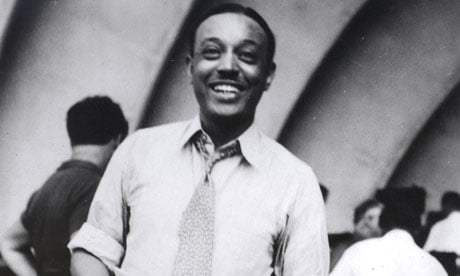
For his many achievements – as the first Black American composer to write a symphony, the first to conduct a major U.S. orchestra, and the first to compose an opera, among other things – William Grant Still would be recognized as the “Dean of Afro-American Composers.” But face it, even under the best of circumstances, a full-time composer has to scramble to make ends meet. Still was not alone in seeking employment in Hollywood, which could always be counted on, once you were in, for a decent paycheck.
However, unlike some of his peers, he was employed mostly as an orchestrator and a composer of “additional music.” One of the films he worked on was Dimitri Tiomkin’s “Lost Horizon” in 1937. John Williams did the same kind of work for Tiomkin on “The Guns of Navarone” in 1961, and we all know how that worked out for him. Still was never given his shot to break into the upper echelon, the way so many white composers who did the same kind of grunt work were. To my knowledge, he never even received a screen credit, but if you know differently, please correct me!
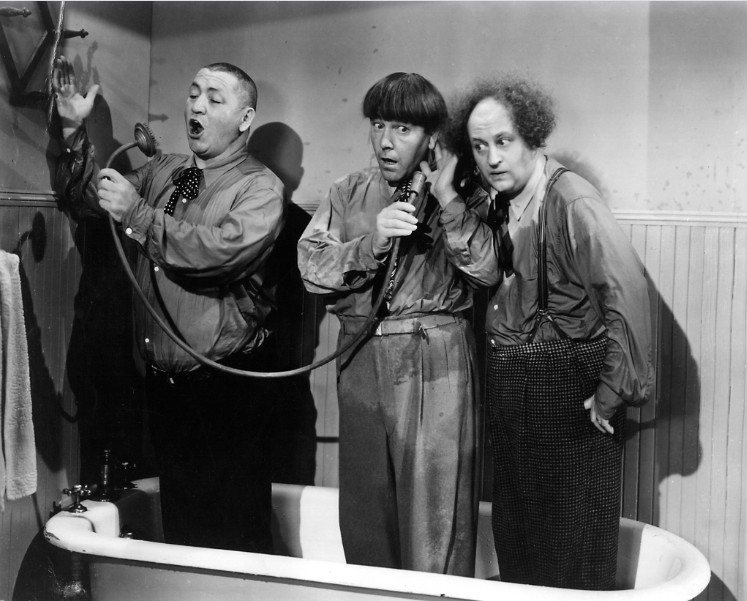
A number of his cues were recycled as “library music” to fill out scores for B-movies and television shows. I was reminded of this yesterday by my friend (and former editor) Dan Aubrey, who will be accompanying me tonight to The Three Stooges Film Festival at the Princeton Garden Theatre, when he made a quip about Still’s music accompanying “eye gauging and cranium pounding.” Allegedly, Still’s work was indeed used in some of the Stooges’ shorts. I’m not sure which ones, and IMDB is no help in this regard, but I will listen more carefully, whenever I go back and watch them.
In the 1950s, he compiled his “Laredo Suite” for use in television westerns, such as “Gunsmoke,” “Have Gun, Will Travel,” and “Rawhide.” (He had written music for a number of film westerns starring Charles Starrett.) Still was far from the only composer to do this. Bernard Herrmann put together some suites of mood music and action cues to be dropped into CBS westerns. The difference is that, even if he wasn’t always credited on the shows, Herrmann was a headliner at the movies.
Still’s involvement with the Stooges is funny and sad at the same time. During the 1930s and ‘40s, Aaron Copland (the “Dean of American Composers”) was scoring prestige pictures such as “Our Town” and “Of Mice and Men.” He was even recognized with an Academy Award for his work on “The Heiress.”
Of course, Still wasn’t alone among talented composers who toiled on the Hollywood production line, but as a Black musician, it’s doubtful he would have been able to rise much higher in mainstream movies until at least the 1960s, after Otto Preminger hired Duke Ellington to score “Anatomy of a Murder,” in 1959, and Quincy Jones made his mark with “The Pawnbroker,” in 1964. And even then, would he have been accepted if the music he wrote wasn’t “jazz”?
While laboring anonymously in motion pictures of the 1930s, Still conducted a concert at the Hollywood Bowl with the Los Angeles Philharmonic. On July 23, 1936, he presented his “Afro-American Symphony.” It was the first time a Black man would conduct a major American orchestra. The next year, in August 1937, the work would be repeated on the first Hollywood Bowl program ever to be devoted exclusively to works by American composers.
Still’s “Afro-American” remains one of my favorite American symphonies.
https://www.youtube.com/watch?v=b9iGFLpO5Nk
Fascinating reconstruction of Still’s “Laredo Suite,” library music for westerns, although I suspect the cuts have been posted out of sequence:
https://www.youtube.com/watch?v=CpJQK1miHV4&list=PLgK8FIC-dBq-qGKj5r3vXlGSP3nd9jfq-
Information on The Three Stooges Film Festival, tonight at the Princeton Garden Theatre:
https://www.princetongardentheatre.org/films/three-stooges-garden
———-
PHOTO: William Grant Still at the Hollywood Bowl