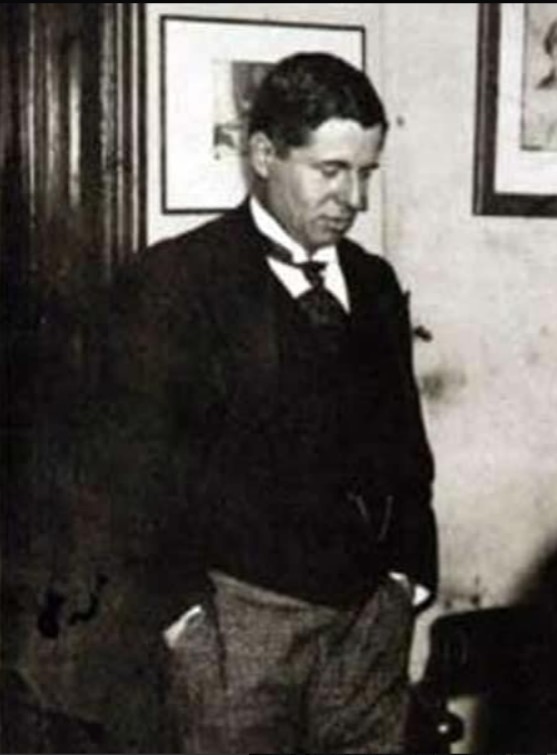
To say that French composer Albéric Magnard had a fiery personality stands the risk of skirting bad taste.
Magnard was born in Paris on this date in 1865. His father, François Magnard, was a notable author and the editor of Le Figaro. His family being rather well off, the younger Magnard exhibited an early determination to make his own way. (As a boy, he had been taunted by cries of “Le fils du Figaro” – the son of Figaro.)
Following military service, he acquired his law degree. However he was destined never to practice. Instead he made a fateful trip to Bayreuth, where he fell under the spell of Richard Wagner and determined to become a composer.
He was accepted into the Paris Conservatory, where he studied with Théodore Dubois, Jules Massenet, and Vincent d’Indy. He became particularly close to d’Indy, though he abhorred the latter’s anti-Semitism. (Magnard was outspokenly pro-Dreyfus.)
Despite his son’s insistence on self-reliance, François helped the young man in whatever way he could, which for the most part meant publishing favorable notices of his son’s music in his influential journal. Magnard “fils” somewhat resented this – but he was also kind of grateful – so that he and his father shared a complicated relationship.
Like Paul Dukas, who was born the same year, Magnard was highly self-critical, so that his output consists of only 22 works with opus numbers. The publication of most of these he paid for himself. The observation has been made that his symphonies in some respects prefigure those of Gustav Mahler, though others have referred to him as “the French Bruckner.” It’s probably more realistic to say Magnard caught his love of cyclic form from César Franck.
Incidentally, I’ll be presenting music by some followers of Franck tomorrow night at 10:00 EDT on “The Lost Chord, on WWFM – The Classical Network. Tune in for music by Armand Marsick and Guillaume Lekeu. Curiously, I didn’t think to include Magnard.
Unfortunately, the most striking feature of Magnard’s life was the manner of his death. In 1914, the composer, aged 59 and a civilian, refused to surrender his property to invading German forces. After sending his wife and two daughters out the back door, he opened fire on some trespassing soldiers and instantly killed one of them. In retaliation, the Germans set fire to his house, and Magnard is assumed to have perished in the conflagration. That said, his body was never discovered.
Might it be possible that he spent a secret retirement in the company of Ambrose Bierce – who, curiously enough, also disappeared in 1914?
https://en.wikipedia.org/wiki/Ambrose_Bierce
Classic Ross Amico, you dog, that is brilliant.
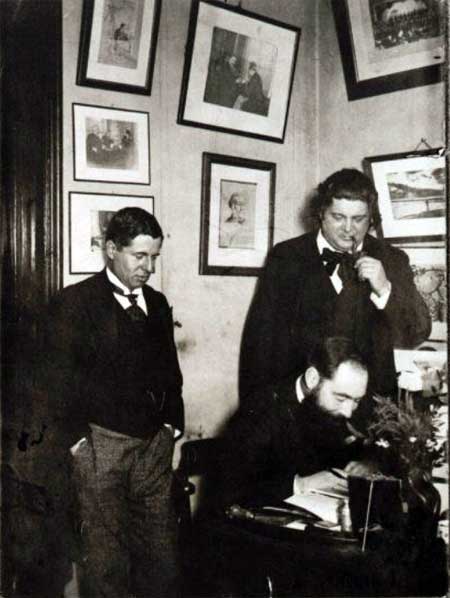
PHOTO: Magnard (left) with famed Belgian violinist Eugène Ysaÿe (standing) and composer Guy Ropartz. Through a remarkable feat of memory, Ropartz, who had recently conducted Magnard’s opera, “Guercoeur,” was able to reconstruct the score, after it was partially destroyed in the fire that consumed Magnard’s home.