Tag: Albert Einstein

  • Einstein’s Unexpected Music Taste at Princeton

    Einstein’s Unexpected Music Taste at Princeton

    Yesterday, I had folks in from out of town and took them over to see Einstein’s furniture at Updike Farm on Quaker Road. Since 2004, the property has been owned by the Historical Society of Princeton.

    I’d been there before, but yesterday was the first time I thought to lean in and take note of what was on Einstein’s turntable. By squinting, I could just about make out Eugene Ormandy and the Philadelphia Orchestra, but it was only by taking a photo, flipping it, and enlarging that I could make out the music: William Schuman’s Symphony No. 3! A most bizarre selection as, despite his friendship with Bohuslav Martinů and association with Arnold Schoenberg, from everything I’ve heard, Einstein was not really a contemporary music guy. He was all about the meat-and-potato classics. (He loved Haydn and Mozart.)

    If this record was indeed from Einstein’s personal collection, it was a very interesting choice, making more of an impression on me than E = mc². But I am the first to admit, as a classical music lover at the science fair, I tend to look at things a little differently.

    More than likely, someone who didn’t know William Schuman from Robert Schumann had selected it – if he or she even knew who Schumann was. I like to think the record was actually from Einstein’s collection and not just something from the period that somebody picked up at a yard sale. The docent, while friendly and attentive, didn’t seem to know anything about it. But I’m used to that.

    In the same room, as part of an Innovators Gallery, there’s also some material on Freeman Dyson, one of Einstein’s colleagues at Princeton’s Institute for Advanced Study, who also happened to be the son of eminent English composer Sir George Dyson. Again, I appeared to be the only one with much interest in the connection (neither was it noted, that I could see, in the literature).

    In his day, William Schumann was recognized as one of our great American symphonists. In particular, his Symphony No. 3 of 1941 was held up, alongside the corresponding symphonies of Roy Harris and Aaron Copland, as among the best this country had to offer. Schuman won the Pulitzer Prize for Music in 1943, became president of the Juilliard School in 1945, and president of Lincoln Center in 1961.

    By coincidence, he was a student of Roy Harris, whose Symphony No. 3 is being performed this afternoon by the Princeton University Orchestra. The concert, a repeat of last night’s program, will be held at Princeton University’s Richardson Auditorium at 3:00. Also on the program will be Hector Berlioz’s “Symphonie fantastique.” Be there, or be square.

    For tickets, visit

    https://tickets.princeton.edu/

    Discover Albert Einstein at Updike Farmstead

    Discover Albert Einstein

    Ormandy conducts William Schuman’s Symphony No. 3

    Article I wrote about Einstein’s musical activities and enthusiasms

    https://www.communitynews.org/princetoninfo/artsandentertainment/relatively-musical-albert-einstein-and-bohuslav-martin/article_68a1ba00-fe7d-11ef-a05a-2f8ce43f2de6.html

  • Einstein Martinů and Princeton’s Pi Day Fest

    Einstein Martinů and Princeton’s Pi Day Fest

    I’ve yet to lay my hands on a copy of this month’s Princeton Echo, but apparently my article on Albert Einstein and Bohuslav Martinů made the cover. It’s a good time for me to mention it, as the story also appears in the Princeton weekly, U.S. 1, out today.

    The timing couldn’t be better, since 3/14 is Pi Day (by coincidence, also Einstein’s birthday), and as always Princeton will pull out all the stops, this year with the celebration spanning two days, Friday and Saturday. So get ready for the Einstein look-alike contest, the Pi Day tours, the pie-throwing, pi memorization and recitation, and of course the fooderies offering deals on pie.

    An amateur violinist who adored Mozart, Einstein knew and even played with a number of notable musicians and scientists, both in Princeton and abroad. While he wasn’t exactly at home with music of the 20th century, Einstein liked and respected Martinů, who taught composition at Princeton University from 1948 to 1951. The two shared much in common, and Martinu wound up writing a piece of music for him.

    It just so happens that the composer, who is not exactly a household name, but perhaps should be, will be the subject of his own music festival, “Martinů and His World,” to be held at Bard College in Annandale-on-Hudson, NY, August 8-17.

    You’ll find lots of information at the links below:

    Cover story in Princeton Echo (March 1)

    https://www.communitynews.org/towns/princeton-echo/relatively-musical-albert-einstein-and-bohuslav-martin/article_64f724c8-f840-11ef-81f3-77d946927c50.html

    Reprinted in U.S. 1 (out today)

    https://www.communitynews.org/princetoninfo/artsandentertainment/relatively-musical-albert-einstein-and-bohuslav-martin/article_68a1ba00-fe7d-11ef-a05a-2f8ce43f2de6.html

    Princeton Pi Day events (March 14-15)

    https://princetontourcompany.com/tours/pi-day/

    Bard Music Festival, “Martinů and His World” (August 8-17)

    https://fishercenter.bard.edu/whats-on/programs/bard-music-festival/

    Fisher Center at Bard

  • Einstein Martinů & Princeton in Print

    Einstein Martinů & Princeton in Print

    I’ve been pretty low-key about it (as in, I haven’t said anything about it at all), but then, I’ve never exactly been a genius at self-promotion. However, my article on Princeton’s most beloved brainiac, Albert Einstein, and his relationship to music, is one of the features in this month’s Princeton Echo. I believe the print edition was issued on March 1. So keep a lookout for my byline in Princeton vending machines and at area businesses.

    An amateur violinist who adored Mozart, Einstein knew and even played with a number of notable musicians and scientists, both in Princeton and abroad. He was even honored at Carnegie Hall by Leopold Godowsky and Arnold Schoenberg.

    While he wasn’t exactly at home with music of the 20th century, Einstein liked and respected Bohuslav Martinů, who taught composition at Princeton University from 1948 to 1951. The two shared much in common, and Martinů wound up writing a piece of music for him.

    It just so happens that the composer, who is not exactly a household name, but perhaps should be, will be the subject of his own music festival, “Martinů and His World,” at Bard College in Annandale-on-Hudson, NY, August 8-17.

    You can access the article at one of the links below. I’ll also include a link to the Bard Music Festival.

    The article is slated to be reprinted in the Princeton weekly U.S. 1 in advance of Pi Day, 3/14 (by coincidence, also Einstein’s birthday), always a big deal in these parts. So you’ll have a choice between the two newspapers in the next week or so.

    For your convenience, I’ll also include a link to the schedule of this year’s Pi Day events (to be held in Princeton on Friday and Saturday, 3/14 & 3/15).

    My article, “Relatively Musical: Albert Einstein and Bohuslav Martinů”

    https://www.communitynews.org/towns/princeton-echo/relatively-musical-albert-einstein-and-bohuslav-martin/article_64f724c8-f840-11ef-81f3-77d946927c50.html

    The Bard Music Festival, “Martinů and His World”

    https://fishercenter.bard.edu/whats-on/programs/bard-music-festival/

    Princeton Pi Day events

    https://princetontourcompany.com/tours/pi-day/

    Better get cracking on your pi memorization!


    Fisher Center at Bard

    PHOTO: Einstein with Gaby Casadesus at Princeton’s Present Day Club

  • Pi Day in Princeton Einstein’s Legacy

    Pi Day in Princeton Einstein’s Legacy

    Because of Einstein’s longtime association with Princeton, International Pi Day (3.14, get it?) is always a pretty big deal here. In fact, I see this year’s festivities are already underway – some of them actually took place on Saturday – with an Einstein look-alike contest, Pi memorization and recitation, Pi Day tours, and of course plenty of pie-tasting. That’s mostly what I care about.

    Pi Day Princeton 2024 will be more irrational fun than ever!

    In case you’re not an Archimedes fan, Pi, represented by the Greek letter “p” (“π”), is the ratio of the circumference of a circle to its diameter, commonly approximated as 3.14159 – though you could take it a good deal further, since the number is wholly irrational and refuses to fall into a repeating pattern. This is clearly known by Mr. Spock when he uses it to confound an evil computer.

    Einstein lived in Princeton for the last 21 ½ years of his life, during his residency at the Institute for Advanced Study, which, in its early days, was located temporarily on Princeton University campus. Scenes from “Oppenheimer” were shot at the institute’s current location, now 1 Einstein Drive, where it relocated in 1939.

    Einstein’s house still stands at 112 Mercer Street. In accordance with his wishes, the house was not turned into a museum after his death in 1955. A lot of his furniture and a number of his belongings are on display at the Historical Society of Princeton’s Updike Farmstead, located at 354 Quaker Road.

    Home

    Though Einstein’s house continues to be owned by IAS, it remains a private residence, as is made abundantly clear from signage posted about the property. The house was registered as a U.S. National Historic Landmark in 1976, but there is no marker to advertise the fact. Its significance, however, remains an open secret, and rare is the time I drive past that there’s not someone standing out front, taking a selfie.

    According to Google Maps, I can walk there in about 40 minutes. I bet I could do it quicker. Maybe I will – and see if I can get someone to take a picture of me, standing next to the “Private Residence” sign on the front gate, eating pie.

    https://en.wikipedia.org/wiki/Albert_Einstein_House

    Einstein was a great music lover. “Life without playing music was inconceivable for me,” he’s been quoted as saying. “I live my daydreams in music. I see my life in terms of music… I get most joy in life out of music.”

    In 2018, Einstein’s violin sold at auction at Bonhams New York for $516,500 – five times the auction house’s estimate. The instrument was made in 1933 by Oscar H. Steger, a member of the Harrisburg (PA) Symphony Orchestra. Einstein gave the violin to Lawrence Wilson Hibbs, the son of Princeton janitor Sylas Hibbs. It remained in the Hibbs family until the time of its auctioning.

    https://www.bonhams.com/press_release/25709/

    There’s a recording that has been circulated around the internet of Einstein playing a Mozart sonata, but don’t believe it. It’s a hoax, like too many other things on social media, shared without question, everyone so wanting to believe it’s Einstein playing the violin.

    Is there an authentic recording somewhere? Maybe. But if it’s discovered, don’t count on Einstein playing as well as Carl Flesch or Arthur Grumiaux.

    Einstein knew the composer Bohuslav Martinu when the latter was a visiting professor at Princeton University beginning in 1943. The two exchanged gifts. Einstein gave Martinu a signed copy of “The Evolution of Physics.” Martinu dedicated to Einstein his “Five Madrigal Stanzas.” Einstein would perform the work in a private recital with pianist Robert Casadesus. Would that someone had recorded it!

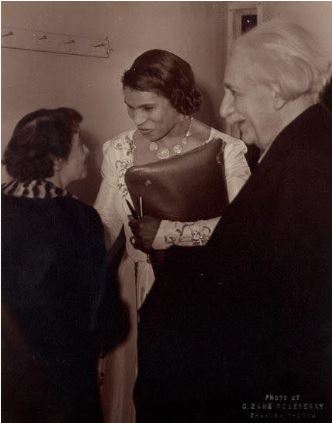
    Einstein was also a good friend to contralto Marian Anderson. After giving a concert at McCarter Theater in 1937, Anderson was denied accommodations at the Nassau Inn. Einstein, who had attended the performance, took Anderson into his home. Thereafter, whenever she was in Princeton, Anderson stayed with Einstein until his death in 1955. I wrote more about it here:

    https://www.facebook.com/photo?fbid=1061448724774190&set=a.883855802533484

    By cosmic coincidence, Einstein was born on this date in 1879. He once observed, “The difference between genius and stupidity is that genius has its limits.” Is Pi, then, as a numerical sequence without limit, stupid? I guess it’s all relative.

    When Walter Matthau played Einstein in the film “I.Q.,” a goofy romantic comedy starring Meg Ryan and Tim Robbins, shot in Princeton in 1994, a neighbor’s house, at 108 Mercer Street, was substituted for Einstein’s actual residence.

    https://paw.princeton.edu/article/princetons-summer-iq-fever?fbclid=IwAR1ruS5cYyYKIVr1K33uCq3pGx3hWgiUKOr9Cnw7guqcLzA-xtBStTx-SXU#:~:text=In%20town%2C%20film%20locations%20included,Mercer%20substitutes%20in%20the%20film

    Only one of many reasons to roll your eyes at “I.Q.,” which not even Jerry Goldsmith could save.

    Still worth seeing it for Matthau, though. And for Princeton, of course.

    https://www.youtube.com/watch?v=ihhHk6awueU

    All together now, as we sing the Albert Einstein Pi Day song!

    The tyranny of Pi

    Face it, YouTube is crazy for Pi

    Scariest Pi song?

    What does Pi actually sound like?

    This way madness lies. Clearly, the possibilities are endless.

  • Einstein Anderson Friendship Defied Racism

    Einstein Anderson Friendship Defied Racism

    Anyone remember the time Marian Anderson spent the night with Albert Einstein?

    If that sounds sordid, it absolutely is, but unfortunately in all the wrong ways.

    Anderson, the contralto whose voice no less than Arturo Toscanini gushed was of a kind that comes once in a hundred years, was notoriously barred from performing at Constitution Hall in Washington, D.C., by the Daughters of the American Revolution because of the color of her skin. In the ultimate example of turning lemons into lemonade, Anderson sang instead from the steps of the Lincoln Memorial – to 750,000 people on the mall and a national radio audience estimated in the millions. That was on April 9, 1939, which, as it turned out, was Easter Sunday.

    Two years earlier, after a performance at Princeton’s McCarter Theatre – a performance that drew a packed house and elicited glowing reviews – Anderson had been denied accommodations at the Nassau Inn.

    Fortunately, Einstein happened to be in the audience. Learning of Anderson’s dilemma, he extended the invitation for her to stay with him in his home at 112 Mercer Street.

    Anderson recollected, “I remember thanking him from the bottom of my heart and he seemed just sort of to brush it aside…. Dr. Einstein greeted one warmly and said, ‘We are very happy that you can come and welcome into our home.’”

    For the next 18 years – through 1955, the same year she made her belated debut at New York’s Metropolitan Opera and the last year of Einstein’s life – Anderson made it a point to stay with Einstein whenever she was in Princeton.

    In 1946, Einstein received an honorary degree from Lincoln University. In his acceptance speech, he stated, “There is a separation of colored people from white people in the United States. That separation is not a disease of colored people. It is a disease of white people. I do not intend to be quiet about it.”

    Einstein himself was no stranger to racism. It was antisemitism that drove him to renounce his German citizenship, at a time it was still within his power to do so. The Nazis barred Jews from holding official positions, including professorships, they repeatedly raided his home, they sold his belongings, they burned his books and – though it seems superfluous under the circumstances – one German magazine put a $5000 bounty on his head. “Jewish intellectualism is dead,” proclaimed Goebbels.

    Hitler’s loss was our gain. Though there were Jewish quotas in place at universities even here in the United States, including at Princeton University (unofficially, but understood), Einstein accepted a position at the newly-formed Institute for Advanced Study – which in its early days, kept offices on Princeton’s campus while its own facilities were under construction. Einstein would become an American citizen in 1940.

    Einstein embraced America’s system of meritocracy. He extolled the “right of individuals to say and think what they pleased,” without social barriers, a right he found conducive to creativity and innovation. At the same time, he condemned America’s racism, which he found to be the country’s “worst disease… handed down from one generation to the next.”

    Einstein joined the Princeton chapter of the NAACP. When he put himself forward as a character witness for civil rights activist W.E.B. Du Bois at a trial in 1951, the judge dropped the case.

    In 1959, Anderson herself received an honorary degree from Princeton University. Although by then Einstein had passed, again she stayed at his home.

    There are a lot of reasons to share this story, but I do so today in conjunction with Pi Day (3.14), always a big deal in Princeton. Find yourself a seat at an integrated lunch counter and order yourself a celebratory slice in honor of this extraordinary friendship.

Tag Cloud

Aaron Copland (92) Beethoven (95) Composer (114) Film Music (119) Film Score (143) Film Scores (255) Halloween (94) John Williams (185) KWAX (229) Leonard Bernstein (99) Marlboro Music Festival (125) Movie Music (134) Opera (198) Philadelphia Orchestra (86) Picture Perfect (174) Princeton Symphony Orchestra (106) Radio (87) Ralph Vaughan Williams (85) Ross Amico (244) Roy's Tie-Dye Sci-Fi Corner (290) The Classical Network (101) The Lost Chord (268) Vaughan Williams (102) WPRB (396) WWFM (881)

DON’T MISS A BEAT

Receive a weekly digest every Sunday at noon by signing up here


RECENT POSTS