Tag: Antonin Dvořák

  • Bernstein and Dvořák’s Graceful Exits

    Bernstein and Dvořák’s Graceful Exits

    With summer winding down and Leonard Bernstein’s birthday right around the corner (on August 25), this week on “The Lost Chord,” I thought it would be a good time to enjoy a program of valedictory works by two complementary composers.

    Bernstein’s autobiographical “Arias and Barcarolles” (1988) was winnowed from its original conception for four singers to a leaner combination of mezzo-soprano, baritone, and piano duet. The texts of the eight-movement song cycle, personal reflections on the nature of familial love, in all its layered harmonies and discords, are mostly by Bernstein himself. One of them, “Little Smary,” is a bedtime story his mother told him when he was a child. Others are propelled by witty repartee and amusing inside jokes.

    The title is taken from a humorous episode Bernstein liked to recount, stemming from a meeting with President Eisenhower in 1960. After a performance at the White House, Eisenhower remarked, “I liked that last piece you played. It’s got a theme. I like music with a theme, not all them arias and barcarolles.”

    The work was subsequently orchestrated, with the composer’s consent, by Bright Sheng, but personally, I think it works much better in this earlier form. It’s nimbler and more intimate, and the words land more cleanly.

    Another composer whose influence on American music was incalculable was Antonin Dvořák. While director of the National Conservatory of Music in New York from 1892 to 1895, the revered Czech master was impressed by the character and individuality of what he heard all around him as only an outsider could be. He became intoxicated with the sounds of a diverse, vibrant culture, and was astonished that few had noticed what was so clearly evident – that the foundation of a nationally-identifiable school of music was not be achieved in emulating European models, but rather in assimilating the great American melting pot, through folk song, Native American elements, and especially what was then termed Negro spirituals. He led by example, composing works such as the “American” String Quartet and the “New World” Symphony.

    Following his academic and administrative sojourn, Dvořák returned to Bohemia, where in his later years, he focused on opera and symphonic poems based on some astonishingly dark fairy tales. An exception was his final orchestral utterance, “A Hero’s Song” (1897). Admittedly, there is a somewhat sobering, somber interlude at its core, but this only serves to emphasize the swaggering exuberance of the 22-minute work’s outer, swashbuckling sections. It’s astonishing and gratifying to hear Dvořák go out in such a blaze of glory!

    I hope you’ll join me for “Graceful Exits” – final works of Bernstein and Dvořák – on “The Lost Chord,” now in syndication on KWAX, the radio station of the University of Oregon!


    Clip and save the start times for all three of my recorded shows:

    PICTURE PERFECT, the movie music show – Friday at 8:00 PM EDT/5:00 PM PDT

    SWEETNESS AND LIGHT, the light music program – Saturday at 11:00 AM EDT/8:00 AM PDT

    THE LOST CHORD, unusual and neglected rep – Saturday at 7:00 PM EDT/4:00 PM PDT

    Stream them, wherever you are, at the link!

    https://kwax.uoregon.edu/


    PHOTOS: Dvořák receiving an honorary doctorate from Cambridge in 1891 (left); Bernstein letting it all hang out in Fairfield, CT, in 1988
  • Dvořák’s Quirky Passions Beyond Music

    Dvořák’s Quirky Passions Beyond Music

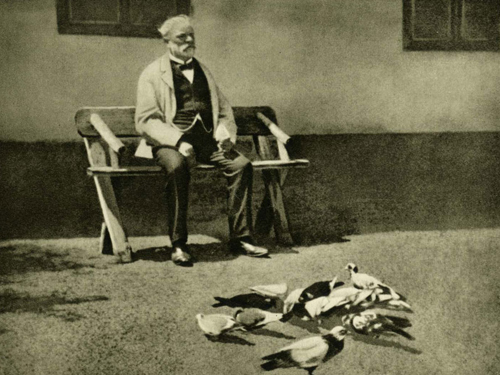
    This exhibition is past, but I found it interesting to read about a few of Dvořák’s “guilty pleasures,” beyond trainspotting and feeding pigeons.

    https://www.nm.cz/en/program/exhibitions/the-guilty-pleasures-of-antonin-dvorak

    More about Dvořák and pigeons in this Classic Ross Amico post from last year:

    https://www.facebook.com/photo?fbid=1165039271081801&set=a.883855802533484

    And another on Dvořák and trains from 2018:

    https://www.facebook.com/photo?fbid=1062790070554949&set=a.279006378933326

    Happy birthday, Antonin Dvořák, “guilty” as charged.

  • Josef Suk’s Summer’s Tale Healing Through Nature

    Josef Suk’s Summer’s Tale Healing Through Nature

    Josef Suk’s 30th year was a tragic one, marked by the deaths of both his young wife, Otilie, and her father, his former teacher, Antonín Dvořák. Not surprisingly, a sense of morbidity colors much of his mature output. The double-loss directly inspired Suk’s “Asrael Symphony,” named for the Angel of Death.

    This week on “The Lost Chord,” for this, his sesquicentennial year (he was born on January 4, 1874), we’ll take a look at “A Summer’s Tale,” the next step in Suk’s emotional rehabilitation. The work is a five-movement symphonic poem, the second of a four-part cycle that contemplates death and the meaning of life. More affirmative than the grim “Asrael,” which is full of pain, loss, and grief, “A Summer’s Tale” explores the healing powers of nature, in a score that at times reflects the epic romanticism of Gustav Mahler and at others the impressionism of Claude Debussy. It was composed over the course of just six weeks in the summer of 1907. Further tinkering took place over the next year-and-a-half. The work received its premiere in January of 1909.

    Suk later described the theme of the piece as “finding a soothing balm in nature.” I hope you’ll join me as we clear a path to “Healing by Nature” – Josef Suk’s “A Summer’s Tale” – on “The Lost Chord,” now in syndication on KWAX, the radio station of the University of Oregon!


    Clip and save the start times for all three of my recorded shows:

    PICTURE PERFECT, the movie music show – Friday at 8:00 PM EDT/5:00 PM PDT

    SWEETNESS AND LIGHT, the light music program – ALL NEW! – Saturday at 11:00 AM EDT/8:00 AM PDT

    THE LOST CHORD, unusual and neglected rep – Saturday at 7:00 PM EDT/4:00 PM PDT

    Stream them, wherever you are, at the link!

    https://kwax.uoregon.edu/

  • Earth Day Classical Music Playlist

    Earth Day Classical Music Playlist

    I’ve done a number of Earth Day shows over the years. Here’s a playlist from April 22, 2019. I’m adding audio links so that the musical experience can be reconstructed. Enjoy the music and, if you can think of a way to do it, kindly persuade your neighbors that just because something has metal or plastic in it doesn’t necessarily mean it’s recyclable. That includes lasagna foil, candy bar wrappers, and frozen food packaging! Or if you can’t think of a nice way to do it, just grab a Hefty bag and take an hour to pick up some trash. Then you won’t have to deal with anybody. You might think it won’t mean anything in the scheme of things, but it will make your environment more pleasant to live in. Also, I think you’ll find other people really do appreciate it. And you’ll feel good about it. If you’re in a wooded area, just watch out for ticks!

    4:00 pm 04/22/2019 Classical Music with Ross Amico

    IN NATURE’S REALM OVERTURE
    COMPOSER: Antonín Dvořák
    ENSEMBLES: Ulster Orchestra
    CONDUCTOR: Vernon Handley

    4:15 pm 04/22/2019 Classical Music with Ross Amico

    IN THE FOREST
    COMPOSER: Mikolajus Ciurlionis
    ENSEMBLES: Slovak Philharmonic Orchestra
    CONDUCTOR: Juozas Domarkas

    4:34 pm 04/22/2019 Classical Music with Ross Amico

    GARBAGE CONCERTO
    COMPOSER: Jan Järvlepp
    ENSEMBLES: Kroumata Percussion Ensemble; Singapore Symphony Orchestra
    CONDUCTOR: Lan Shui

    [Incorporates percussion instruments fashioned out of recyclable material]

    Tracks 1-3

    5:05 pm 04/22/2019 Classical Music with Ross Amico

    THEME FOR EARTH DAY
    COMPOSER: Patrick Williams
    ENSEMBLES: Boston Pops Orchestra
    CONDUCTOR: John Williams

    5:10 pm 04/22/2019 Classical Music with Ross Amico

    WALDSZENEN (FOREST SCENES)
    COMPOSER: Robert Schumann
    SOLOIST: Clara Haskil, piano
    ALBUM: Clara Haskil: Philips Recordings 1951-1960

    5:34 pm 04/22/2019 Classical Music with Ross Amico

    AZUL
    COMPOSER: Osvaldo Golijov
    ENSEMBLES: The Knights
    SOLOIST: Yo-Yo Ma, cello; Michael Ward-Bergeman, hyper-accordion; Jamie Haddad & Cyro Baptista, percussion

    [Inspired by view of the Earth from the International Space Station]

    Tracks 3-6

    6:06 pm 04/22/2019 Classical Music with Ross Amico

    FAREWELL TO STROMNESS
    COMPOSER: Sir Peter Maxwell Davies
    SOLOIST: Sir Peter Maxwell Davies, piano
    ALBUM: A Celebration of Scotland

    [Protest against proposed uranium mine in Orkney Islands]

    Only the first of these two pieces

    6:13 pm 04/22/2019 Classical Music with Ross Amico

    SYMPHONY NO. 63 “LOON LAKE”
    COMPOSER: Alan Hovhaness
    ENSEMBLES: Royal Scottish National Orchestra
    CONDUCTOR: Stewart Robertson

    [Commissioned in part by the Loon Preservation Committee]

    6:40 pm 04/22/2019 Classical Music with Ross Amico

    EARTH CRY
    COMPOSER: Peter Sculthorpe
    ENSEMBLES: New Zealand Symphony Orchestra
    SOLOIST: William Barton, didgeridoo

    6:55 pm 04/22/2019 Classical Music with Ross Amico

    FOR THE BEAUTY OF THE EARTH
    COMPOSER: John Rutter
    ENSEMBLES: Cambridge Singers; City of London Sinfonia
    CONDUCTOR: John Rutter

  • Dvořák, Black Music & a Night at the Garden

    Dvořák, Black Music & a Night at the Garden

    On this date in 1894, Antonin Dvořák, then serving as director of the newly-established National Conservatory of Music in New York, presented a concert of African-American choral music at Madison Square Garden.

    The event, which also featured at least some of Rossini’s “Stabat Mater,” was given to benefit the New York Herald Tribune’s Free Clothing Fund. The program was performed by members of St. Philip’s Colored Choir, with the participation of vocal soloists Sissieretta Jones and Harry T. Burleigh.

    Jones was a graduate of the New England Conservatory, a soprano equally at home in the singing of grand opera, light opera, and popular music. She wound up touring internationally and sang for four consecutive U.S. presidents. One critic dubbed her “The Black Patti” – a reference to Italian singer Adelina Patti – an epithet that Jones, a modest woman, disliked.

    However, given the limited opportunities for black singers at the time, ultimately she decided to capitalize on the association, founding the Black Patti Troubadours, a successful revue that ran for 20 years. By 1895, she had become the best-known and highest-paid African-American performer.

    As for Burleigh, American art music might have developed very differently without him. Born in Erie, PA, in 1866, he was accepted into the National Conservatory, a progressive institution for the time. On Dvořák’s insistence, students were not to be discriminated against on the basis of ethnicity.

    There, he studied with, among others, Rubin Goldmark, the hidebound pedagogue who would later give lessons to Aaron Copland and George Gershwin. He also played double-bass and timpani in the school’s orchestra, which Dvořák conducted.

    One day, the story goes, while seated at his desk, Dvořák was transfixed by the most soulful, plaintive air, being sung by Burleigh in an adjacent corridor. This was his first exposure to the African-American spiritual, and it had the force of an epiphany. Thereafter, Burleigh was a regular guest at the Dvořák home.

    Reflecting on his own debt to the folk idioms of his native land for his part in the development of a Czech national sound, Dvořák was eager to share his impressions with American composers, and to encourage them to embrace this unique and neglected resource.

    “I am now satisfied that the future music of this country must be founded upon what are called negro melodies,” he wrote. “This must be the real foundation of any serious and original school of composition to be developed in the United States. When I first came here last year I was impressed with this idea and it has developed into a settled conviction. These beautiful and varied themes are the product of the soil. They are American.”

    This was quite the pronouncement for 1893.

    African-American spirituals, of course, would profoundly influence Dvořák’s “New World” Symphony. Interestingly, another Dvorak pupil, William Arms Fisher, was responsible for transforming the work’s famous Largo into the neo-spiritual “Goin’ Home.” Since the symphony was intended, in part, as instructional, an attempt to lead American composers by example, Burleigh’s significance becomes inescapable.

    Burleigh himself went on to a distinguished career as a composer and arranger. Not only did he popularize a great many spirituals, he also wrote hundreds of original songs. Isn’t it ironic that one of the great, unsung figures in American music wound up changing the course of our music through singing?

    Here’s one of the works that received its premiere on that 1894 Madison Square Garden concert – Dvořák’s arrangement of Stephen Foster’s “Old Folks at Home.”

    Burleigh’s setting of “Goin’ Home”

    Sissieretta Jones:


    CLOCKWISE FROM LEFT: Dvořák (doing his best Sean Connery impression), Burleigh, and Jones

Tag Cloud

Aaron Copland (92) Beethoven (94) Composer (114) Film Music (116) Film Score (143) Film Scores (255) Halloween (94) John Williams (185) KWAX (228) Leonard Bernstein (99) Marlboro Music Festival (125) Movie Music (131) Opera (197) Philadelphia Orchestra (86) Picture Perfect (174) Princeton Symphony Orchestra (106) Radio (86) Ralph Vaughan Williams (85) Ross Amico (244) Roy's Tie-Dye Sci-Fi Corner (290) The Classical Network (101) The Lost Chord (268) Vaughan Williams (99) WPRB (396) WWFM (881)

DON’T MISS A BEAT

Receive a weekly digest every Sunday at noon by signing up here


RECENT POSTS