Tag: Aram Khachaturian

  • Aram Khachaturian Composer of the Sabre Dance

    Aram Khachaturian Composer of the Sabre Dance

    Aram Khachaturian may have been the most renowned Armenian composer of the 20th century, but he was actually born in Georgia, in the capital city of Tiflis (Tblisi) or thereabouts, on this date in 1903. Tiflis had a large Armenian population and served as a major Armenian cultural center.

    Following the Sovietization of the Caucasus, Khachaturian moved to Moscow in 1921. There, he studied cello and composition at the Gnessin Musical Institute – which it is said he entered without any formal musical training – and the Moscow Conservatory, where Nikolai Myaskovsky was among his teachers.

    In his lifetime, he was celebrated both at home and abroad. Everyone knows the manic “Sabre Dance” from his ballet “Gayane,” once the preferred music of plate-spinners everywhere, and frequently employed at the circus. Liberace played the “Sabre Dance” on his TV show. In 1968, Stanley Kubrick used the Adagio from “Gayane” on the soundtrack to “2001: A Space Odyssey.” The same year, the Adagio from the ballet “Spartacus” was featured in the film “Mayerling,” starring Omar Sharif and Catherine Deneuve. More recently, the Coen Brothers used “Spartacus” (as well as the “Sabre Dance”) in “The Hudsucker Proxy.”

    In the West, the public loved him, even as his music came in for critical brickbats, variously described as “lightweight,” “pop” and “schlock.”

    At home, that’s precisely what they loved about him. Anyone who got too introspective or innovative was in danger of being labeled “formalist” and “anti-people.”

    From the late 1930s, Khachaturian was rewarded with several high posts in the Union of Soviet Composers. But nobody was allowed to get too big in Stalin’s USSR. So in common with just about every other Soviet composer, Khachaturian was denounced, busted down, and humiliated, only to be built back up when it was thought he had been sufficiently humbled. As punishment, he was sent to Armenia – which I would think would be the equivalent of sending someone to their room, with all their things around them, when grounded!

    Once Khachaturian was restored to favor, he taught at the Gnessin Institute and the Moscow Conservatory. As a conductor, he toured Europe, Latin America, and the United States. In 1957, he was appointed Secretary of the Union of Soviet Composers, a position he held until his death in 1978.

    There’s plenty of great Khachaturian footage on YouTube. Below are some links to “Kach” at your convenience.

    Happy birthday, Aram Khachaturian!


    Khachaturian conducting his Violin Concerto, with a 13-year-old Yoko Sato the soloist

    David Oistrakh and Leonid Kogan have a go at it

    Khachaturian conducts his Piano Concerto, with Nikolai Petrov, the soloist (complete)

    Petrov plays the Concerto-Rhapsody for Piano and Orchestra, in color (complete)

    Mstislav Rostropovich plays the Concerto-Rhapsody for Cello and Orchestra (complete)

    Khachaturian at the keyboard

    Khachaturian conducting his biggest hit, the “Sabre Dance,” at the Bolshoi

    A “making of” featurette with lots of Khachaturian footage

    https://www.youtube.com/watch?v=MsuE8x77id0


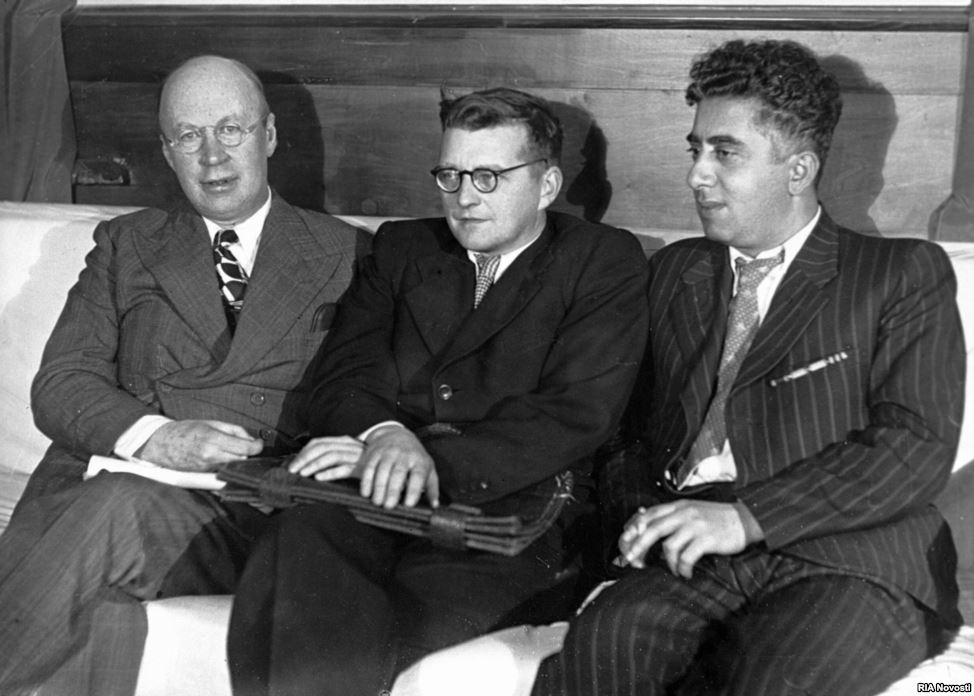
    The Manny, Moe and Jack of Soviet music: (left to right) Prokofiev, Shostakovich, and Khachaturian in 1945
  • Aram Khachaturian’s Birthday Celebrate the Sabre Dance

    Aram Khachaturian’s Birthday Celebrate the Sabre Dance

    Today is the birthday of Aram Khachaturian. You know, the guy who wrote that frenetic music that makes you want to spin plates on sticks.

    Here’s the “Sabre Dance,” with Khachaturian conducting:

    Liberace gives it a whirl:

    Mstislav Rostropovich, the soloist, with again the composer conducting (and highly-decorated), in Khachaturian’s “Concerto-Rhapsody”

    Adagio from the ballet “Spartacus”

    https://www.youtube.com/watch?v=wXsDsLHasWo

    Cristian Macelaru and the West German Radio Symphony Orchestra in a mesmerizing visual fantasy on the Romance from Khachaturian’s “Masquerade Suite”

    Khachaturian at the piano!

    Happy birthday, Aram Khachaturian!


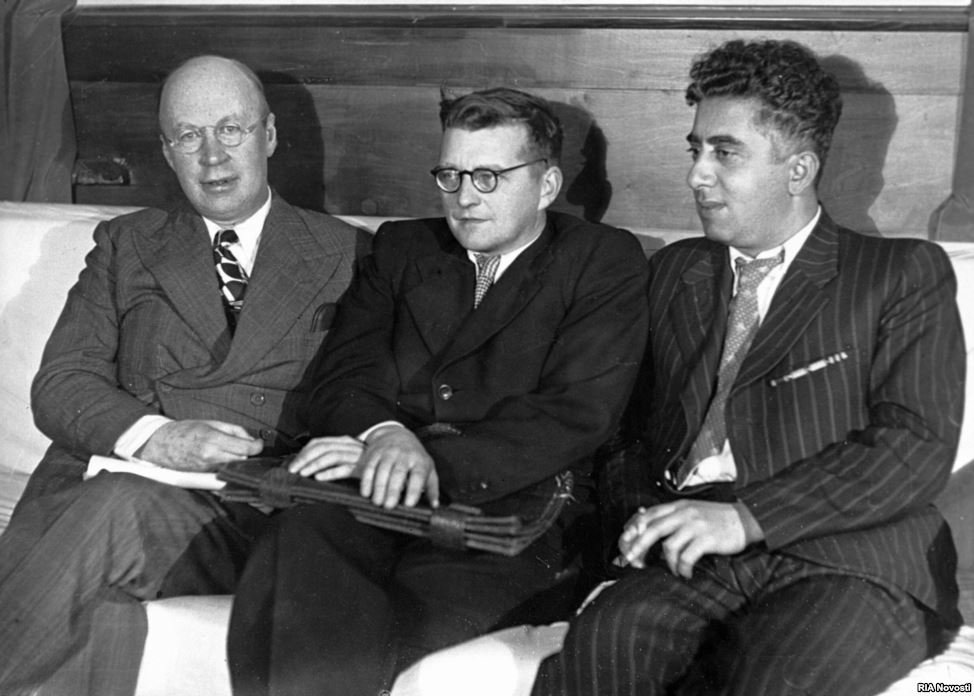
    PHOTO: Troika! (Right to left) Khachaturian with Shostakovich and Prokofiev

  • Kabalevsky F Troop and Soviet Music Anniversaries

    Kabalevsky F Troop and Soviet Music Anniversaries

    The guy who taught me basic music theory was a nut for Dmitri Kabalevsky (1904-1987). In particular, he was crazy for Kabalevsky’s piano sonatas. It was a rare instance in which he introduced me to something I hadn’t heard (I would have been 19 at the time), as opposed to the other way around. That’s the thing about musicians. They’re so busy performing that they have no time to laze around and listen to records!

    In any case, of course I knew Kabalevsky from his “Colas Breugnon Overture” (from his opera after the novel of Romain Rolland) and the ubiquitous Galop from “The Comedians,” which I believe I first heard on Bob McAllister’s “Wonderama,” if you remember that show.

    Am I the only one who detects Kabalevsky in the theme to “F Troop?”

    “The Comedians: Galop”

    “Colas Breugnon Overture”

    “F Troop”

    Interesting choice, to allude to a Soviet composer in a sitcom about the Wild West. Happy birthday, Dmitri Kabalevsky!

    Vladimir Horowitz plays Kabalevsky’s Piano Sonata No. 3


    It’s quite a day for the Soviets. This date also marks the anniversaries of the first performances of Aram Khachaturian’s Symphony No. 2, in Moscow, in 1943, Dmitri Shostakovich’s Symphony No. 4, also in Moscow, in 1961 (the work was originally scheduled to be performed in 1936, but was prudently withdrawn by the composer after he was denounced in Pravda for his “formalist” opera “Lady Macbeth of Mtsensk”), and – one hundred years ago today – Sergei Prokofiev’s opera “The Love for Three Oranges,” in Chicago, of all places, with the composer in attendance.

    Finally, according to the Julian calendar, Reinhold Glière was born on this date in 1875!


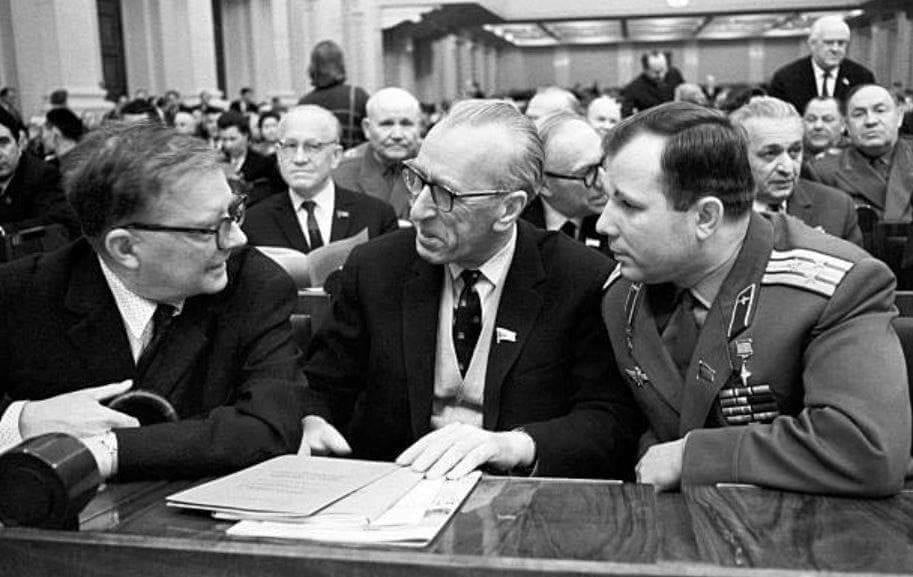
    TOP PHOTO: Kabalevsky with Shostakovich (left) and cosmonaut Yuri Gagarin at the Kremlin, 1966

    BOTTOM PHOTO: Union of Soviet Composers plenum in Moscow, 1946

    Standing (left to right): Yuri Shaporin, Dmitri Kabalevsky, Ivan Dzerhinsky, Maran Koval, Vano Muradelli

    Sitting (also left to right): Aram Khachaturian, Uzeyir Hajibeyli, Dmitri Shostakovich, Reinhold Glière, Sergei Prokofiev

  • Khachaturian’s Lost Symphony Rediscovered

    Khachaturian’s Lost Symphony Rediscovered

    You know Aram Khachaturian, right? The guy who wrote that frenetic tune that makes you want to spin plates on the tops of sticks? The one that is used to usher in the elephants at the circus?

    This Sunday night on “The Lost Chord,” we’ll be listening to Leopold Stokowski’s rarely-heard recording of Khachaturian’s Symphony No. 2, sometimes called “The Bell.”

    Khachaturian wrote the work in 1943, the height of World War II, while he was holed up at a Composers Union retreat with Shostakovich, Prokofiev, Miaskovsky and Gliere. He said of the piece, “The Second Symphony is a requiem of wrath, a requiem of protest against war and violence.”

    The symphony’s nickname alludes to a kind of alarm that opens and closes the work. Overall, the tone is one of resolve in the face of tragedy.

    Stokowski’s recording, long unavailable, was originally issued on United Artists Records in the late 1950s. It reappeared briefly on compact disc, on the EMI label, in 1994, and again in 2009, as part of a 10-disc box set of entrancing Stokowski performances.

    The master tapes have not weathered the years well, alas, so there are moments of distortion, but the power of the piece transcends any technical limitations. There is certainly nothing wanting in the performance.

    To round out the hour, we’ll hear the Russian-born pianist, Nadia Reisenberg, in a selection from her 1947 Carnegie Hall recital, Khachaturian’s most famous piano work, the “Toccata.” Reisenberg studied at Philadelphia’s Curtis Institute of Music under Josef Hoffman.

    Join me for these Khachaturian rarities, “Khach as Catch Can,” tonight at 10 EDT, on WWFM – The Classical Network and at wwfm.org.


    Here’s the composer, highly-decorated, conducting his “Concerto-Rhapsody,” with Mstislav Rostropovich:

    Music for spinning plates, Liberace style:

    A rare document of Khachaturian singing about the glories of Armenian wine!

    https://www.youtube.com/watch?v=vtKHrg7w3_o

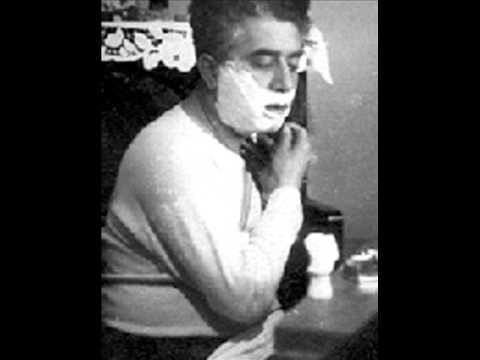
    PHOTO: The composer getting ready for his big day

  • Aram Khachaturian’s Birthday Sabre Dance & More

    Aram Khachaturian’s Birthday Sabre Dance & More

    Today is the birthday of Aram Khachaturian. You know, the guy who wrote that frenetic tune that makes you want to spin plates on the tops of sticks.

    Here he is, conducting (and highly-decorated), with Mstislav Rostropovich the soloist in his “Concerto-Rhapsody”:

    And – why not? – music for spinning plates, Liberace style:

    PHOTO: The composer “cleaning up nice” for his special day

Tag Cloud

Aaron Copland (92) Beethoven (94) Composer (114) Film Music (117) Film Score (143) Film Scores (255) Halloween (94) John Williams (185) KWAX (228) Leonard Bernstein (99) Marlboro Music Festival (125) Movie Music (132) Opera (197) Philadelphia Orchestra (86) Picture Perfect (174) Princeton Symphony Orchestra (106) Radio (86) Ralph Vaughan Williams (85) Ross Amico (244) Roy's Tie-Dye Sci-Fi Corner (290) The Classical Network (101) The Lost Chord (268) Vaughan Williams (99) WPRB (396) WWFM (881)

DON’T MISS A BEAT

Receive a weekly digest every Sunday at noon by signing up here


RECENT POSTS