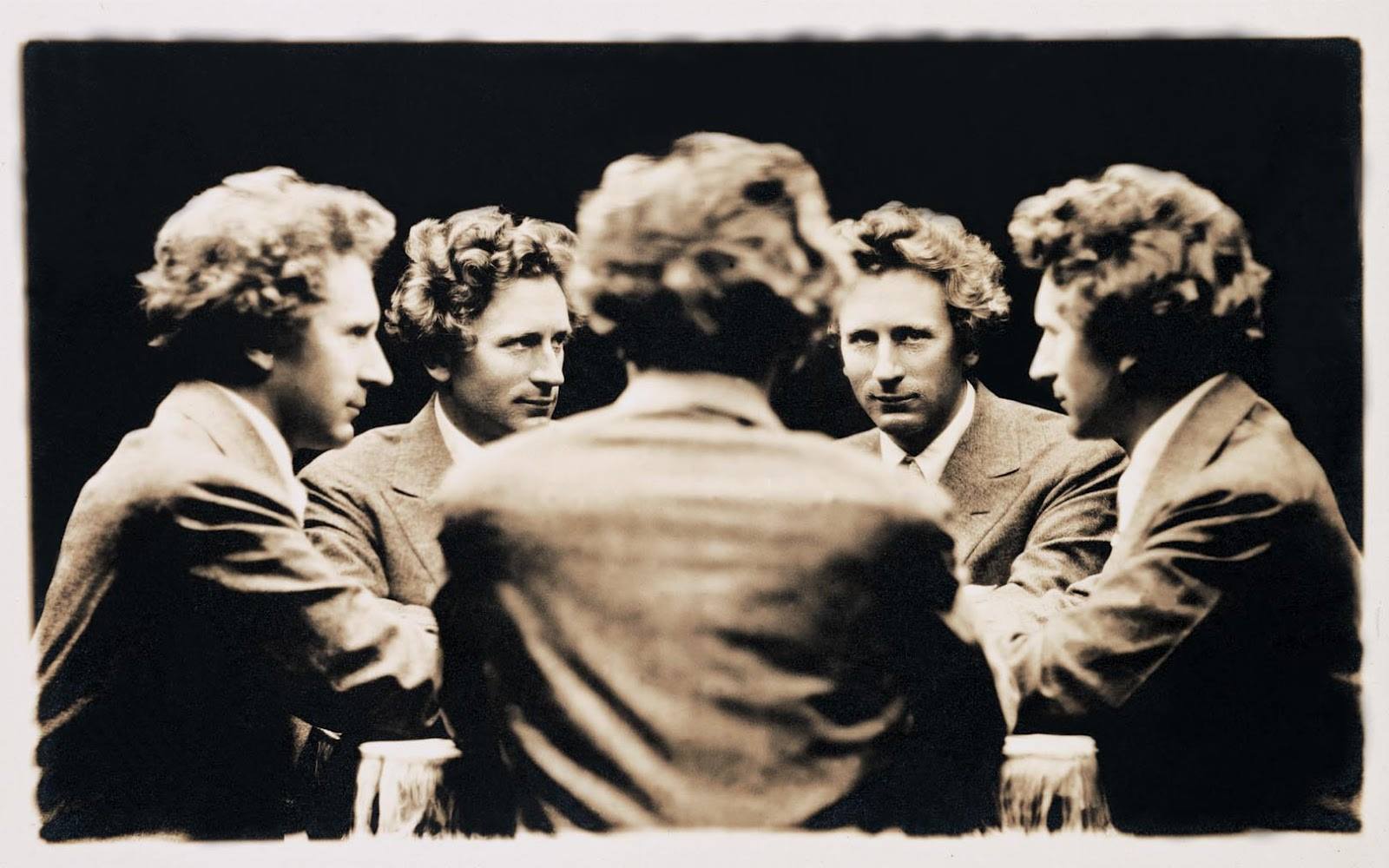
In the course of working so much with Australian music over the past week, I happened to come across some interesting photos of Percy Grainger. Grainger, in addition to being an extraordinary pianist, was a visionary composer, whose music has frequently been undersold. He’s remembered largely as a collector and arranger of folk songs, especially those from the British Isles (“Country Gardens,” “Shepherd’s Hey,” “Molly on the Shore,” “Irish Tune from County Derry,” etc.).
But it’s clear he was not afraid to think outside the box, either in his life or in his music. Even in these overexposed sweetmeats, which he arranged multiple times, he plays with rhythm and harmony, and in the case of “Shepherd’s Hey,” completely alters the original mood. Some of his orchestrations can only be described as “out there.” Part of the reason so little of his music is known is that he’ll decide to drop in a bass concertina or a detuned guitar for a piece that lasts only a couple of minutes.
In life, of course, he was a force of nature. A physical fitness nut, he would throw a ball over the top of a house and run around the other side in time to catch it. He preferred to jog from engagement to engagement, sometimes with his favorite piano bench in a wheel barrow. It was not uncommon for him to take the concert stage with a running leap.
He also had his dark or queasy side. He was unusually close to his mother (who didn’t touch him until he was five years-old, for fear that she would pass on her syphilis). He held contradictory views about the superiority of the Anglo-Saxon race (he married a “Nordic princess” before a crowd of 20,000 at the Hollywood Bowl), yet was enthralled by music of non-Western cultures and loved jazz (he was a friend of Duke Ellington). He endowed a museum in his birthplace of Melbourne with his collection of whips, bloodied clothes, and even his own skeleton. (As far as I know, the latter was not accepted.)
Later in life, while living in White Plains, NY, he devoted himself to the construction of machines that would help him realize his dream of what he termed “Free Music,” a music liberated from what he saw as the “goose-stepping” rigidity of Western tradition. These cumbersome beasts were, in some respects, precursors of the modern synthesizer.
Clearly so much can be written about this eccentric and his freewheeling genius, but for today my purpose is to share with you something new to me. On top of everything else, Grainger designed what he called “toweling outfits.” Here’s a link to some photos, with the composer’s own comments at the bottom of the page.
http://collectedphotographs.blogspot.com/2012/04/percy-grainger-towel-clothes-and.html
More about Grainger’s Free Music Machine here:
The ‘Free Music Machine’. Percy Grainger & Burnett Cross, USA/Australia , 1948
The multifaceted Percy Grainger